
L
O
A
D
I
N
G


Zoho, Odoo, ERPNext, Dynamics 365 and custom ERP, delivered by one accountable team.

Many UAE groups run a mainland trading company, a free zone entity and an overseas branch. An ERP brings them into one consolidated set of accounts without weeks of spreadsheet work.
An ERP consolidates a UAE group by mapping each entity's ledger to a group chart of accounts, eliminating intercompany balances, translating non-AED entities and producing consolidated P&L, balance sheet and segment reports. Typical groups combine a mainland LLC, a free zone company and overseas subsidiaries. Odoo, ERPNext and Dynamics 365 support multi-company setups, while Zoho groups often consolidate in Zoho Analytics.
An ERP for financial consolidation in the UAE combines the accounts of several legal entities into one set of group financial statements, removing the transactions between them. A common structure is a mainland LLC that sells locally, a free zone company that imports and re-exports, a holding company, and sometimes a subsidiary in Saudi Arabia, Oman or India.
Without a shared system, each entity closes its own books, often in different software, and the group accountant collects trial balances by email, maps them to a group chart of accounts in Excel, chases intercompany differences, and translates foreign currency balances by hand. A single wrong mapping can take days to find.
This page covers the consolidation step itself: mapping, eliminations, currency translation and group reporting. Day-to-day cross-entity postings are covered in intercompany accounting, and the setup of several companies in one system in multi-company ERP.

These issues come up at almost every group month-end and year-end that relies on Excel.
Each entity was set up at a different time by a different accountant. Mapping hundreds of accounts to group lines is repeated every month and errors creep in.
Entity A shows a receivable of one amount, entity B a payable of another, because of timing, currency or unposted invoices. Eliminations cannot be completed until someone investigates.
Group reporting waits for the slowest entity. Board packs arrive weeks after month end, too late to drive decisions.
Subsidiaries in SAR, OMR, INR or EUR need balance sheet items at closing rates and P&L at average rates. Doing this manually invites mistakes in the translation reserve.
Corporate tax, transfer pricing and auditors all need a clear trail from group figures back to entity transactions. A spreadsheet chain is hard to defend.
A repeatable month-end routine for the group, run inside the ERP or a connected reporting layer.
One shared database: every step updates stock, finance and reports in real time.
These capabilities make consolidation repeatable rather than a monthly project.
All entities in one database or tenant, with their own ledgers, VAT registrations and fiscal settings.
A shared or mapped chart so every entity reports to the same group lines.
Matching sales and purchase documents between entities so both sides post at the same amount.
Closing and average rates for translation. See multi-currency ERP for rate management.
Rules or templates that remove intercompany revenue, cost, receivables, payables and investments.
Reporting by business line, emirate or country alongside the legal entity view.
Lock dates per entity so figures do not change after consolidation.
Consolidated statements, board packs and drill-down to entity transactions.
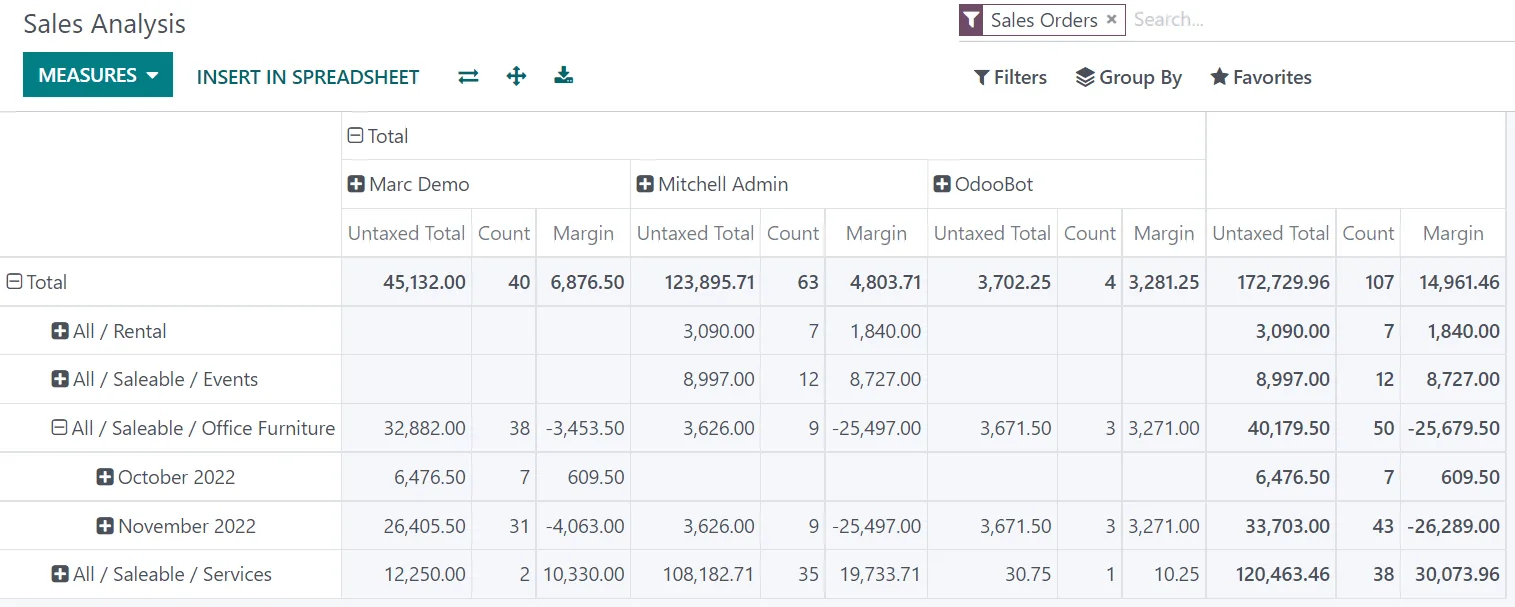
Group CFOs typically review consolidated results and the status of the close on one screen.
Consolidation depth varies more between platforms than most finance processes. Confirm features for your edition and version.
| Zoho | Odoo | ERPNext | Dynamics 365 | |
|---|---|---|---|---|
| Multi-entity model | Separate Zoho Books organizations per entity | Multi-company in one database | Multi-company with parent and child companies | Multiple companies in Business Central; legal entities in Finance |
| Consolidated statements | Usually built in Zoho Analytics or a consolidation add-on; check current Zoho Books features | Multi-company reports; consolidation features vary by version | Consolidated Financial Statement report for company groups | Business units and consolidation in Business Central; consolidation and eliminations in Finance |
| Intercompany | Typically manual or automated with Zoho Flow or custom functions | Inter-company rules to mirror sales and purchase documents | Inter Company Journal Entry and inter-company invoices | Intercompany setup and postings |
| Currency translation | Handled in the reporting layer | Multi-currency with company-level currencies | Presentation currency in consolidated reports | Closing and average rate translation in consolidation |
| Best fit | Smaller groups with simple structures | SME and mid-size groups in one database | Groups wanting open-source with built-in group reports | Mid-size to large groups with complex structures |
Where native consolidation is limited, a reporting layer such as Power BI or Zoho Analytics is a common solution.
Not every entity runs the same ERP. These are the connections we often build.
Group structures have tax and reporting effects. Confirm treatment with your auditor and tax advisor.
UAE corporate tax allows qualifying resident companies to form a tax group subject to ownership and other conditions. The ERP should be able to produce entity and group-level figures either way.
Related-party transactions must follow the arm's length principle. Master and local file documentation applies at revenue of 200 million dirhams or consolidated group revenue of 3.15 billion dirhams, so intercompany pricing should be traceable.
Qualifying Free Zone Persons need to separate qualifying and non-qualifying income, which affects how intercompany flows are tagged. See corporate tax ERP.
Unless entities are in a VAT tax group, each files its own return. Consolidation does not change VAT reporting, so entity ledgers must stay clean.
General information, not tax or legal advice. Rules change; confirm current FTA, MOHRE and Ministry of Finance guidance with your advisor.
These are the improvements group finance teams aim for.
Mapping and eliminations repeat automatically, so the group close is not rebuilt each month.
Mirrored documents mean both sides record the same amount on the same date.
Group figures drill down to entity journals. Pair this with ERP financial reporting for board packs.
Group-level margins by business line, and with project financial management, by major contract.
Consolidation projects depend on how many entities there are and whether they share a platform. Durations are typical ranges.
Durations are typical ranges; your plan is agreed after discovery.
Map legal entities, ownership, currencies, existing systems and reporting requirements.
Design the group chart of accounts and map every entity account to it.
Configure intercompany documents, matching rules and elimination templates.
Run consolidation in the ERP alongside the old spreadsheet until results agree.
We configure the system for the rules UAE businesses report against, and test it before go-live.
General information, not tax or legal advice. Confirm current requirements with the FTA, MOHRE or your advisor. See all UAE compliance guides.
On-site workshops in Dubai, Abu Dhabi and Sharjah, and remote or on-site delivery across the Northern Emirates and free zones.
Official sources and references
Facts on this page were checked against these sources in October 2026. Rules change, so confirm current requirements before acting.
Still have a question? Our consultants are happy to help.
Ask an ExpertIt helps a lot but is not required. Entities on other systems can send trial balances that are imported and mapped. Over time many groups move all entities to one platform.
Where a subsidiary is not wholly owned, the non-controlling interest is calculated in the consolidation step. Larger platforms support this natively; others handle it with templates in the reporting layer.
Yes. Once mapping and elimination rules are set up, a monthly group close becomes practical and gives owners timely numbers.
Odoo or ERPNext multi-company setups often work well for small groups in one database. Larger or international groups often look at Dynamics 365. We implement all four and recommend by fit.
The subsidiary keeps its books in SAR and meets local rules. For group reporting its balances are translated into AED at closing rates and its P&L at average rates, with the difference going to a translation reserve.
Related Solutions
Related Industries
Related ERP Platforms
Related Guides
Share your group structure and we will outline a consolidation approach that fits your entities and platforms.
Dubai, United Arab Emirates










