
L
O
A
D
I
N
G


Zoho, Odoo, ERPNext, Dynamics 365 and custom ERP, delivered by one accountable team.

Most owners only see a reliable profit figure once the auditors finish. We set up ERP so the income statement is complete, consistent and ready within days of month end.
A reliable monthly P&L comes from fixing what flows into it: perpetual inventory that posts cost of goods sold at delivery, monthly gratuity, leave and air ticket provisions, recurring journals that spread rent and licence costs, and dimensions for branch or project. With these in Zoho Books, Odoo, ERPNext or Dynamics 365, UAE owners see real margins within days of month end.
Using an ERP for profit and loss reporting UAE businesses can rely on is less about the report layout and more about what flows into it. The income statement shows revenue, cost of sales, gross profit, operating expenses and net profit for a period. In practice, many UAE companies produce it from accounting software where stock movements, payroll accruals and project revenue are posted late or as lump sums, so the monthly figure swings for reasons that have nothing to do with trading.
Typical symptoms: gross margin swings sharply from month to month because cost of goods sold is booked only when a stock count is done; salaries are posted on the payment date, so WPS timing moves expenses across months; end-of-service gratuity and leave are provided once a year; and rent paid by post-dated cheque in one installment lands as a single expense.
Since UAE corporate tax applies to financial years starting on or after 1 June 2023, accounting profit is also the starting point for taxable income. A P&L built on accrual accounting and a clean chart of accounts makes the tax computation easier. For the balance side of the same close, see balance sheet reporting; for the full statutory set, see ERP for financial reporting.

These issues make the P&L hard to read, even when the bookkeeping is technically correct.
When stock is valued only at quarter end, monthly gross profit is a guess. Purchases are expensed as they arrive instead of when goods are sold.
Rent, insurance, trade licence fees and visa costs are expensed when paid. One month carries a year of cost and the other eleven look better than reality.
Gratuity, annual leave and air ticket provisions are booked at year end, so monthly profit is overstated and the audit adjustment comes as a surprise.
Many charts were set up in 2018 around VAT codes, with expenses in a few large buckets. Owners cannot see what drives overheads.
Revenue and cost are not tagged by branch, division or project, so a loss-making activity hides inside a profitable total.
Reclassifications are made in a spreadsheet rather than in the ledger, so the P&L shared with the bank differs from the books.
The steps that turn transactions into a P&L you can sign off.
One shared database: every step updates stock, finance and reports in real time.
A good income statement depends on these modules posting automatically to the right accounts.
A chart of accounts designed for decision-making, mapped to IFRS headings and to VAT and corporate tax needs.
Perpetual valuation (FIFO or weighted average) that posts cost of goods sold at delivery.
Monthly gratuity, leave and ticket accruals posted alongside salary journals.
Templates that spread rent, insurance and licence costs across the months they cover.
Revenue recognized by milestone or percentage of completion, linked to project cost.
Branch, division, salesperson or project tags on every revenue and expense line.
Monthly depreciation by asset class, so the charge is not a single year-end entry.
P&L layouts with comparatives, percentages of revenue and drill-down to transactions.
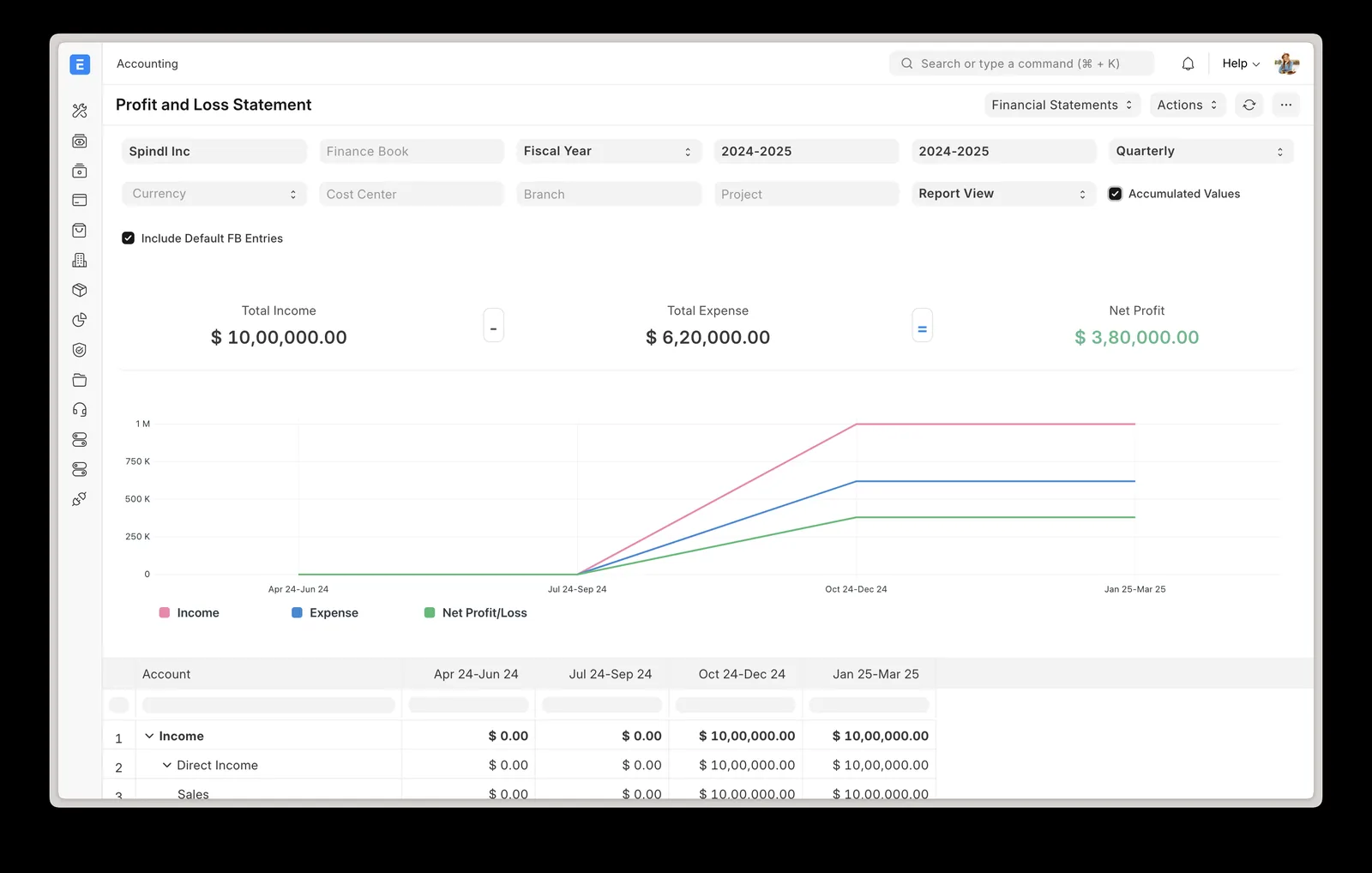
An income statement view that finance and owners can use without exporting to Excel.
Every ERP has a profit and loss report. The differences are in layout control, segment reporting and drill-down. Confirm features for your edition.
| Zoho | Odoo | ERPNext | Dynamics 365 | |
|---|---|---|---|---|
| Standard P&L | Profit and Loss report in Zoho Books, cash or accrual basis | Profit and Loss in Accounting reporting | Profit and Loss Statement report | Income statement via Financial Reports in Business Central |
| Custom layouts | Custom report groupings with limits; deeper layouts in Zoho Analytics | Report engine is configurable in Enterprise | Account tree drives layout; custom reports via report builder | Row and column definitions give detailed control |
| Segment reporting | Reporting tags and locations | Analytic accounts and plans | Cost centers and accounting dimensions | Dimensions (global and shortcut) |
| Comparatives | Compare with previous periods | Period comparison filters | Periodicity and multiple periods | Column layouts for prior year and budget |
| Drill-down | To transactions | To journal items | To General Ledger | To G/L entries |
| Perpetual COGS | With Zoho Inventory or inventory tracking | Automated stock valuation | Perpetual inventory by default | Inventory posting with cost adjustment |
For groups needing Power BI on top, see our ERP Power BI integration options.
Many P&L errors come from systems that post summaries late. Connecting them gives a timely, detailed P&L.
These points shape how the income statement should be built. Confirm treatment with your tax advisor.
Taxable income generally starts from accounting profit under applicable accounting standards, then adjusts for items such as non-deductible expenses and exempt income. Mapping accounts that need adjustment (fines, entertainment, donations) helps the computation.
UAE companies generally prepare financial statements under IFRS, or IFRS for SMEs where permitted. Your P&L structure should map cleanly to the audited format.
Revenue should be reported net of output VAT, with VAT posted to a liability account. Irrecoverable input VAT is an expense and should be visible.
Ledger detail behind the P&L must generally be kept for at least 5 years (7 for real estate) under Cabinet Decision 74 of 2023.
General information, not tax or legal advice. Rules change; confirm current FTA, MOHRE and Ministry of Finance guidance with your advisor.
Benefits depend on discipline at month end.
Gross margin moves only when pricing, mix or cost changes.
Provisions and accruals are booked monthly rather than found at year end.
Accounts needing corporate tax adjustment are tagged and reported.
The P&L shared with banks, partners and management comes from the same locked period.
Hedged ranges; depends on how much historical data is restated.
Durations are typical ranges; your plan is agreed after discovery.
Redesign expense and revenue accounts and agree dimensions.
Perpetual inventory, payroll provisions and recurring journals.
P&L layouts, comparatives and segment views.
Run the new P&L alongside the old one to explain differences.
We configure the system for the rules UAE businesses report against, and test it before go-live.
General information, not tax or legal advice. Confirm current requirements with the FTA, MOHRE or your advisor. See all UAE compliance guides.
On-site workshops in Dubai, Abu Dhabi and Sharjah, and remote or on-site delivery across the Northern Emirates and free zones.
Official sources and references
Facts on this page were checked against these sources in October 2026. Rules change, so confirm current requirements before acting.
Still have a question? Our consultants are happy to help.
Ask an ExpertUsually because cost of sales is not posted when goods are delivered. Perpetual inventory with automatic COGS postings is the main fix, together with correct landed cost on imports.
Yes, by tagging transactions with dimensions or cost centers. How to design those tags is covered on our cost center accounting page.
The P&L is one statement. A management pack adds KPIs, cash, receivables and commentary; see ERP for management reporting.
Accrual basis gives the correct picture and is what audited IFRS statements use. Some software offers a cash-basis view for owners, but it should not be the basis for tax or bank reporting.
Yes. All four platforms can feed Power BI or a similar tool. Our ERP reporting solutions page explains when native reports are enough and when a BI layer helps.
The P&L is the starting point for taxable income. Our corporate tax compliance page covers the adjustments the ERP can help track. This is not tax advice.
Related Solutions
Related Industries
Related ERP Platforms
Related Guides
We review your chart of accounts and month-end process, then show the P&L your ERP could produce.
Dubai, United Arab Emirates