
L
O
A
D
I
N
G


Zoho, Odoo, ERPNext, Dynamics 365 and custom ERP, delivered by one accountable team.

Track cost, billing and margin for every contract, from first purchase order to final retention release. We configure project accounting in Zoho, Odoo, ERPNext and Dynamics 365.
ERP project accounting records costs and revenue against each contract so finance can see whether a project is making money. UAE contractors, MEP firms, fit-out companies and consultants tag purchase orders, GRNs, timesheets, subcontractor bills, progress invoices and retention with a project code. Budgets by cost code are compared with committed and actual cost, and WIP and margin reports run per project.
Project accounting records costs and revenue against a specific job, so finance can answer one question at any time: is this project making money? Contractors, MEP firms, fit-out companies, engineering consultants and IT integrators in the UAE all live by that answer. An ERP for project accounting in the UAE ties purchase orders, GRNs, timesheets, subcontractor bills, progress invoices and retention to the project code at the moment they are posted.
Without it, project managers keep their own cost trackers while finance keeps the ledger, and the two disagree. Material bought for one site is charged to another, labor is spread by guesswork, and nobody knows the true work-in-progress balance until the job closes, often with a surprise.
This page covers the accounting side: cost capture, billing, WIP and revenue. Planning and scheduling belong to project management ERP, and detailed estimating to project costing software. For the revenue standard behind percentage-of-completion, see revenue recognition.

These gaps usually show up in companies running jobs from spreadsheets next to a general accounting package.
Finance sees invoices only after they are booked. Purchase orders and subcontract agreements already issued are not in the cost report, so a project looks healthy until the bills arrive.
Site staff and engineers work on several jobs, but payroll posts as one line. Without timesheets, labor is split by estimate and project margins are distorted.
Retention receivable from clients, retention payable to subcontractors and mobilization advance recovery are calculated on separate sheets and often missed at final account.
Interim payment applications are prepared outside the system, so invoiced value, certified value and cost to date are never on one report.
Without a project status control, stock issues and small bills keep landing on completed jobs, and true final margin is never known.
The ERP flow below follows a contract from award to close-out.
One shared database: every step updates stock, finance and reports in real time.
The modules below must all carry the project code for job accounting to be reliable.
Project master with customer, contract value, cost codes, budget and status that controls whether costs can still be posted.
Purchase requests and orders linked to a project and cost code, so committed cost appears before invoices arrive.
Material issues from the store to a project, or direct delivery to site, posting cost to the job.
Hours by employee, project and task, costed at a labor rate that reflects salary, allowances, visa and accommodation.
Subcontract agreements with payment applications, retention deduction and back-charges.
Milestone, percentage or measured progress invoices, advance recovery and retention receivable.
WIP, unbilled revenue, billing in excess and retention accounts with period-end entries.
Budget vs committed vs actual, cost to complete, margin and cash position per project.
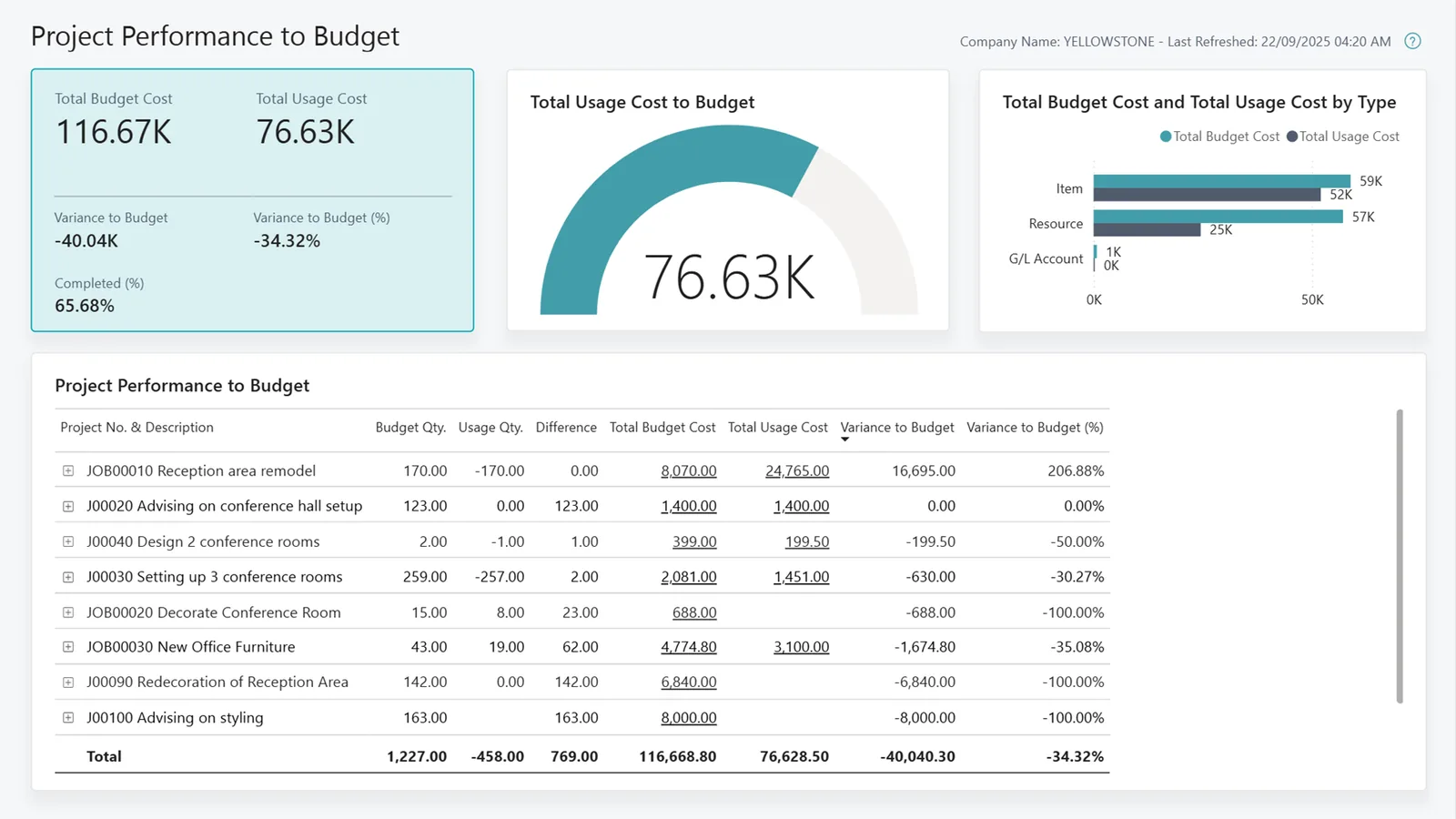
These reports come from the posted project transactions, not a separate tracker.
Fit depends on project size, billing style and whether you need commitments and retention. Confirm features for your edition and version.
| Zoho | Odoo | ERPNext | Dynamics 365 | |
|---|---|---|---|---|
| Project cost capture | Zoho Books projects with timesheets and expenses; Zoho Projects for task-level work | Project analytic accounts collecting bills, timesheets and stock moves | Project field on POs, bills, stock entries and timesheets with project costing | Business Central Jobs; Project Operations for larger services firms |
| Budget by cost code | Basic budgets; detailed cost codes often custom | Budgets on analytic accounts | Budget against project or cost center; task-level estimates | Job planning lines by task (Business Central) |
| Committed cost | Limited natively; often via reports on open POs | Open purchase orders visible per analytic account in reports | Purchase orders linked to project; reports show ordered vs received | Commitments shown on job lines in Business Central |
| Progress billing and retention | Milestone or percentage invoicing; retention usually configured | Milestone and timesheet invoicing; retention via configuration or app | Sales invoice against project; retention often configured or custom | Job billing with WIP methods; retention typically configured |
| WIP and revenue | Usually manual journals | Manual entries or apps depending on version | Period-end journals or customization | Built-in WIP methods in Business Central Jobs |
Construction firms with BOQs and IPCs usually need more than the basics; see project financial management.
Project data often starts in tools outside finance.
Contracts raise specific tax timing questions; confirm treatments with your tax advisor.
For supplies with periodic or progress payments, VAT is generally due at the earlier of the invoice date, payment received or the payment due date. The ERP should calculate VAT on each progress invoice, not only on the final account.
How VAT applies to retention amounts depends on contract terms and invoicing. Configure retention lines to follow your advisor's position.
Taxable income starts from accounting profit, so the revenue method used on contracts affects tax. Keep the WIP calculation documented.
Progress invoices to UAE business clients will fall under the e-invoicing framework. Check the latest MoF/FTA guidance on timelines.
General information, not tax or legal advice. Rules change; confirm current FTA, MOHRE and Ministry of Finance guidance with your advisor.
The value comes from one set of numbers for project managers and finance.
Committed cost and cost to complete show overruns while there is still time to act.
Retention receivable and payable are tracked per contract until released.
Timesheet-based labor cost replaces estimates and shows which jobs consume people.
Status controls stop new costs on closed jobs and final margin is reported once.
Indicative for a mid-size contractor or services firm; project accounting is often part of a wider rollout.
Durations are typical ranges; your plan is agreed after discovery.
Review contract types, cost codes, billing methods, retention terms and current trackers.
Configure projects, cost codes, budgets, purchasing links, timesheet costing and billing templates.
Load open projects with budget, cost to date, billed to date and retention balances.
Run live with project managers and finance, then review the first month-end WIP together.
We configure the system for the rules UAE businesses report against, and test it before go-live.
General information, not tax or legal advice. Confirm current requirements with the FTA, MOHRE or your advisor. See all UAE compliance guides.
On-site workshops in Dubai, Abu Dhabi and Sharjah, and remote or on-site delivery across the Northern Emirates and free zones.
Official sources and references
Facts on this page were checked against these sources in October 2026. Rules change, so confirm current requirements before acting.
Cost centers are permanent parts of the business. Projects have a start, an end, a contract value and a customer, so project accounting adds billing, retention and WIP that cost centers do not need.
Use timesheets by project and a labor rate that includes basic salary, allowances, visa, insurance and accommodation. The ERP posts labor cost to the job from approved timesheets.
Yes, usually through retention lines on progress invoices and subcontractor bills, posting to separate retention accounts. The release is invoiced or paid at handover or after the defects period.
It depends on your contracts and accounting policy. Many contractors recognize revenue over time based on cost or progress. The ERP supplies the data; your auditor confirms the method.
Timesheet-heavy consulting projects often fit Zoho or Odoo well. Firms with heavy procurement and subcontracting tend to need ERPNext or Dynamics 365. See project profitability software for more.
Yes. Combining receipts, supplier payments and retention gives a project cash position, which is critical for contractors funding work before certification.
Related Solutions
Related Industries
Related ERP Platforms
Related Guides
We review your projects, billing and cost tracking, then show how project accounting would work in your ERP.
Dubai, United Arab Emirates










