L
O
A
D
I
N
G


Zoho, Odoo, ERPNext, Dynamics 365 and custom ERP, delivered by one accountable team.

Configure Odoo Accounting with the UAE chart of accounts, VAT taxes, bank feeds and reporting your auditors and tax advisors will ask for.
Odoo Accounting in the UAE starts with the UAE localisation package, which loads a local chart of accounts, VAT tax codes and a VAT report layout. Each company then shapes accounts, tax mappings, journals and reports around how it trades. Bank synchronisation, reconciliation, follow-ups, assets, budgets and most financial reports require Odoo Enterprise rather than Community.
Odoo Accounting UAE projects start with the UAE localization package, which loads a local chart of accounts, VAT tax codes and a VAT report layout. That is a useful base, but it is not a finished setup. Each company still needs its accounts, tax mappings, journals, payment terms and reports shaped around how it actually trades, whether that is a Dubai mainland distributor, a free zone holding company or a contractor with retention invoices.
Odoo Accounting is the full accounting app in Odoo Enterprise, while Community provides invoicing and basic accounting with fewer features. In Enterprise you get bank synchronization, the reconciliation widget, follow-up letters, analytic accounting, budgets, asset depreciation, deferred revenue and expenses, and a library of financial reports. Because it shares one database with Sales, Purchase and Inventory, every confirmed invoice, vendor bill and stock movement posts entries automatically.
As an Odoo Official Partner in Dubai, we set up Odoo Accounting for new companies, re-implement it for businesses whose books have drifted, and connect it to the rest of their Odoo apps. If you are still choosing a platform, our accounting ERP software guide compares the main options.

The products we configure, integrate and support on projects like this one.
 Odoo Invoicing / Accounting
 Odoo Sales
 Odoo CRM
 Odoo Inventory
 Odoo Purchase
 Odoo Manufacturing
Product names and logos are trademarks of their respective owners and are shown only to identify the software we implement.
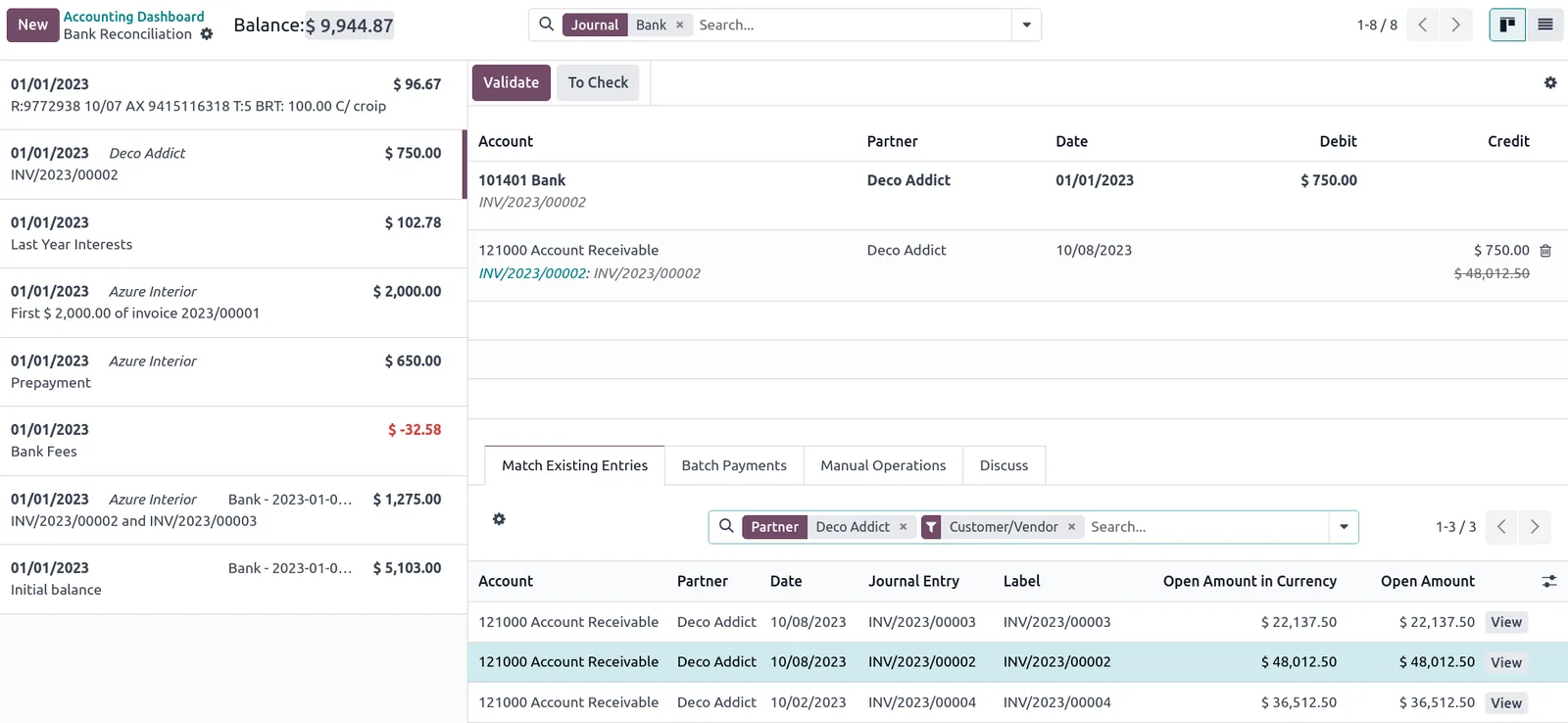
Odoo opens finance users on a journal-based dashboard that shows what needs attention today.
Most entries in Odoo Accounting are created by operational documents, so finance reviews and reconciles rather than retyping.
One shared database: every step updates stock, finance and reports in real time.
These are the features UAE finance teams use most once Odoo is properly configured.
A UAE-specific chart of accounts, VAT tax codes and a VAT report structure that we adjust to your business.
Import statements by feed or file and match them using reconciliation models that suggest the right invoice or bill.
Automated reminder levels by email or letter for overdue invoices, with a log of each action taken.
Foreign currency invoices and bills with exchange rate updates and realized and unrealized gain or loss entries.
Tag costs and revenue by branch, project, department or cost center to produce management reports beyond the legal ledger.
Depreciation schedules for fixed assets and automatic spreading of prepaid expenses and deferred revenue.
Set budgets by analytic account and compare them to actual results during the year.
Run mainland and free zone entities in one database with separate books and intercompany rules.
Accounting is the end point for data from many systems. These are common connections in UAE projects.
Odoo provides the records and reports; your company and its tax advisor make the filings. Confirm specific treatments with your tax advisor.
Taxes are configured for the 5% standard rate, zero-rated and exempt supplies, and reverse charge on imports of services and goods where applicable. Tax invoices print your TRN and the prescribed fields, and the VAT report supports the quarterly return filed through EmaraTax.
Under Federal Decree-Law No. 47 of 2022, taxable income above AED 375,000 is taxed at 9%. We set accounts and analytic tags so non-deductible expenses, related-party transactions and qualifying free zone income can be reported separately.
The UAE is moving to Peppol-based e-invoicing using the PINT AE specification, with mandatory dates from 1 January 2027 for businesses with revenue of AED 50 million or more and 1 July 2027 for others. We prepare Odoo invoice data and the connection to your chosen Accredited Service Provider. Check the latest Ministry of Finance and FTA guidance, as dates have changed before.
Lock dates, posted-entry protection and the chatter log on each document help keep an audit trail that external auditors can follow.
General information, not tax or legal advice. Rules change; confirm current FTA, MOHRE and Ministry of Finance guidance with your advisor.
Lessons from UAE finance setups that save rework later.
Explore related Odoo apps and UAE tax guides.
We configure the system for the rules UAE businesses report against, and test it before go-live.
General information, not tax or legal advice. Confirm current requirements with the FTA, MOHRE or your advisor. See all UAE compliance guides.
On-site workshops in Dubai, Abu Dhabi and Sharjah, and remote or on-site delivery across the Northern Emirates and free zones.
Official sources and references
Facts on this page were checked against these sources in October 2026. Rules change, so confirm current requirements before acting.
Still have a question? Our consultants are happy to help.
Ask an ExpertYes. The UAE localization includes VAT taxes and a VAT report, which we configure for your supplies and purchases. We do not describe Odoo as FTA certified; what it does is keep the tax records and reports you need to prepare your EmaraTax return.
Community covers invoicing, payments and basic journals. Bank synchronization, full reconciliation tools, follow-ups, assets, budgets and most financial reports require Enterprise, which most UAE companies with an accountant on staff choose.
Yes. Odoo supports Arabic, and invoice templates can be set to show bilingual labels, product descriptions and amounts alongside your TRN.
We usually migrate the chart of accounts, customers, suppliers, open invoices and a closing trial balance, rather than every past transaction. Our Tally Prime to Odoo and QuickBooks to Odoo pages explain the details.
Yes, with multi-company. Each entity keeps its own books, taxes and reports, and intercompany sales and purchases can create matching documents automatically.
Related Solutions
Related Industries
Related ERP Platforms
Talk to our Odoo finance consultants about a new setup or a cleanup of your current books.
Dubai, United Arab Emirates