
L
O
A
D
I
N
G


Zoho, Odoo, ERPNext, Dynamics 365 and custom ERP, delivered by one accountable team.

ERPNext gives you accounting, stock, buying, selling, manufacturing and projects in one open source system. We set it up for UAE rules, your processes and your hosting choice.
ERPNext is an open source ERP built on the Frappe Framework, covering accounting, selling, buying, stock, manufacturing and projects with no per-user software licence fee; costs sit in hosting, implementation and support. UAE companies can self-host it or use Frappe Cloud, and its UAE regional settings support 5% VAT, reverse charge and bilingual Arabic-English tax invoices carrying the TRN.
ERPNext is an open source ERP built on the Frappe Framework. There is no per-user license fee for the software itself: you pay for hosting, implementation and support. For many companies weighing ERPNext UAE options, that cost model is the first attraction, especially for trading firms, light manufacturers and service groups that have outgrown Tally, QuickBooks or spreadsheets but do not want enterprise license bills.
The second attraction is control. Because the code is open, your data and your customizations are not locked to one vendor. You can self-host ERPNext on a UAE or regional cloud server, use Frappe Cloud managed hosting, or move between the two later. Every document type, field, report and print format can be adjusted, which matters when your tax invoices must carry a TRN and bilingual labels or your warehouse in Al Quoz works differently from the one in Jebel Ali.
UAE ERP Experts is an ERPNext / Frappe partner based in Dubai, serving all seven emirates on-site and remotely. This page is the hub for everything ERPNext on our site: what the system covers, how it handles UAE compliance, how a rollout runs, and where to go next. If you are still choosing between platforms, our four-way ERP comparison puts ERPNext side by side with Zoho, Odoo and Dynamics 365.

The products we configure, integrate and support on projects like this one.
 ERPNext
 Frappe HR
 Frappe Framework
 Frappe CRM
Product names and logos are trademarks of their respective owners and are shown only to identify the software we implement.
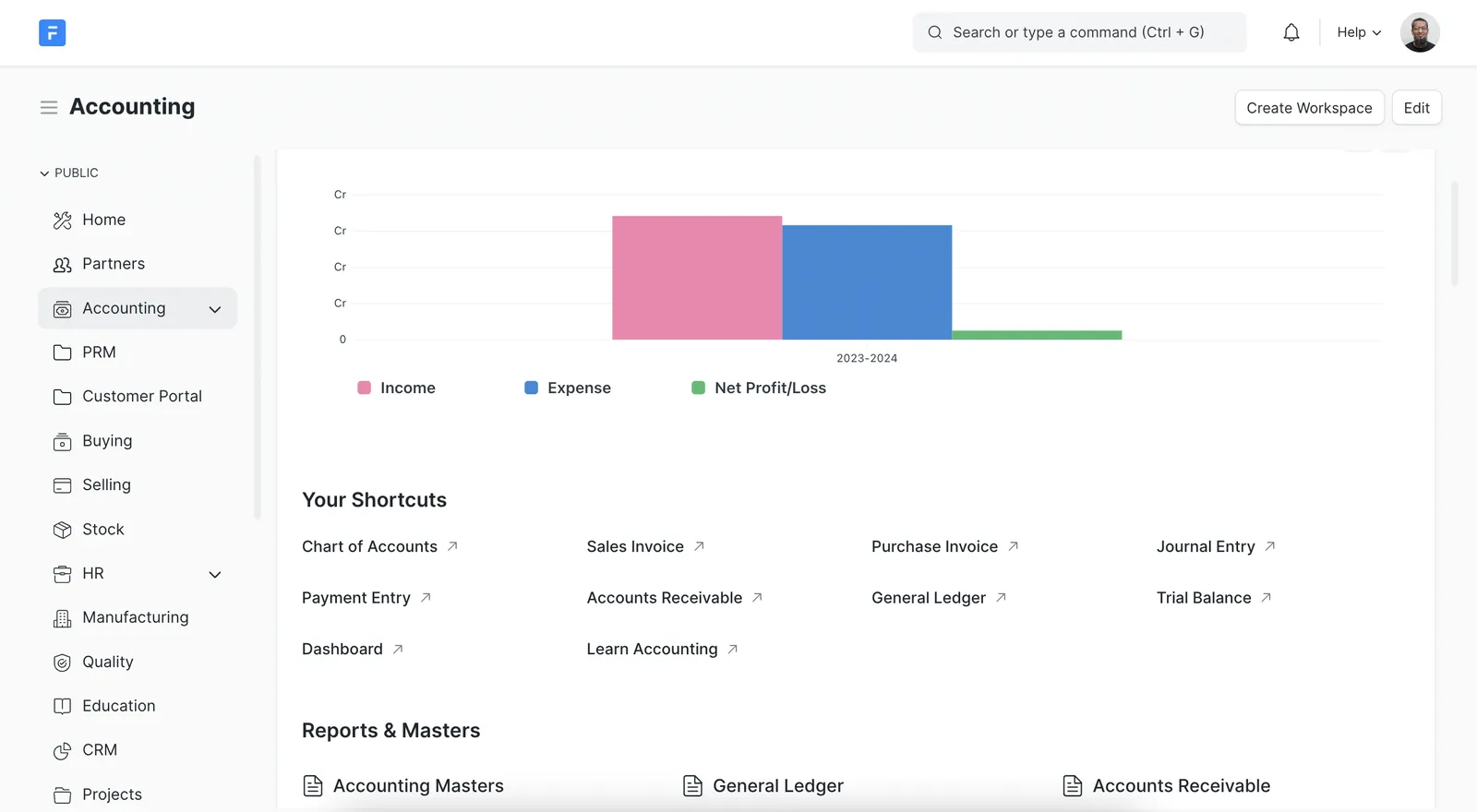
ERPNext workspaces group shortcuts, charts and number cards by role. Below is the kind of finance view we build for a UAE controller who needs cash, receivables and VAT exposure on one screen.
ERPNext ships as one application with several modules sharing the same items, customers, suppliers and accounts. HR and payroll now live in Frappe HR, a separate app installed alongside it.
General ledger, multi-company books, bank reconciliation, payment entries, budgets and accounting dimensions. See ERPNext accounting.
Leads, opportunities, quotations, sales orders and customer pricing rules, feeding straight into delivery and invoicing.
Material requests, supplier quotations, purchase orders and receipts, with approval workflows on spend thresholds.
Multi-warehouse inventory, batch and serial tracking, landed costs and stock valuation by FIFO or moving average.
Bills of materials, work orders, job cards, routing and production planning for discrete and process plants.
Projects, tasks, timesheets and project costing, useful for contractors and service firms billing by milestone or time.
Fixed asset register, depreciation schedules, asset movements and maintenance logs per location.
Employees, leave, attendance, expense claims and payroll, with UAE-specific outputs such as WPS files added during setup.
These are the traits that most often decide an ERPNext selection when we sit with finance and operations teams.
Every rule, report and calculation can be read and verified. Auditors and IT teams appreciate seeing exactly how a figure is produced.
Custom fields, form changes, scripts and print formats are stored as configuration, so most adjustments survive version upgrades.
Run it on Frappe Cloud, a regional AWS or Azure region, or your own server if data residency or group IT policy requires it.
The interface supports Arabic with right-to-left layout, and print formats can show Arabic and English side by side.
Mainland entities, free zone companies and overseas branches can share masters while keeping separate books and tax setups.
Every document type is exposed through a REST API and webhooks, which keeps e-commerce, bank and payroll integrations straightforward.
ERPNext provides the building blocks; we configure them against your tax advisor's treatment list. Please confirm tax positions with your tax advisor.
ERPNext includes regional settings for the UAE, including tax templates, reverse charge handling and a VAT return style report. We map standard, zero-rated, exempt and out-of-scope supplies, and print the TRN and required fields on tax invoices, so your EmaraTax filing draws on clean data.
Under Federal Decree-Law No. 47 of 2022, income up to AED 375,000 is taxed at 0% and above it at 9%. We use accounting dimensions and account tagging so non-deductible expenses, related-party transactions and qualifying free zone income can be separated for your advisor.
The UAE is moving to Peppol-based e-invoicing using the PINT AE specification through Accredited Service Providers, mandatory from 1 January 2027 for businesses with revenue of AED 50 million or more and from 1 July 2027 for others. ERPNext does not act as an ASP; we connect it to your chosen ASP. Check the latest Ministry of Finance and FTA guidance, as dates have changed before.
Frappe HR runs payroll; we add the Salary Information File export your bank or exchange house needs for MOHRE's Wage Protection System, plus end-of-service gratuity calculations aligned to the UAE Labour Law.
General information, not tax or legal advice. Rules change; confirm current FTA, MOHRE and Ministry of Finance guidance with your advisor.
Most focused rollouts follow these steps. Smaller single-company projects often take 6-10 weeks; multi-company or manufacturing scopes take longer.
We walk through your order-to-cash, procure-to-pay and stock flows against standard ERPNext and list what fits, what needs configuration and what needs development.
We provision the site on Frappe Cloud or your server, set up companies, chart of accounts, warehouses, tax templates and user roles.
Customers, suppliers, items, opening balances and open documents are cleaned and imported. Coming from Tally? See Tally to ERPNext migration.
Print formats, workflows, reports and integrations are built and tested against real transactions.
Users are trained by role, a parallel run checks the numbers, and we support the first month-end and VAT period closely.
ERPNext's API makes it practical to connect the tools UAE teams already use.
Go deeper into ERPNext services, modules and comparisons.
We configure the system for the rules UAE businesses report against, and test it before go-live.
General information, not tax or legal advice. Confirm current requirements with the FTA, MOHRE or your advisor. See all UAE compliance guides.
On-site workshops in Dubai, Abu Dhabi and Sharjah, and remote or on-site delivery across the Northern Emirates and free zones.
28 detailed guides in this section.
Official sources and references
Facts on this page were checked against these sources in October 2026. Rules change, so confirm current requirements before acting.
Still have a question? Our consultants are happy to help.
Ask an ExpertThe ERPNext software is open source and has no license fee. You still pay for hosting, implementation, any custom work and ongoing support. Total cost depends on scope, which is why we quote after a fit-gap workshop rather than offering a fixed price.
Yes. ERPNext has UAE regional settings, VAT tax templates and reporting that we configure for standard, zero-rated, exempt and reverse charge cases. We review the setup with your tax advisor before go-live, because treatment varies by business.
That is your choice. You can use Frappe Cloud managed hosting, a cloud provider region in or near the UAE, or your own server. We help you weigh cost, backups, data residency and who manages updates.
It handles multi-company groups, multiple warehouses and manufacturing well. Very large groups with complex global consolidation or heavy industry-specific needs may be better served by Dynamics 365, which we also implement. We will tell you honestly which fits.
Yes. Print formats are built with Jinja templates, so we can design bilingual Arabic and English tax invoices with your TRN, logo and the fields your advisor requires.
ERPNext can produce the structured invoice data, and we connect it to an Accredited Service Provider that handles PINT AE exchange. Timelines follow the Ministry of Finance schedule, so check the latest guidance and plan your ASP appointment early.
Related Solutions
Related Industries
Related ERP Platforms
Book a short call and we will tell you whether ERPNext fits your business, what the rollout involves and what it would take to go live.
Dubai, United Arab Emirates