
L
O
A
D
I
N
G


Zoho, Odoo, ERPNext, Dynamics 365 and custom ERP, delivered by one accountable team.

One record for every account customer: their documents, approved terms, payment behavior, reminders, cheques and disputes, so credit decisions are based on evidence rather than memory.
An ERP manages customer credit in the UAE by keeping the whole credit file on the customer record: the signed application, trade license and TRN certificate, approved limit and terms, payment history, reminders, post-dated cheques and disputes. It blocks or flags orders over the limit, sends statements and staged reminders, schedules periodic limit reviews and supports provisions or write-offs with approvals.
Customer credit management covers everything from the day a customer asks for credit terms to the day an old balance is collected or written off. An ERP for customer credit management in the UAE keeps that history in one place: the signed credit application, copies of the trade license and TRN certificate, the approved limit and terms, the payment record, every reminder sent, every post-dated cheque received, and every dispute raised.
In many UAE companies these pieces are spread across a shared folder, the salesperson's phone, the cheque safe and an ageing report exported to Excel. When a customer asks for higher terms, nobody can quickly see how they have paid over the last year. When a key account starts paying late, the signs are there but are only noticed after a large balance is overdue.
The ERP brings the credit file, the ledger and the collection activity together. The enforcement of limits at order and delivery is covered in ERP for credit limit control; this page covers the process around it: onboarding, reviews, statements, reminders, collections and provisioning.

These issues appear in trading, distribution, contracting supply and service companies across the UAE.
Customers get credit before their trade license, TRN certificate and authorized signatory details are collected. Expired licenses are not noticed at renewal.
Limits are set once and left for years, whether the customer pays in 30 days or 150. Good customers are held back while risky ones keep a high limit.
Follow-up depends on one accountant's calendar. When they are on leave, reminders stop and the ageing grows.
Customers dispute statements because unapplied receipts, credit notes and returns are not reflected. Disputes stall payment.
PDCs are kept in a safe with a separate register. Returned cheques and replacements are not linked back to the invoices they were meant to settle.
At year-end, auditors ask for an expected credit loss assessment and the company has no history of payment patterns by customer group.
The cycle repeats for every account customer; the ERP schedules each step.
One shared database: every step updates stock, finance and reports in real time.
Credit management uses finance, CRM and document features together.
Trade license, TRN, signatory ID and credit application attached with expiry dates and alerts.
Approval record for limit and terms, with reviewer, date and next review date.
Open items by due date with unapplied receipts and credit notes matched.
Scheduled statements and staged reminder letters by email. See ERP for customer statements.
Calls, promises to pay and next actions logged against the customer.
Cheques received, deposit dates, clearance, returns and replacements linked to invoices.
Disputed invoices flagged and assigned so they do not block the rest of the balance.
Ageing-based provision matrix and write-off approvals for year-end.
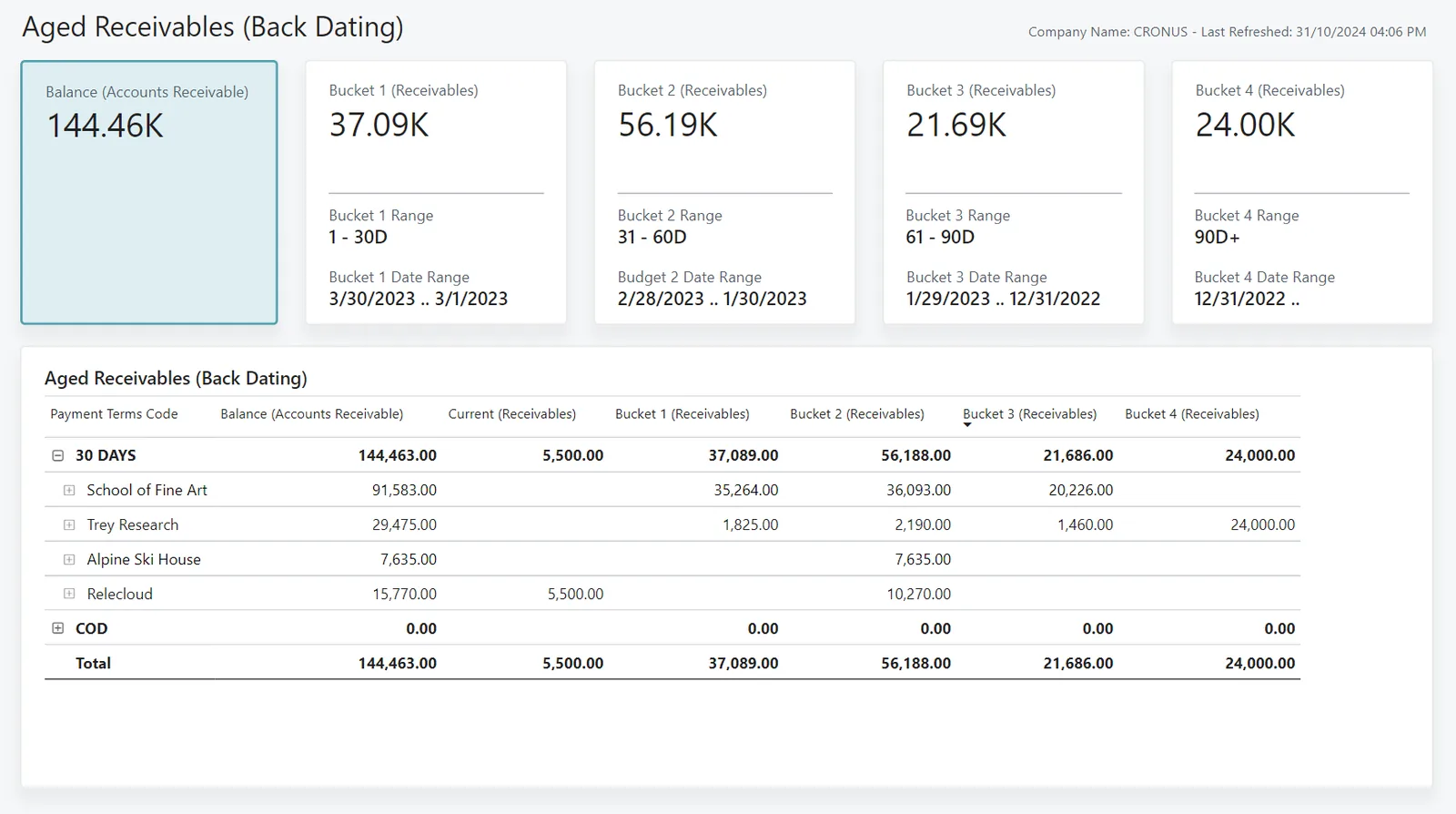
Finance managers track how the receivable book is behaving, not just how big it is.
A hedged summary; capabilities vary with edition and version.
| Zoho | Odoo | ERPNext | Dynamics 365 | |
|---|---|---|---|---|
| Statements and reminders | Customer statements and automated payment reminders in Zoho Books | Payment follow-up levels with email and letters | Statement of accounts emails and Dunning | Customer statements, reminders and finance charge memos in Business Central |
| Ageing and collections | AR ageing reports; collection notes via CRM | Aged receivable report and follow-up reports | Accounts Receivable report with ageing | Aged receivables; collections features in recent releases |
| Document expiry tracking | Custom fields and workflows, or Zoho Creator | Documents app or custom fields | Attachments with custom expiry fields | Attachments and custom fields or extensions |
| PDC handling | Usually configured with custom fields or an extension | Localization or third-party apps | Configured via Payment Entry reference dates or custom app | Typically via partner extensions |
| Customer portal | Customer portal for invoices and payments | Customer portal for invoices and payments | Customer portal | Typically via partner portal or Power Pages |
PDC handling in particular varies; we confirm the approach for your platform before design.
Faster payment information means fewer wrong reminders.
Confirm legal and tax points with your advisors; these are configuration notes.
Checking and storing the customer TRN at onboarding keeps tax invoices correct and supports structured e-invoicing data from 2027. Check the latest Ministry of Finance / FTA guidance.
VAT relief on bad debts depends on conditions such as the debt being written off in the accounts and the customer being notified. Keep the evidence trail in the ERP. See VAT in ERP.
Signatory IDs and personal guarantees are personal data under the UAE PDPL. Limit access to the credit file by role.
Credit applications, statements and correspondence support receivable balances and should be kept for at least 5 years.
General information, not tax or legal advice. Rules change; confirm current FTA, MOHRE and Ministry of Finance guidance with your advisor.
Typical improvements, depending on discipline in follow-up.
Credit is granted only when documents and approvals are complete.
Reminders go out on schedule regardless of who is on leave.
Receipts, returns and credit notes appear on the statement promptly.
Payment history supports provision calculations and auditor questions.
Typical ranges for a company with several hundred account customers.
Durations are typical ranges; your plan is agreed after discovery.
Agree the credit application, required documents, review frequency and reminder stages.
Collect missing documents, confirm terms and reconcile opening balances and PDCs.
Set up reminders, statements, PDC handling, dispute flags and dashboards.
Train finance and sales, then start the first reminder cycle.
We configure the system for the rules UAE businesses report against, and test it before go-live.
General information, not tax or legal advice. Confirm current requirements with the FTA, MOHRE or your advisor. See all UAE compliance guides.
On-site workshops in Dubai, Abu Dhabi and Sharjah, and remote or on-site delivery across the Northern Emirates and free zones.
Official sources and references
Facts on this page were checked against these sources in October 2026. Rules change, so confirm current requirements before acting.
Still have a question? Our consultants are happy to help.
Ask an ExpertMany UAE companies review key accounts every six or twelve months and others on trigger events, such as repeated late payment or a request for higher terms. The ERP can schedule reviews and show payment behavior since the last one.
Yes, through the WhatsApp Business Platform via an approved provider, using pre-approved message templates and only to contacts who have opted in. Email remains the formal channel for statements.
The ERP reverses the receipt, reopens the invoices, records charges if applicable and flags the customer. Many companies also place the account on hold until the cheque is replaced.
Finance usually owns limits and collections, while sales owns the relationship and gathers documents. The ERP gives both teams the same view. Automated nudges can help, see customer follow-up automation.
Many payment delays start as service complaints. Linking disputes to tickets in a customer service system helps resolve them faster.
Any of the four we implement can support it; the choice usually follows your wider ERP needs. Larger groups with complex collections often look at Dynamics 365, while Zoho, Odoo and ERPNext suit most SMEs.
Related Solutions
Related Industries
Related ERP Platforms
Book a consultation and we will review your credit process, ageing and collection steps and recommend how to run them in your ERP.
Dubai, United Arab Emirates










