L
O
A
D
I
N
G


Zoho, Odoo, ERPNext, Dynamics 365 and custom ERP, delivered by one accountable team.

If your accountant still re-types invoices into a ledger, builds the VAT return in a workbook and reconciles the bank with a highlighter, the problem is not effort. It is the process. An ERP posts accounting entries from the business documents themselves.
Replacing manual accounting with an ERP means accounting entries are posted directly from invoices, bills, receipts and payments instead of being re-keyed into a ledger. For UAE businesses this gives tax invoices with TRN, bank feed matching, a VAT return built from tagged transactions and a full audit trail, which matters more now that corporate tax applies and e-invoicing starts in 2027.
An ERP for manual accounting replacement in the UAE is for companies whose books are still kept largely by hand: paper or Excel day books, sales invoices typed in Word, purchase bills stapled into monthly files, and a part-time accountant who posts everything into a basic ledger at month-end. Many of these businesses are growing trading, contracting or service firms in Dubai, Sharjah and Ajman that started small and never changed the routine.
The weakness is not the accountant. It is that every transaction is recorded twice: once in the operational document and again in the books. Each re-keying step is a chance for a wrong TRN, a missed invoice, a VAT amount on the wrong line or a payment posted to the wrong customer. With corporate tax now in force and UAE e-invoicing on the way, the cost of those errors has gone up.
Replacing manual accounting means the sales invoice, supplier bill, expense claim and bank payment create the journal entry automatically. The accountant moves from data entry to review, reconciliation and reporting. If you want to understand whether you need a full ERP or a smaller accounting package, see our comparison of ERP vs accounting software.

These are the problems we see when we review manual accounting in UAE companies.
Bills arrive late, bank statements are reconciled by hand and accruals are calculated in a separate sheet. Management sees last month's profit in the middle of this month, if at all.
The VAT 201 return is prepared from a workbook that does not tie to the ledger. Corrections after filing require voluntary disclosures and create penalty exposure.
Customer balances live in a sales person's notebook or a shared sheet. Collection calls are made against old numbers and disputes drag on.
Only one accountant understands the files. When they go on leave or resign, nobody can produce a trial balance.
Overwritten cells and missing source documents make audits slower and raise questions about controls, especially for corporate tax and bank facilities.
Invoices from a POS, a job sheet or a CRM are typed again into the ledger. The two never match exactly.
This is the record-to-report cycle we configure to replace manual bookkeeping.
One shared database: every step updates stock, finance and reports in real time.
The move is mostly about structure and discipline. The software part is the easier half.
Manual ledgers often have hundreds of accounts used inconsistently. We design a lean chart that maps cleanly to financial statements, VAT and corporate tax, with cost centres or branches where you need them.
Most companies switch at a month or quarter end, loading the trial balance plus open customer invoices, supplier bills and bank items. Full history usually stays in the old files for reference.
Sales invoices, credit notes and supplier bills are raised in the ERP so that VAT and receivables update in one step. See our accounts payable page for the bill approval side.
Bank reconciliation, accruals, depreciation, prepayments and VAT review are listed with owners and deadlines inside the ERP, so month-end no longer depends on one person's memory.
A typical scope for a UAE SME moving off manual books.
Chart of accounts, journals, cost centres and period locking.
Tax invoices with TRN, credit notes, customer statements and aging.
Supplier bills, debit notes, payment runs and supplier aging.
Bank feeds or statement imports, cheque and PDC tracking, reconciliation rules.
Tax codes, reverse charge, VAT return report and FTA Audit File export where available.
Asset register with automatic depreciation journals.
Employee claims and petty cash with receipts attached.
P&L, balance sheet, cash flow and budget vs actual from live data.
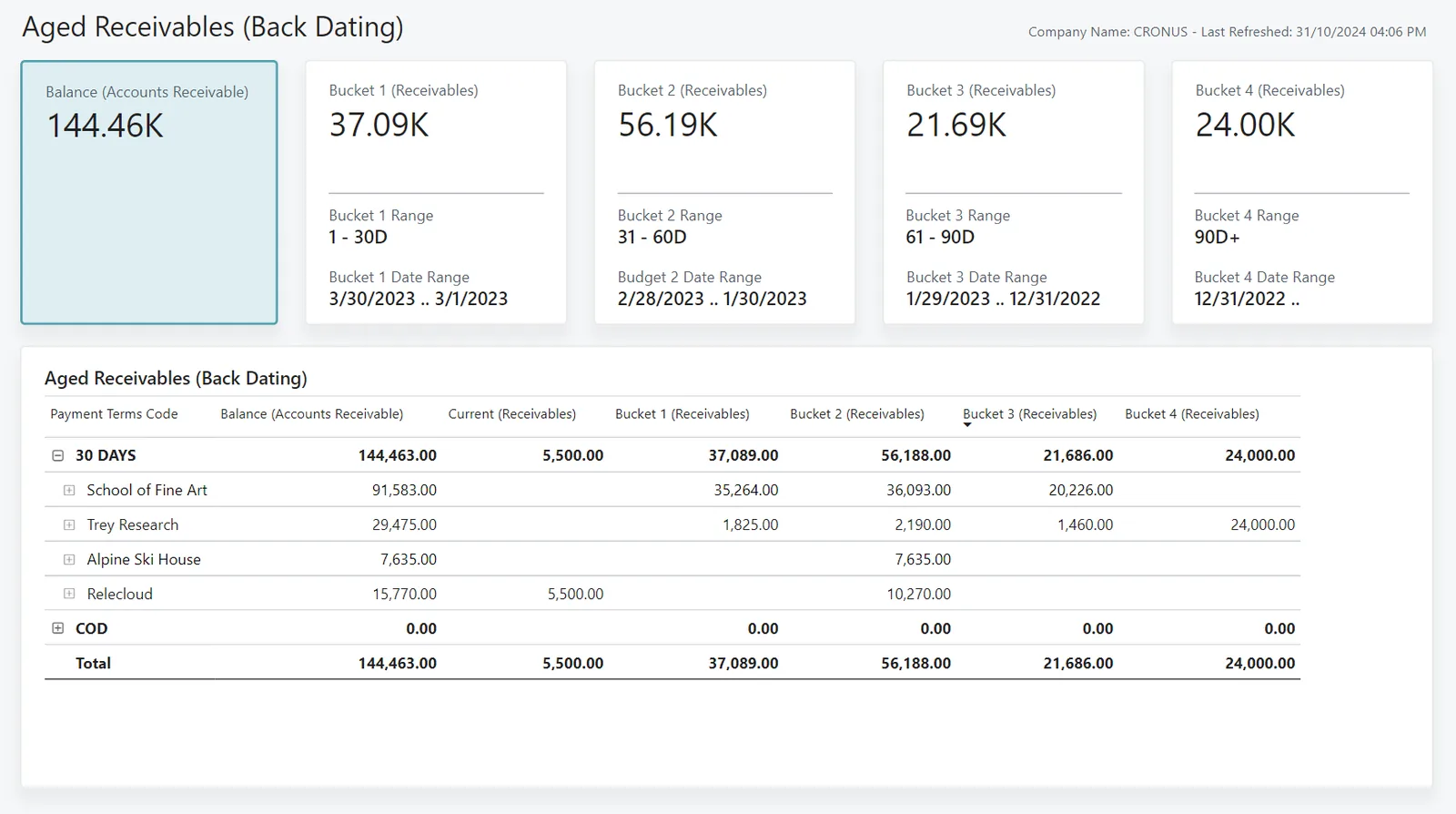
The reports you used to build by hand now refresh as documents are posted.
All four support UAE VAT; the right choice depends on what else you need beyond accounting. Confirm features for your edition.
| Zoho | Odoo | ERPNext | Dynamics 365 | |
|---|---|---|---|---|
| Core product | Zoho Books, often the first step for SMEs | Odoo Accounting with UAE localization | ERPNext Accounts with UAE regional settings | Business Central for SMEs; Finance for larger groups |
| UAE VAT | UAE VAT settings and VAT return report | UAE tax report from localization | UAE VAT 201 report | VAT setup with UAE localization from partners or apps |
| Bank reconciliation | Bank feeds for supported banks, statement import, matching rules | Bank sync for supported banks, statement import, reconciliation models | Bank statement import and reconciliation tool | Bank reconciliation with statement import and matching rules |
| Audit trail | Transaction history and audit trail | Chatter log; audit trail options in recent versions | Version history on documents | Change log configurable per table |
| Growth path | Add Zoho Inventory, CRM, Payroll | Add Inventory, Sales, Manufacturing in the same database | Add stock, manufacturing, HR in the same site | Add supply chain, projects, Power Platform |
| Typical fit | Small teams wanting quick adoption | SMEs that will add operations modules | Budget-conscious firms with in-house IT | Companies needing Microsoft stack and scale |
Check the FTA's current Tax Accounting Software Register for any specific product you are considering.
Removing re-keying means connecting the systems that create transactions.
Configured correctly, the ERP supports these requirements. It does not replace professional advice; confirm with your tax advisor.
Tax invoices with the required fields and TRN, 5% standard rate, zero-rated and exempt codes, reverse charge on imports, and a return that ties to the ledger. See VAT accounting software.
Accurate financial statements are the basis for corporate tax returns under Federal Decree-Law 47 of 2022. Tag non-deductible expenses so the adjustment is easier at year-end.
Under Ministerial Decisions 243 and 244 of 2025, businesses must exchange e-invoices through Accredited Service Providers, from 1 January 2027 for revenue of AED 50 million or more and from 1 July 2027 for others. Check the latest MoF/FTA guidance.
Keep accounting and tax records for at least five years (seven for real estate) in a form the FTA can access.
General information, not tax or legal advice. Rules change; confirm current FTA, MOHRE and Ministry of Finance guidance with your advisor.
Results depend on adoption and data quality; these are the typical areas of improvement.
Entries are posted daily from documents, so month-end becomes review rather than catch-up.
Tax codes on each line mean the return is built from the same data as the ledger.
Receivables, payables and bank balances are current, which helps with supplier payments and bank covenants.
Processes and data live in the system, so another accountant or an auditor can follow them.
Typical ranges for an SME accounting replacement; larger scopes take longer.
Durations are typical ranges; your plan is agreed after discovery.
Review current books, design the chart of accounts, VAT codes and approval rules.
Configure the system, load masters and the opening trial balance with open items.
Train the team and run one month in both the old method and the ERP.
Support the first month-end and the first VAT return prepared from the ERP.
We configure the system for the rules UAE businesses report against, and test it before go-live.
General information, not tax or legal advice. Confirm current requirements with the FTA, MOHRE or your advisor. See all UAE compliance guides.
On-site workshops in Dubai, Abu Dhabi and Sharjah, and remote or on-site delivery across the Northern Emirates and free zones.
Official sources and references
Facts on this page were checked against these sources in October 2026. Rules change, so confirm current requirements before acting.
Still have a question? Our consultants are happy to help.
Ask an ExpertIf you only need invoicing, bills, bank and VAT, an accounting product such as Zoho Books may be enough. If stock, projects or purchasing also need control, an ERP avoids a second migration later.
We do not implement Tally or QuickBooks, but we migrate from them. Our Tally to ERP migration service moves masters, open items and balances into Zoho, Odoo, ERPNext or Dynamics 365.
Usually opening balances and open items at cut-over, plus optional summarized history for comparisons. Detailed old transactions can stay archived, as long as they are retained for the legal period.
It produces the return figures from tagged transactions. A qualified person should still review the return and file it through EmaraTax.
Yes. Most platforms allow an accountant user role, so your auditor or bookkeeping firm works directly in the system instead of on exported files.
Most teams are confident after the first full month-end and VAT period in the new system, which is why we stay involved through that cycle.
Related Solutions
Related Industries
Related ERP Platforms
Related Guides
We review your current accounting process and propose the right system and cut-over plan.
Dubai, United Arab Emirates