
L
O
A
D
I
N
G


Zoho, Odoo, ERPNext, Dynamics 365 and custom ERP, delivered by one accountable team.

Give every branch its own P&L and cash view while keeping one set of books, one TRN and one VAT return. We set this up in Zoho, Odoo, ERPNext and Dynamics 365.
ERP branch accounting in the UAE keeps one legal set of books, one TRN and one VAT return while giving each branch its own profit and loss, cash and stock view. Branches are set up as a dimension, branch object or child company, inter-branch transfers post through clearing accounts, and head office charges are allocated. Zoho, Odoo, ERPNext and Dynamics 365 all support this model.
Many UAE businesses grow by opening branches: a second showroom in Sharjah, a branch license in Abu Dhabi, a counter in a mall or a site office in Al Ain. Legally these are usually the same company. ERP for branch accounting in the UAE lets you keep one legal set of books while still producing a separate profit and loss, cash position and stock value for each branch.
The typical starting point is either one accounting file where branches are not separated at all, or separate files per branch that head office merges in Excel. The first gives no branch visibility. The second creates duplicate customers, mismatched inter-branch balances and a VAT return built by copying figures between files. A shared ledger in your accounting ERP removes the merge step entirely.
A branch-aware ERP tags every invoice, bill, receipt and stock movement with the branch, posts inter-branch transfers through clearing accounts, and reports branch by branch or combined. If your branches are separate legal entities with their own licenses and TRNs, you need intercompany accounting instead, and for cost analysis inside a branch see cost center accounting.

These issues appear when branches run on separate files, shared spreadsheets or an entry-level accounting tool.
Branch A records stock sent to Branch B, but Branch B books it days later or at a different value. The head office and branch current accounts drift apart and month-end becomes a reconciliation exercise.
Revenue is tagged by branch but rent, salaries and head office charges are not, so every branch looks profitable until the combined numbers say otherwise.
Each branch exports its sales and purchases, and finance merges them for the single EmaraTax return. Errors in one branch file flow straight into the filing.
Branch cash sales, card settlements and petty cash are recorded late or in a separate sheet. Head office sees deposits but cannot match them to daily sales.
The same customer or item is created differently in each branch, so customer statements, credit limits and stock reports are unreliable.
This is the flow we usually configure so branches can work independently while head office keeps one ledger.
One shared database: every step updates stock, finance and reports in real time.
Branch accounting is a configuration across modules, not a single app.
Branches defined as a dimension, branch object or child company, depending on the platform, under one legal entity and TRN.
Branch-specific invoice series, price lists and POS sessions posting daily takings to the branch.
One or more warehouses per branch, with stock transfer documents and in-transit locations.
Branch cash books, card settlement accounts and deposit matching against bank statements.
Branch purchase orders with central approval and a shared supplier master.
Employees assigned to branches so the WPS payroll journal posts salaries by branch.
Monthly charge of head office rent, management and shared services to branches on agreed drivers.
Branch P&L, branch cash position, inter-branch balance check and combined statements.
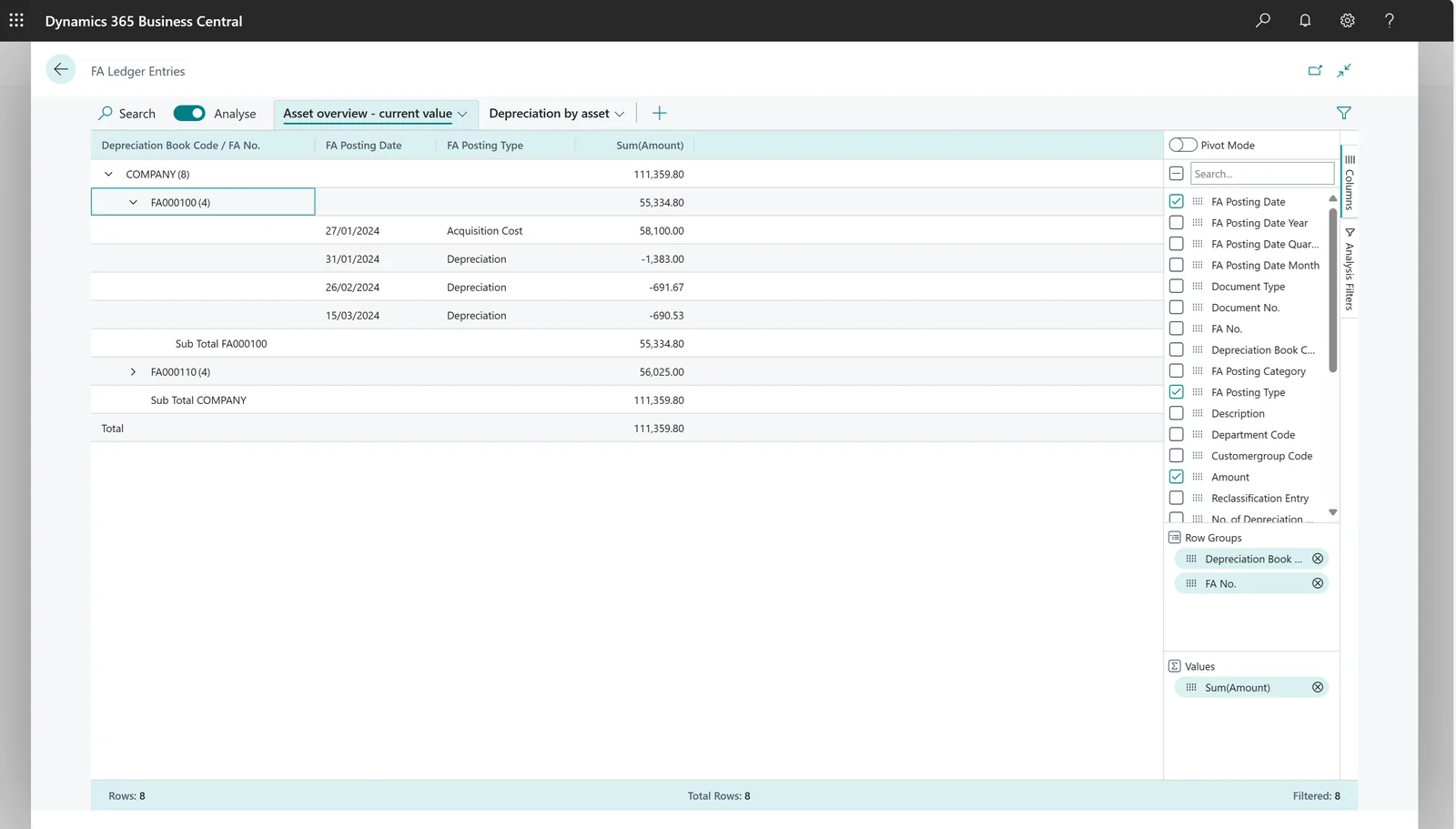
With branch tagging enforced, the same ledger answers branch and company questions.
Each platform can run branch accounting; the right model depends on how independent your branches are. Confirm features for your edition.
| Zoho | Odoo | ERPNext | Dynamics 365 | |
|---|---|---|---|---|
| Branch model | Branches feature in Zoho Books on higher plans, with branch-level transactions | Branches as child companies under a parent in recent versions, or analytic tags | Branch field and accounting dimension, or cost center per branch | Dimensions in Business Central; dimensions or legal entities in Finance |
| Branch numbering | Transaction series per branch | Separate journals and sequences per branch | Naming series per branch | Number series per dimension or location |
| Stock by branch | Locations or warehouses in Zoho Inventory | Warehouses per branch with internal transfers | Warehouses per branch with Stock Entry transfers | Locations with transfer orders |
| Branch user access | Users restricted to branches | Users restricted by company or branch | User permissions by branch or warehouse | Permission sets and dimension-based security |
| Single VAT return | One return per organization across branches | Tax report at parent level | UAE VAT report per company | VAT statement per legal entity |
For a broader view of growing across sites, see multi-branch ERP for UAE businesses.
Branch data often starts outside the ERP and must arrive tagged with the right branch.
Branch setups have tax and licensing implications; confirm details with your tax advisor.
Branches of the same legal person are not separate taxable persons, so all branches report under one TRN in one VAT return. The ERP should produce the combined return and a branch breakdown for review.
Tax invoices must carry the supplier's name, address and TRN. Branch invoices can show the branch address, but the TRN is the company's.
A UAE branch is part of the same taxable person for corporate tax, so branch results are combined in one return. Foreign branches raise separate questions for your advisor.
Under the upcoming e-invoicing framework, invoices from every branch will flow through your Accredited Service Provider. Check the latest MoF/FTA guidance and see e-invoicing in your ERP.
General information, not tax or legal advice. Rules change; confirm current FTA, MOHRE and Ministry of Finance guidance with your advisor.
Most benefits come from removing the merge step between branch files.
Each branch carries its own revenue, direct costs and a fair share of head office costs.
Transfers post on both sides from one document, so clearing accounts net to zero.
No merging of files; the combined trial balance and VAT return are produced from one ledger.
Daily takings are matched to deposits per branch, so gaps are seen the next day.
A typical branch accounting rollout for an existing company; durations vary with branch count and data quality.
Durations are typical ranges; your plan is agreed after discovery.
Map branches, licenses, warehouses, cash points and current reporting.
Configure branches, numbering, warehouses, permissions, clearing accounts and allocation rules.
Clean and merge customer, supplier and item masters, then test transfers, POS postings and VAT reports.
Go live branch by branch or together, train branch staff and run the first combined close.
We configure the system for the rules UAE businesses report against, and test it before go-live.
General information, not tax or legal advice. Confirm current requirements with the FTA, MOHRE or your advisor. See all UAE compliance guides.
On-site workshops in Dubai, Abu Dhabi and Sharjah, and remote or on-site delivery across the Northern Emirates and free zones.
Official sources and references
Facts on this page were checked against these sources in October 2026. Rules change, so confirm current requirements before acting.
Generally no. Branches of the same legal entity report under the company's TRN. Separate legal entities are different and may form a VAT group; confirm your position with a tax advisor.
Only if branches are separate legal entities or need fully separate books. For branches of one company, a branch dimension or branch object is usually simpler and keeps one ledger and one VAT return.
A transfer document moves stock out of one branch warehouse, through an in-transit location if needed, and into the other. The ERP posts both sides at the same cost, with branch clearing where branch balance sheets are kept.
Yes. User permissions can restrict documents and reports to a branch, while head office sees all branches and combined figures.
Set allocation rules based on drivers such as sales, headcount or floor area, and post them monthly. Many companies show branch results before and after allocation.
Yes. Branches are locations that usually carry revenue and stock. Department accounting tracks functions such as sales, operations and admin, which may exist in every branch.
Related Solutions
Related Industries
Related ERP Platforms
Related Guides
We map your branches, licenses and warehouses and propose the right branch model for your platform.
Dubai, United Arab Emirates










