
L
O
A
D
I
N
G


Zoho, Odoo, ERPNext, Dynamics 365 and custom ERP, delivered by one accountable team.

A budget prepared in Excel and compared once a quarter does not control spending. We set up ERP so budgets live next to purchase requests and invoices, and variances are visible while there is still time to act.
An ERP tracks budget vs actual by loading the approved budget by account, cost center and month, then comparing it with posted transactions on demand. It also counts commitments: an approved purchase order or signed subcontract reduces available budget before the invoice arrives, and purchase requests that would exceed budget can be warned or blocked. Variance reports and quarterly reforecasts replace exporting the trial balance into Excel.
An ERP for budget vs actual UAE setup compares what each department, branch or project planned to spend and earn with what has been posted, every month and on demand. In many UAE companies the annual budget is approved in a workbook in December and then put away. Finance compares actuals at quarter end by exporting the trial balance, and by the time an overspend is spotted, the purchase orders were raised months ago.
ERP changes two things. First, the budget is loaded by account, cost center and month, so every report can show plan, actual and variance without re-keying. Second, commitments are counted: an approved PO or a signed subcontract reduces the available budget before the invoice arrives, and the system can warn or block a purchase request that would exceed it.
This page covers operating budgets and their control. For contract and site budgets, see project budget management; for planning tools used to build the budget itself, see budgeting software. If you are still deciding whether a spreadsheet can do the job, our ERP vs Excel comparison sets out the trade-offs.

The issues below are common in UAE SMEs and mid-sized groups using spreadsheet budgets.
The workbook is built by department while the chart of accounts is by expense type. Mapping them each month causes errors and arguments.
Rent paid by quarterly cheque, Ramadan seasonality, summer slowdowns and year-end bonuses are ignored when the budget is divided by twelve, so monthly variances are meaningless.
A department head sees budget remaining because invoices have not arrived, and approves more POs. The overspend appears only when bills are posted.
Reports go out without thresholds or owners, so nobody is asked to explain a 20% overspend on travel.
When a contract is won or lost mid-year, the original budget stays as the only comparison, and the full-year outlook is unknown.
Several copies of the budget workbook circulate, and the board approved a different one from the one finance uses.
Budget control runs through the purchase cycle, not only through month-end reports.
One shared database: every step updates stock, finance and reports in real time.
Budget vs actual needs the budget, the purchase cycle and the ledger to share the same structure.
Budget versions by account, cost center and month, with approval status and locked baselines.
The same department, branch or project codes used in budgets and on every transaction.
Budget check when a request is raised, with a warning or block if it exceeds available budget.
Open PO and contract values held against the budget until invoiced or cancelled.
Over-budget requests routed to a higher approver or finance for a budget transfer.
Month, year to date and full-year outlook, with variance in amount and percent.
Quarterly reforecasts stored as separate versions, compared with the original budget.
Alerts to budget owners when spend crosses an agreed threshold.
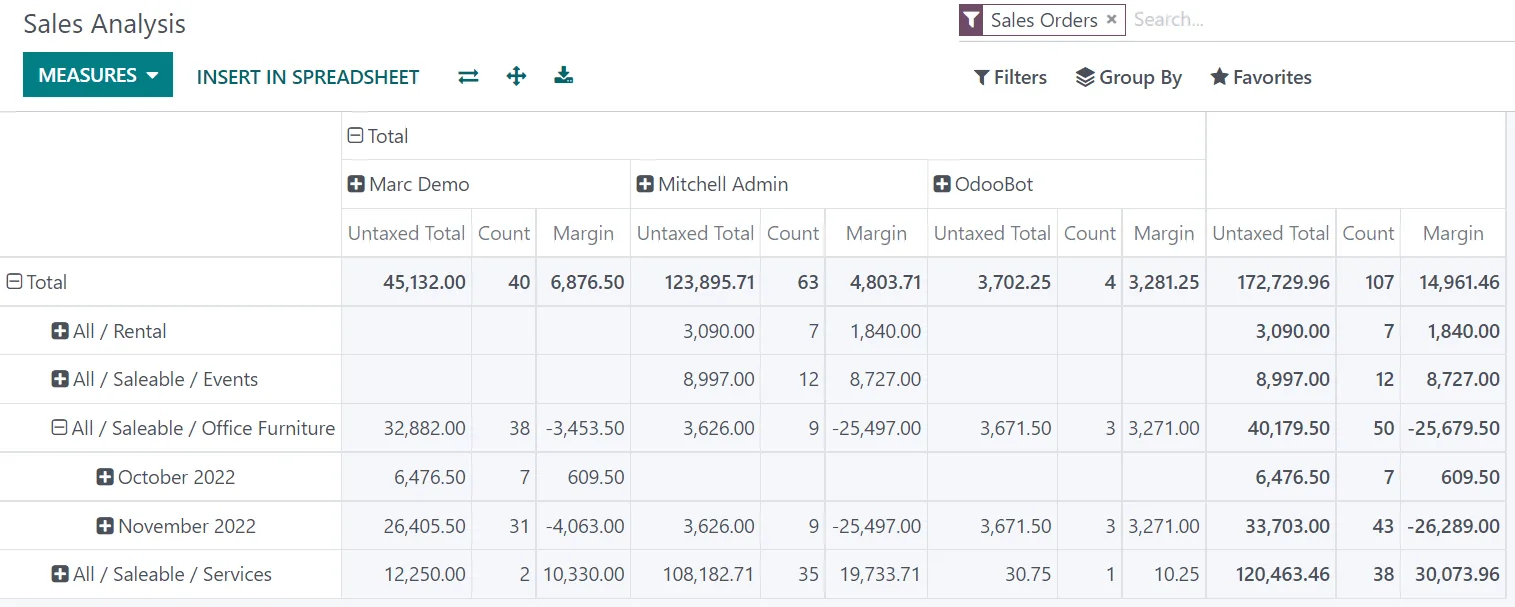
What budget owners and finance review each month.
All four platforms support budgets; they differ in commitment control and blocking. Confirm features for your edition.
| Zoho | Odoo | ERPNext | Dynamics 365 | |
|---|---|---|---|---|
| Budget entry | Budgets in Zoho Books by account, with monthly, quarterly or yearly periods | Budgets on analytic accounts (Enterprise) | Budget doctype per cost center or project with monthly distribution | G/L budgets with dimensions in Business Central |
| Budget vs actual report | Budget vs Actuals report | Budget analysis report | Budget Variance Report | Budget comparisons in Financial Reports and analysis views |
| Check on PO | Not standard; usually via custom functions | Typically via approvals or customisation | Can warn or stop on material request, PO and actual expense | Commonly via approval workflows or extension; stronger budget control in Dynamics 365 Finance |
| Commitments | Usually tracked in a custom report | Committed amounts available in some versions; confirm | Can include POs in budget check | Encumbrance in Dynamics 365 Finance; Business Central via customisation |
| Versions and reforecast | Multiple budgets can be created | Multiple budgets per period | Multiple budgets per fiscal year | Multiple budget names |
| Revenue budgets | Supported on income accounts | Supported via analytic accounts | Typically expense-focused; revenue via custom reports | Supported on any G/L account |
ERPNext offers stop or warn actions on budget breaches as standard; other platforms often need workflow configuration for similar control.
Budgets are often prepared outside the ERP, then loaded and monitored inside it.
Budgets are internal, but some tax and governance points shape how they are built. Confirm specifics with your advisors.
Budgets should be set net of recoverable VAT, so actuals and budget compare on the same basis. Irrecoverable VAT, for example on entertainment, should be budgeted as a cost.
Including a corporate tax line, at 9% on taxable income above the AED 375,000 threshold, gives a more realistic net profit target. This is not tax advice.
Staff budgets should include end-of-service and leave provisions under UAE Labour Law, not only salaries paid through WPS.
Budget changes and over-budget approvals should be logged with user and date, which supports internal audit and governance reviews.
General information, not tax or legal advice. Rules change; confirm current FTA, MOHRE and Ministry of Finance guidance with your advisor.
Outcomes depend on budget owners using the reports and approvals.
Requests that exceed budget are flagged at the PR or PO stage.
Each cost center has an owner who receives and explains variances.
Quarterly reforecasts show full-year results before the year ends.
Budget and ledger share one structure, so no monthly mapping.
Best timed before the next budget cycle; ranges are hedged.
Durations are typical ranges; your plan is agreed after discovery.
Align cost centers, accounts and budget owners.
Phase and import the approved budget, lock the baseline.
Configure budget checks on PR and PO, thresholds and alerts.
Variance reports, dashboards and monthly review routine.
Create a forecast version and compare with budget.
We configure the system for the rules UAE businesses report against, and test it before go-live.
General information, not tax or legal advice. Confirm current requirements with the FTA, MOHRE or your advisor. See all UAE compliance guides.
On-site workshops in Dubai, Abu Dhabi and Sharjah, and remote or on-site delivery across the Northern Emirates and free zones.
Official sources and references
Facts on this page were checked against these sources in October 2026. Rules change, so confirm current requirements before acting.
Still have a question? Our consultants are happy to help.
Ask an ExpertFor discretionary spend such as marketing or travel, a block with an override approval works well. For operational items such as raw materials, a warning is usually better, so production is not stopped.
Yes, if both are set up as dimensions. Our cost center accounting page explains how to design them without making data entry harder.
Record a budget revision with approval, rather than editing the original. The ERP keeps both, so variance against the original and the revised budget can be reported.
Variance pages are a core part of the monthly pack. See management reporting for how they fit with the rest of the pack.
Basic budget vs actual reports exist in most accounting tools. Commitment control and PO budget checks usually need an ERP. Our ERP vs accounting software page compares the two.
Project budgets need cost codes, BOQ lines and variations, which go beyond departmental budgets. That is covered under project budget management.
Related Solutions
Related Industries
Related ERP Platforms
We review your current budget workbook and show how it would run as budget control inside your ERP.
Dubai, United Arab Emirates