L
O
A
D
I
N
G


Zoho, Odoo, ERPNext, Dynamics 365 and custom ERP, delivered by one accountable team.

Run every conference, exhibition stand, launch and wedding as a costed project, with supplier commitments, deposits, crew and equipment in one place.
An ERP for event management companies in the UAE treats each conference, exhibition stand, launch or wedding as a project with budget lines matching the client quote. Supplier purchase orders are committed against those lines, client deposits, milestone invoices and variations are tracked per event, and crew and owned equipment are scheduled across overlapping events, so every event closes with a reconciled profit figure.
An ERP for event management companies in the UAE treats each event as a project with its own budget, suppliers, crew, equipment and client billing. A product launch at a Downtown hotel, an exhibition stand at Dubai World Trade Centre or ADNEC, a government conference in Abu Dhabi and a destination wedding in Ras Al Khaimah share one thing: the date cannot move, and costs keep arriving after the client has signed off the budget.
Most event agencies we meet track budgets in spreadsheets shared between producers and finance. Suppliers send quotes by email, deposits are paid from the main account and freelancers invoice weeks later. By the time all costs land, the team is three events further on and nobody knows whether the original quote was profitable. Overruns for extra AV, last-minute printing or overtime crew are absorbed rather than billed.
UAE ERP Experts, based in Dubai, sets up project-based ERP for agencies of different sizes. The approach builds on our project management ERP experience, with event-specific additions such as equipment check-out and crew call sheets. Agencies that also run marketing campaigns may find our page on ERP for marketing agencies useful.

These problems are common across corporate event agencies, exhibition contractors and wedding planners.
Venue extras, freelancer invoices and supplier overtime are often billed weeks later. Without commitments recorded at the time, the event's true cost is unknown when the team reviews it.
Clients add a second LED wall, extra catering covers or an earlier build day. If producers do not raise a variation, the agency pays for the change and the margin disappears.
Venues, hotels and production houses ask for deposits on booking. When deposits are paid from a general account, finance cannot match them to the right event or recover them on cancellation.
Agencies that own staging, lighting, furniture or branded displays send the same kit to two events on overlapping dates, then hire replacements at short notice.
From October to April, crew and freelancers move between events daily. Tracking hours, per diems and transport by event is difficult without a shared schedule.
We configure this flow for corporate events, exhibitions and private events, adjusting the approval steps to your structure.
One shared database: every step updates stock, finance and reports in real time.
A common module set. Small agencies often begin with projects, purchasing and accounting.
Each event as a project with budget lines for venue, production, AV, catering, talent, logistics and staffing.
Costed proposals built from rate cards and supplier quotes, with margin visible to producers before sending.
Purchase orders and deposits raised against budget lines, so committed cost is visible before invoices arrive.
Owned kit with availability calendars, check-out and return, damage notes and maintenance.
Call times, roles and hours by event, with freelancer agreements and day rates.
Deposits, milestone invoices, variation orders and final invoices against each event.
Producer petty cash, taxis and on-site purchases captured from a phone with receipts and coded to the event.
Event-level P&L, multi-currency suppliers for overseas events and VAT return mapping.
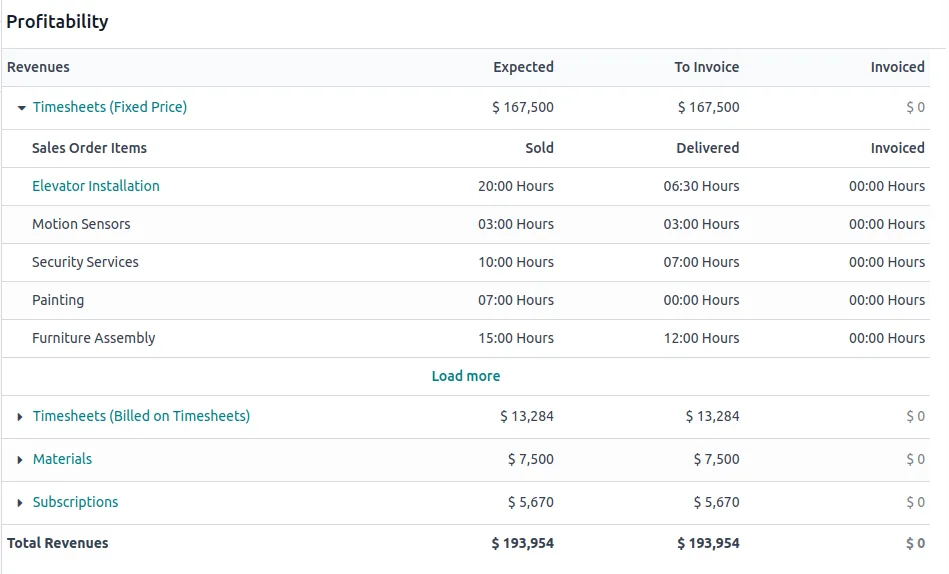
A project dashboard so producers and finance see the same numbers for every live event.
Event agencies vary widely, from two-person wedding planners to exhibition contractors with warehouses.
| Company profile | Platform that usually fits | Why it fits | Watch-out |
|---|---|---|---|
| Boutique planner or small agency | Zoho Books with Zoho Projects | Project budgets, time and expenses, and VAT invoicing at a modest scale | Equipment rental tracking is limited without a custom app |
| Corporate event agency with owned AV and staging | Odoo | Projects, purchase, rental, inventory, timesheets and accounting in one database | Rental and project flows must be designed together to avoid duplicate entry |
| Exhibition stand builder with a workshop | ERPNext or Odoo | Adds manufacturing-style job costing for built stands alongside projects | Requires clear rules for reusing stand components across shows |
| Large events group with several companies | Dynamics 365 Business Central | Jobs module, multi-company consolidation and Power BI | More configuration effort and higher licensing than lighter options |
We implement Zoho, Odoo, ERPNext, Dynamics 365 and custom ERP. We do not sell ticketing or registration platforms; we connect them where needed.
Event work crosses borders and involves many short-term suppliers, which affects tax and payroll setup. Confirm details with your tax advisor.
Events held in the UAE are generally standard-rated at 5%. Events abroad, or services for overseas clients, may be treated differently depending on the place of supply rules, so the system supports separate tax codes per event.
Recoverable input VAT depends on valid tax invoices from VAT-registered suppliers. The ERP checks TRNs on supplier records and flags missing tax invoices before month end.
Most event clients are businesses or government entities, so the e-invoicing rollout under Ministerial Decisions No. 243 and 244 of 2025 is relevant. Check the latest Ministry of Finance and FTA guidance for your phase.
Employed staff are paid through WPS. Freelancers and agency crew are paid as suppliers, and their contracts and permits should be stored against their records.
General information, not tax or legal advice. Rules change; confirm current FTA, MOHRE and Ministry of Finance guidance with your advisor.
Directional improvements we aim for. Results depend on producers recording commitments as they happen.
Every event closes with a reconciled P&L, so pricing for the next pitch is based on evidence.
Changes captured on site are turned into client variations instead of absorbed cost.
Owned kit is booked on a shared calendar, reducing last-minute hire.
Client and supplier deposits are matched to events, which matters most when an event is postponed or cancelled.
Indicative ranges. We usually plan go-live outside the peak season from October to April where possible.
Durations are typical ranges; your plan is agreed after discovery.
Review proposal templates, budget categories, supplier processes, equipment lists and crew practices.
Agree project structure, budget lines, approval limits, rental rules and the chart of accounts.
Set up projects, purchasing, rental inventory, timesheets, expenses and billing.
Run a few live events end to end in the new system and refine templates.
Move all new events into the ERP and review event P&Ls monthly with leadership.
Pages that event agencies often read when planning their systems.
We configure the system for the rules UAE businesses report against, and test it before go-live.
General information, not tax or legal advice. Confirm current requirements with the FTA, MOHRE or your advisor. See all UAE compliance guides.
On-site workshops in Dubai, Abu Dhabi and Sharjah, and remote or on-site delivery across the Northern Emirates and free zones.
Official sources and references
Facts on this page were checked against these sources in October 2026. Rules change, so confirm current requirements before acting.
Still have a question? Our consultants are happy to help.
Ask an ExpertIt links each event's budget to real purchase orders, supplier bills, crew hours and client invoices in one place. Producers and finance see the same live numbers, and every event closes with a reconciled profit figure.
Yes. Owned equipment is set up as rentable stock with an availability calendar. Items are checked out to an event, returned, inspected and sent for repair if damaged.
Producers log changes against the event as they are requested. Each change can carry a client price, and approved variations flow into the next invoice.
Yes. Events can use foreign currency suppliers and separate tax codes. Your tax advisor should confirm the VAT treatment of each overseas event.
Freelancers are set up as suppliers with agreed day rates. Their hours on each event generate a bill for approval, which is coded straight to the event cost.
Usually, yes, if the platform has an API or export. Registrations and payments can post to the event project for revenue tracking.
Related Solutions
Related Industries
Related ERP Platforms
Related Guides
Share how you budget and deliver events today, and we will suggest a project-based ERP setup that fits your season.
Dubai, United Arab Emirates