
L
O
A
D
I
N
G


Zoho, Odoo, ERPNext, Dynamics 365 and custom ERP, delivered by one accountable team.

Bring purchase orders, GRNs, subcontract certificates, labor hours and plant charges onto one cost code structure so the cost report is right before the month closes.
Construction project costing software charges every cost to a project and cost code when it is committed or incurred: LPOs, GRNs, subcontractor certificates, labor hours at loaded rates and plant charges. UAE contractors then see committed cost and cost-to-complete before month end, rather than discovering overruns months later from a quantity surveyor's spreadsheet. ERP ledgers in Odoo, ERPNext, Zoho or Dynamics 365 support this.
Most UAE contractors know their contract value to the dirham and their actual cost only roughly. Construction project costing software fixes that by charging every cost to a project and a cost code at the moment it is committed or incurred: the LPO to the steel supplier, the GRN for ready-mix concrete, the subcontractor's monthly certificate, the hours a mason crew booked against blockwork, the day rate of a hired crane.
In a typical Dubai or Abu Dhabi fit-out or MEP contractor, the quantity surveyor keeps a cost report in Excel, accounts posts supplier invoices against a single project code weeks later, and labor cost arrives as one payroll journal. By the time the numbers meet, the job is two months further along and the overrun is already sunk. A proper ERP ledger with cost codes changes the question from "what did we spend?" to "what will this job cost at completion?"
This page covers costing: how cost is captured, coded, committed and forecast. For the estimate and bill structure that feeds the budget see construction BOQ software, and for approval limits and budget blocking see construction budget control.

These are the patterns we see when reviewing cost reports for contractors across the emirates.
Supplier invoices for shared deliveries are posted to whichever project the AP clerk guesses. Material moved between sites is never re-charged, so one job looks healthy and the other carries its cost.
The cost report shows only invoiced amounts, while issued LPOs and subcontract orders worth a large share of the budget sit outside it. The QS cannot see that a trade package is already fully committed.
WPS payroll runs per company, and labor reaches the job as an allocation estimate. Overtime on one tower and idle time on another never show up in the cost per activity, which is why construction timesheets by activity matter.
Owned cranes, scaffolding and vehicles move between sites without internal charges. Hired plant is invoiced monthly, often after the activity has finished.
Cost-to-complete is typed into a spreadsheet by the project manager with no link to remaining quantities. Month-end WIP and revenue recognition then depend on a number nobody can audit.
Each step posts to the same project and cost code, so the cost report is a live view of the ledger rather than a separate spreadsheet.
One shared database: every step updates stock, finance and reports in real time.
Costing is not one screen. It is the result of several modules writing to the same project dimension, the same principle behind general project costing software but with construction documents.
Project, phase, activity and cost code hierarchy, so a cost is coded at the right level once.
LPOs carry project and cost code, creating committed cost as soon as they are approved.
Subcontract orders, monthly certificates and retention held, each linked to its trade package.
Material issued from site stores is charged to the activity that consumed it, not the job as a whole.
Crew hours by activity are costed at a loaded hourly rate that includes accommodation, visa and transport cost.
Internal hire rates for owned plant and recharges for hired plant, logged by day or hour.
Cost and revenue by project, WIP postings and percentage-of-completion support under IFRS 15 policies.
Cost report by cost code with budget, committed, actual, cost-to-complete and forecast at completion.
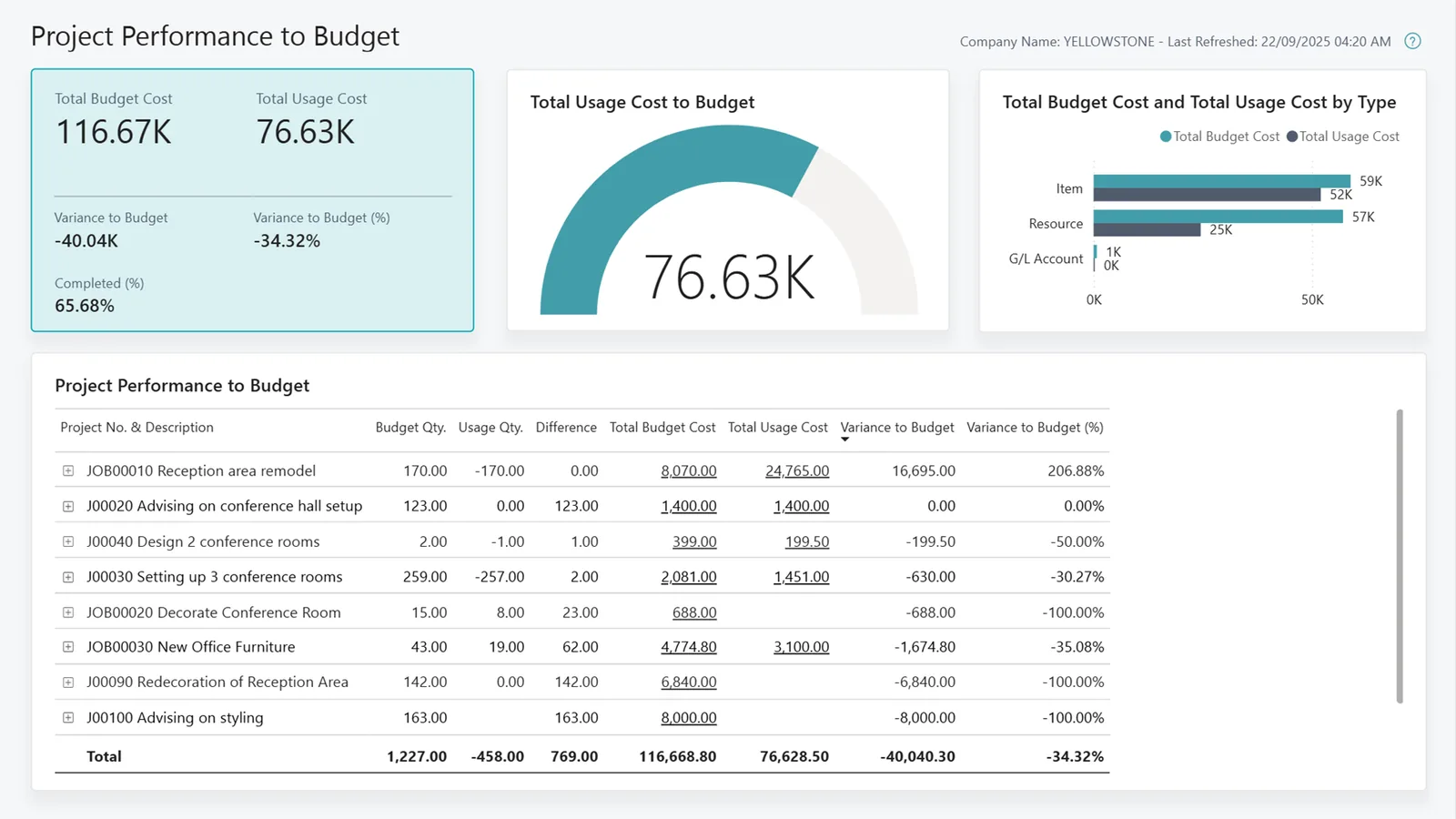
The same data drives a site view for the project manager and the portfolio view in a construction project dashboard.
All four can cost a construction job well when configured properly. The difference is how much is native and how much needs setup or extension. Confirm details for your edition.
| Zoho | Odoo | ERPNext | Dynamics 365 | |
|---|---|---|---|---|
| Project cost structure | Projects in Zoho Books or Zoho Projects; cost codes usually built with custom fields or Zoho Creator | Project plus analytic accounts and analytic plans for cost codes | Project, tasks, cost centers and custom accounting dimensions | Business Central Projects (formerly Jobs) with project tasks and planning lines |
| Committed cost | Open purchase orders by project; committed view often needs a custom report | Purchase orders carry analytic distribution; committed reporting via budget or custom report | Budget can consider material requests and POs; committed cost via reports | Project planning lines and purchase lines give committed usage; strong standard reporting |
| Labor costing | Zoho Projects timesheets with cost rates | Timesheets post cost to analytic accounts at employee cost rates | Timesheets with costing rate per activity type | Resource cost on project journals and time sheets |
| Plant and equipment | Usually custom app or manual journal | Possible via Maintenance plus custom recharge logic | Asset and custom doctype for plant logs | Resources or items for equipment with unit costs |
| WIP and revenue recognition | Manual journals based on report | Configurable with accounting entries; often extended for POC | Custom scripts or reports for POC | Built-in WIP methods in Business Central Projects |
| Best fit | Smaller fit-out and maintenance contractors | Mid-size contractors wanting one integrated suite | Cost-conscious contractors open to Frappe customization | Larger contractors needing standard WIP and Microsoft tools |
Capabilities summarized from standard editions; we confirm against your current version during discovery.
Costing is only as current as the data feeding it. These are the connections we most often set up.
Costing setup affects tax and audit, so we design it with your accountant in the room. Confirm treatment with your tax advisor.
Input VAT on materials, plant hire and subcontract invoices must be captured separately from the cost charged to the job, with valid tax invoices carrying the supplier TRN. Reverse charge on imported services and goods needs its own tax codes.
Taxable income under Federal Decree-Law No. 47 of 2022 starts from accounting profit, so the way you recognize revenue and WIP on long contracts flows straight into the corporate tax return.
Under Ministerial Decisions 243 and 244 of 2025, supplier and subcontractor invoices will arrive as structured PINT AE data through Accredited Service Providers, with phased dates from 1 January 2027 for larger businesses. Mapping project and cost code on receipt keeps coding automatic. Check the latest MoF and FTA guidance.
Tax records must be kept at least five years under Cabinet Decision 74 of 2023, so certificates, GRNs and cost journals belong in the ERP with an audit trail, not in site folders.
General information, not tax or legal advice. Rules change; confirm current FTA, MOHRE and Ministry of Finance guidance with your advisor.
Benefits our clients look for, described without invented figures.
Committed cost exposes a trade package that is over budget at LPO stage, months before the invoice.
QS, project manager and finance read the same numbers, so month-end meetings discuss actions rather than reconciliations.
Cost-to-complete is tied to remaining quantities and approved forecasts, which auditors can trace.
Actual cost per unit by activity on finished jobs feeds the next estimate and the profitability analysis by client and job type.
Durations are typical ranges for a mid-size contractor and depend on the number of live projects and data quality.
Durations are typical ranges; your plan is agreed after discovery.
Agree the WBS and cost code library with QS, project control and finance.
Set up projects, budgets, purchasing, timesheet costing and the cost report.
Load budgets, open POs, subcontracts and cost to date for running jobs.
Run the ERP cost report next to the old spreadsheet and reconcile differences.
Switch monthly cost-to-complete reviews to the ERP and retire the spreadsheet.
We configure the system for the rules UAE businesses report against, and test it before go-live.
General information, not tax or legal advice. Confirm current requirements with the FTA, MOHRE or your advisor. See all UAE compliance guides.
On-site workshops in Dubai, Abu Dhabi and Sharjah, and remote or on-site delivery across the Northern Emirates and free zones.
Official sources and references
Facts on this page were checked against these sources in October 2026. Rules change, so confirm current requirements before acting.
Still have a question? Our consultants are happy to help.
Ask an ExpertCosting records and forecasts what a project costs. Budget control uses those numbers to warn or block spending before it happens. Most contractors set up costing first and then add the blocking rules described on our budget control page.
Detailed enough to match how you estimate and buy, usually trade package plus cost type such as material, labor, plant and subcontract. Codes that are too fine get ignored on site, so we keep the list short and use the BOQ for item detail.
Yes. Most contractors use a loaded hourly rate per trade that includes salary, allowances, accommodation, transport and visa cost, reviewed periodically. Hours come from site timesheets or attendance devices.
It depends on size and how much you want standard. Dynamics 365 Business Central has strong standard project WIP, Odoo gives an integrated suite with analytic accounting, ERPNext is flexible and open source, and Zoho suits smaller contractors. We implement all four and recommend by fit; see ERP for construction companies.
We usually load opening budgets, committed orders and cost-to-date per cost code for live jobs, and keep closed jobs in a read-only archive or summary journals.
Yes, all four platforms offer mobile or web access for timesheets, material requests and GRNs, so costs are coded on site rather than retyped in the office.
Related Solutions
Related Industries
Related ERP Platforms
Share one live project and we will show how its budget, commitments and actuals would look in an ERP cost report.
Dubai, United Arab Emirates










