L
O
A
D
I
N
G


Zoho, Odoo, ERPNext, Dynamics 365 and custom ERP, delivered by one accountable team.

One system for deployed workers, client timesheets, hourly billing and WPS payroll, so you can see the real margin on every person you supply.
A UAE manpower supply company needs an ERP that links each worker's cost to the revenue earned at client sites. Client-approved timesheets should feed both payroll and billing, rate cards should vary by client, trade and overtime, the WPS Salary Information File should come from the same payroll run, and visa, accommodation and transport costs should be allocated per worker.
An ERP for manpower companies in the UAE has one job above all others: connect the cost of each worker to the revenue that worker earns at a client site. Labour supply firms in Dubai, Sharjah and Abu Dhabi often run hundreds of people across dozens of client sites, with rates that differ by trade, by client and by shift. When timesheets live in one file, payroll in another and invoices in an accounting package, nobody can say with confidence which contracts are profitable.
The pressure points are familiar. A site supervisor sends a photo of a paper timesheet on WhatsApp. Someone in the office retypes it. Payroll runs before the client approves the hours, so overtime gets paid but never billed. Visa renewals, medical tests and Emirates ID fees are booked to a general expense account instead of the worker who caused them. By the time the month closes, the margin you thought you had has quietly gone.
We configure ERP so that the employee record, the deployment, the approved timesheet, the payroll line and the client invoice all share the same data. That is the difference between knowing your gross margin per worker and guessing it. If you also run cleaning or security crews, see our pages on ERP for cleaning companies and security companies, which cover scheduled service work rather than pure labour supply.

These issues come up again and again when we review labour supply operations in the UAE.
Overtime is approved verbally on site and paid through payroll, but the client invoice is built from a different sheet. The gap is rarely noticed until a client disputes the next invoice.
Visa processing, medical fitness, insurance, accommodation and transport are booked as overheads. Without allocating them to the worker, a low-rate contract can look profitable when it is not.
Passports, residence visas and labour cards expire on different dates for every worker. A missed renewal can mean fines and a worker who cannot legally be deployed.
The same welder may bill at a different hourly rate to three clients, with separate overtime, Friday and public holiday rates. Manual invoicing struggles to apply these consistently.
Large headcounts mean WPS files with hundreds of lines, advances, deductions and absences. One wrong figure causes salary rejections and unhappy workers.
You pay workers monthly, but clients often pay 60 to 90 days later. Without clear ageing by client, it is hard to decide who should get more workers next month.
Each step creates data the next step uses, so hours are entered once and reused for payroll, billing and costing.
One shared database: every step updates stock, finance and reports in real time.
Most manpower companies need a tight core rather than every app on the menu. These are the modules that matter.
Worker profiles with trade, skills, passport, visa, Emirates ID and labour card details, plus automatic expiry alerts.
Client contracts with rate cards by trade and shift, and a record of which worker is at which site on which dates.
Daily or weekly hours captured by supervisors on mobile, with normal, overtime and holiday hours split out for billing.
Salary calculation with allowances, deductions and advances, producing the SIF file your bank or exchange house needs.
Invoices built from approved hours and the client rate card, with VAT applied and ageing reports by client.
Visa, medical, accommodation and transport costs assigned to each worker so margin reports reflect reality.
Candidate tracking from sourcing country to visa issue, so you know who is arriving and when.
Room allocation in labour accommodation and bus routes to client sites, with costs shared across contracts.
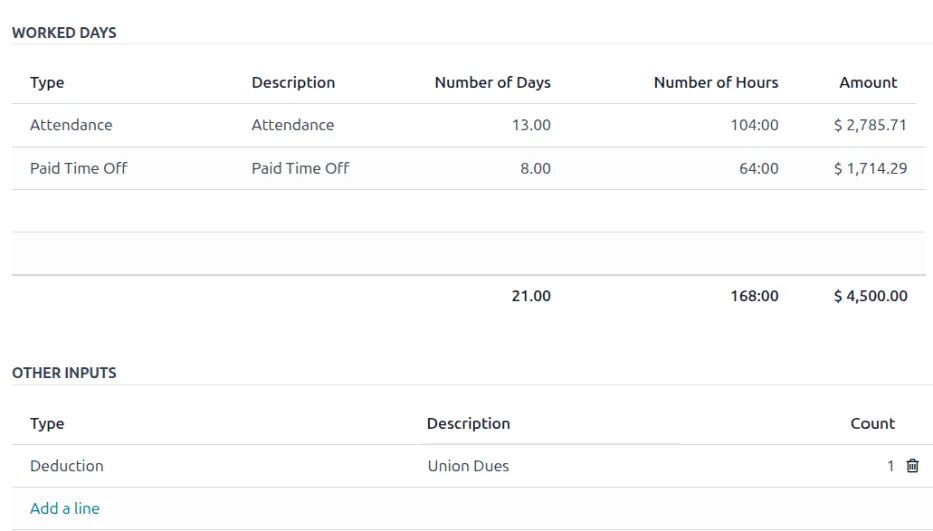
Managers need to see deployment and payroll status together, not in separate reports.
We implement all four platforms below. The right choice depends on headcount, how complex your rate cards are and how much custom logic you need.
| Company profile | Often a good fit | Why |
|---|---|---|
| Up to about 150 workers, few clients | Zoho One (People, Payroll, Books) | Quick to set up, good mobile apps for supervisors, and Zoho Creator can hold a simple deployment register. |
| 150 to 1,000 workers, many rate cards | Odoo | Timesheets, payroll, contracts and invoicing share one database, and custom rate logic is straightforward to add. |
| Cost-sensitive with in-house IT | ERPNext | Open-source HRMS and payroll with timesheet-based billing; no per-user licence fees to scale headcount. |
| Group with several licensed entities | Dynamics 365 Business Central | Strong multi-company finance and consolidation, paired with an HR and payroll solution suited to UAE needs. |
| Very specific deployment rules | Custom ERP | When your allocation, camp and billing logic does not match any standard package, a custom build can model it exactly. |
Payroll localization for UAE varies by platform and edition. We confirm WPS and gratuity handling during discovery.
Labour supply is one of the most regulated service lines in the UAE. ERP should make compliance routine rather than a monthly scramble.
Salaries must be paid through the Ministry of Human Resources and Emiratisation Wage Protection System via an approved bank or agent. The ERP payroll run should produce a correct Salary Information File for every worker on your licence.
Gratuity is calculated under Federal Decree-Law No. 33 of 2021 on basic salary and length of service. Monthly accruals per worker keep the liability visible on your balance sheet.
Supplying staff is generally a taxable service at the standard 5% rate. Invoices must carry your TRN and the prescribed fields, and VAT returns are filed through EmaraTax. Confirm treatment of specific arrangements with your tax advisor.
Corporate tax at 9% applies to taxable income above AED 375,000. E-invoicing through Accredited Service Providers becomes mandatory in phases from 1 January 2027 for larger businesses and 1 July 2027 for others; check the latest Ministry of Finance and FTA guidance.
General information, not tax or legal advice. Rules change; confirm current FTA, MOHRE and Ministry of Finance guidance with your advisor.
These are the outcomes manpower companies usually aim for. Results depend on data quality and how consistently supervisors use the system.
Invoices come from the same timesheet that drives payroll, so overtime and holiday hours stop slipping through.
Visa, accommodation and transport costs sit against each person, showing which contracts actually make money.
Bank details, labour card numbers and salary components are validated before the SIF file is created.
Alerts for passports, visas and labour cards give the PRO team time to renew before a worker is stood down.
Timings below are typical ranges for a focused rollout and depend on headcount, data quality and how many entities are involved.
Durations are typical ranges; your plan is agreed after discovery.
Map your rate cards, payroll components, cost allocation rules and client approval process.
Set up employee records, contracts, timesheets, payroll and billing, then build the margin reports.
Load worker master data, document expiry dates, opening leave and gratuity balances, and open receivables.
Run one month in both old and new systems to prove the WPS file and payslips match.
Train site supervisors on mobile timesheets and support the first two month-end closes.
Explore payroll, HR and related industry pages.
We configure the system for the rules UAE businesses report against, and test it before go-live.
General information, not tax or legal advice. Confirm current requirements with the FTA, MOHRE or your advisor. See all UAE compliance guides.
On-site workshops in Dubai, Abu Dhabi and Sharjah, and remote or on-site delivery across the Northern Emirates and free zones.
Official sources and references
Facts on this page were checked against these sources in October 2026. Rules change, so confirm current requirements before acting.
Still have a question? Our consultants are happy to help.
Ask an ExpertYes. All the platforms we implement have mobile apps or web forms that work on a phone. Supervisors enter hours per worker per day, and the office approves them before they move to payroll and billing.
Yes. Rate cards are held on each client contract, with separate rates for normal hours, overtime, rest days and public holidays. The invoice picks the right rate automatically from the approved timesheet.
We configure payroll to produce the Salary Information File in the format your bank or exchange house accepts. We test it with a sample file before go-live so the first real run is not a surprise.
Costs can be tagged to the employee when they are posted, or spread using allocation rules such as per bed in a camp or per seat on a bus. Margin reports then show cost and revenue per worker and per contract.
Usually not. Odoo, ERPNext and Zoho One all include HR and payroll that link to timesheets and invoicing. Larger groups on Dynamics 365 sometimes pair it with a dedicated HR and payroll solution.
No software makes you compliant on its own. ERP keeps accurate records, produces the WPS file and tracks gratuity, but your HR and PRO team still own the legal processes. We help you set the system up to support them.
Related Solutions
Related Industries
Related ERP Platforms
Talk to our Dubai team about an ERP setup built around your timesheets, rate cards and WPS payroll.
Dubai, United Arab Emirates