
L
O
A
D
I
N
G


Zoho, Odoo, ERPNext, Dynamics 365 and custom ERP, delivered by one accountable team.

When a contract says 30% on signing, 40% on go-live and 30% on acceptance, the money depends on knowing exactly when each milestone is reached. Milestone billing software makes that moment visible and billable.
Milestone billing in an ERP invoices clients in agreed instalments tied to project events, such as 30% on signing, 40% on go-live and 30% on acceptance. The payment schedule is copied from the signed quotation into the project, each milestone links to tasks and an acceptance document, and a draft invoice is raised on sign-off. UAE IT, engineering, fit-out and supply-and-install firms use it to stop billing delays.
Milestone billing software lets a business invoice a client in agreed instalments that are tied to events in the project, not to hours worked or a monthly calendar. It is the standard commercial model for IT implementations, engineering design packages, fit-out works, exhibition and event builds, and supply-and-install contracts across Dubai, Abu Dhabi and Sharjah. The contract fixes the payment schedule; the software makes sure each instalment is raised on time and only when it is genuinely due.
The weak point in most UAE firms is the handover between the delivery team and accounts. The project manager knows the design freeze was approved last Tuesday, but the accountant only finds out at month-end when someone asks why cash is short. Good milestone billing in an ERP closes that gap: the milestone is a record on the project, linked to tasks and an acceptance document, and its completion puts a draft invoice in the billing queue.
Milestone billing sits alongside other models. Contractors who are paid on certified percentage complete use progress billing with interim payment certificates instead, and service firms that bill hours use time and material billing. Many contracts mix the two, which is why the milestone schedule should live inside the same project billing software that handles your other models.

These are the patterns we see when we review how project firms in the UAE actually raise milestone invoices.
The payment schedule is agreed in the signed proposal and never entered anywhere structured. Accounts staff reread the contract each month to work out what can be billed.
A milestone completed on the 3rd is not invoiced until the 30th because nobody told finance. That is close to a month of avoidable delay on every instalment.
The client disputes the invoice because the acceptance certificate or approval email cannot be found. Without evidence attached to the milestone, collection stalls.
Mobilization advances are received before any invoice exists, and the VAT on them is either missed or declared in the wrong period. The tax point for an advance is often earlier than teams assume.
A client approves extra scope worth a new instalment, but the original schedule is never revised. The extra work is delivered and never billed.
Management cannot see what has been delivered but not invoiced, or invoiced but not collected, across all projects at once.
Each step creates a record, so the path from contract to cash can be audited later.
One shared database: every step updates stock, finance and reports in real time.
Milestone billing touches sales, projects and finance, so the modules must share one project record.
Payment terms and milestone percentages entered once on the quotation and carried into the project when the deal is won.
Milestones sit on the project plan with planned dates, owners and the tasks that must be closed first.
Each instalment holds its amount or percentage, the trigger event and its status: planned, ready to bill, invoiced, paid.
Signed acceptance certificates, handover notes and client emails attached to the milestone they prove.
Tax invoices with TRN and the milestone description, including advance invoices and credit notes when a milestone is reduced.
Due dates, reminders and receipts matched to each milestone invoice, with ageing by project.
Advances held as contract liabilities until earned, so the P&L reflects delivery rather than cash timing.
A finance or project director review before a milestone invoice is released to the client.
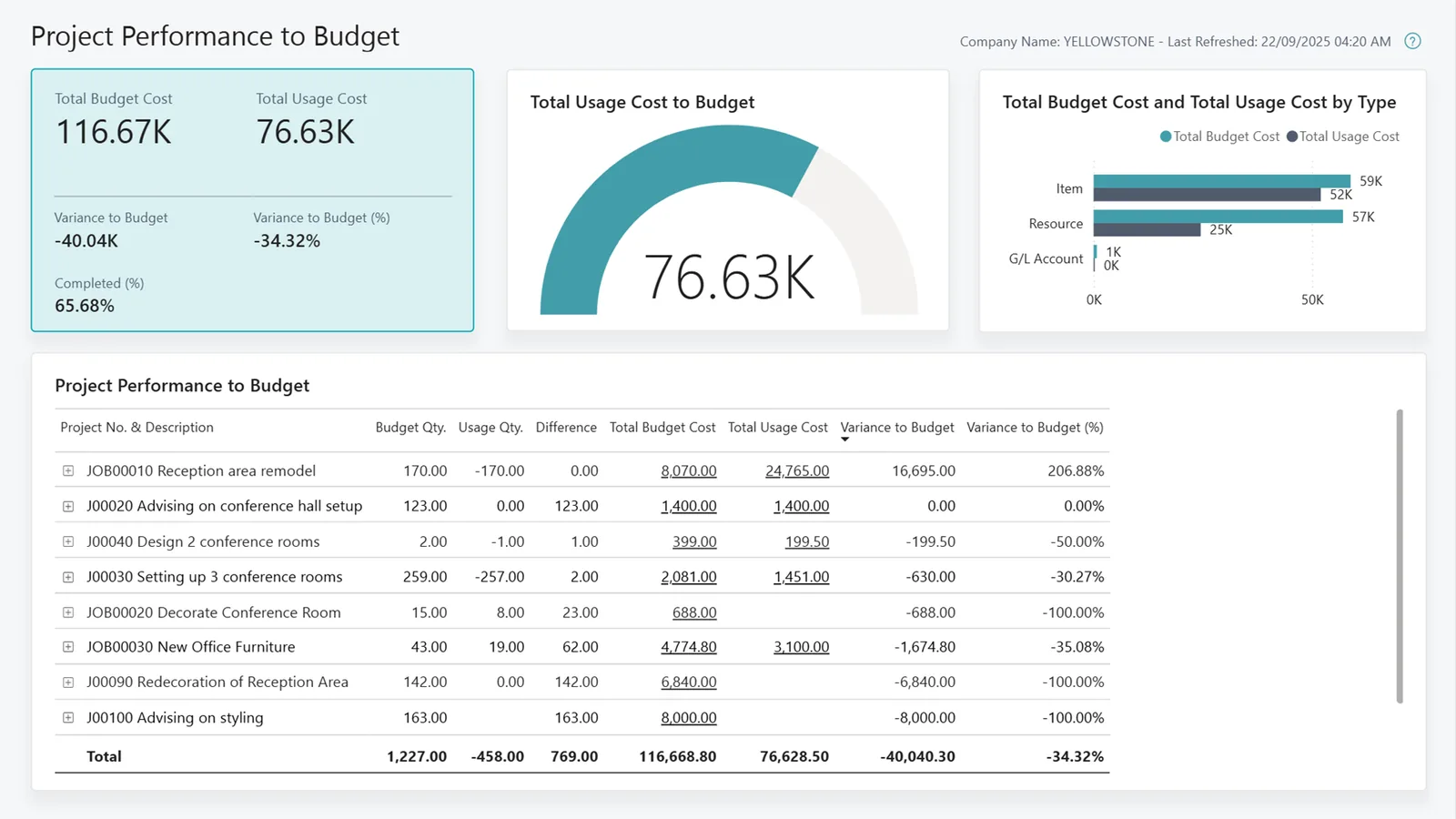
These views let project managers and the credit controller work from the same list.
All four platforms we implement can bill by milestone. They differ in how tightly the milestone is linked to project tasks. Confirm details for your edition and version.
| Zoho | Odoo | ERPNext | Dynamics 365 | |
|---|---|---|---|---|
| Billing schedule setup | Zoho Projects milestones with invoicing through Zoho Books project billing | Sales order lines delivered by milestone; invoicing based on milestones reached | Payment schedule on sales order or project, with payment terms templates | Billing schedules on jobs in Business Central; milestone billing rules in Project Operations |
| Link to tasks | Milestones group tasks in Zoho Projects | Milestones on the project linked to sales order lines in recent versions | Tasks linked to project; milestone tracking often added by configuration | Job tasks and planning lines; project contract lines in Project Operations |
| Advance invoices | Retainer invoices in Zoho Books | Down payment invoices on sales orders | Advance payments allocated against invoices | Prepayment invoices in Business Central |
| Acceptance evidence | Attachments on milestone or invoice | Documents attached to project or chatter | File attachments on any document | Attachments and SharePoint links |
| Revenue recognition | Usually handled by journals or Zoho Analytics reporting | Deferred revenue entries; depends on setup | Deferred revenue settings on items | Revenue recognition features vary by product; confirm for your edition |
| Best fit | Service firms already on Zoho One | Firms wanting sales, project and accounting in one database | Cost-conscious firms happy to configure | Larger groups or firms already on Microsoft 365 |
The billing schedule is more useful when the acceptance and payment events reach it without retyping.
These points shape how the billing schedule and invoice templates are configured. Confirm the treatment for your contracts with your tax advisor.
Under UAE VAT the date of supply for services is generally the earliest of invoice issue, payment receipt or completion, so a mobilization advance can create a VAT liability when the cash arrives. The ERP should allow an advance invoice or receipt voucher with VAT at that point.
Each milestone invoice must carry the supplier TRN, client details where required, a description of the milestone, the taxable amount and VAT at 5%. Credit notes are needed when a milestone value is reduced after invoicing.
Once your mandatory date applies (from 1 January 2027 for businesses at or above AED 50 million revenue, 1 July 2027 for others), milestone invoices go through an Accredited Service Provider in the PINT AE format. Check the latest Ministry of Finance and FTA guidance.
Corporate tax starts from accounting profit, so the way milestone revenue is recognized under your accounting standards affects taxable income per period.
Contracts, acceptance certificates and invoices should be kept for at least five years under the tax record rules, and linked so an auditor can follow each milestone.
General information, not tax or legal advice. Rules change; confirm current FTA, MOHRE and Ministry of Finance guidance with your advisor.
The benefits come from shorter gaps between delivery, invoice and cash.
Draft invoices appear when the milestone is accepted, so billing no longer waits for month-end.
Acceptance evidence travels with the invoice, so clients have less reason to hold payment.
Advances are invoiced or receipted with VAT in the right period instead of being fixed later.
Management sees delivered-but-unbilled value across all projects, not only overdue receivables.
Durations are indicative for a firm adding milestone billing to an existing ERP or as part of a wider rollout.
Durations are typical ranges; your plan is agreed after discovery.
Collect live contracts, list payment term patterns and agree the trigger and evidence for each type of milestone.
Set up payment term templates, billing schedule fields, invoice layouts and the approval step.
Enter open projects with their remaining milestones, advances received and amounts already billed.
Run a billing cycle with project managers and accounts together, then fix gaps before wider use.
We configure the system for the rules UAE businesses report against, and test it before go-live.
General information, not tax or legal advice. Confirm current requirements with the FTA, MOHRE or your advisor. See all UAE compliance guides.
On-site workshops in Dubai, Abu Dhabi and Sharjah, and remote or on-site delivery across the Northern Emirates and free zones.
Official sources and references
Facts on this page were checked against these sources in October 2026. Rules change, so confirm current requirements before acting.
Still have a question? Our consultants are happy to help.
Ask an ExpertMilestone billing invoices a fixed amount when a defined event happens, such as design approval or go-live. Progress billing invoices a percentage of work completed, usually certified by a consultant through an IPC, which is common in construction billing.
Yes, if the contract allows it. Most systems let finance mark a milestone as ready to bill manually, but we recommend recording the reason and the client approval so the exception is visible later.
The advance is invoiced or receipted with VAT, held as a liability, and then deducted from later milestone invoices in the proportion the contract specifies. The ERP should show the advance balance remaining on every project.
The change order adds a new milestone or increases an existing one. It should go through the same approval as the original quotation so the schedule and contract value stay in step.
Usually, yes. Milestones decide when you bill, while fixed fee project billing is about controlling cost and recognizing revenue against a set price. Most fixed fee projects use both.
Rarely. Zoho, Odoo, ERPNext and Dynamics 365 all support milestone schedules. The work is in configuring them around your contract patterns and approval rules.
Related Solutions
Related Industries
Related ERP Platforms
Share two or three of your contracts and we will show how their payment schedules would run in your ERP.
Dubai, United Arab Emirates










