
L
O
A
D
I
N
G


Zoho, Odoo, ERPNext, Dynamics 365 and custom ERP, delivered by one accountable team.

For owner-run UAE businesses with a handful of staff, we set up a lean ERPNext that covers quotes, VAT invoices, stock and cash without the overhead of a big ERP.
ERPNext suits small UAE businesses of roughly 2 to 20 people that want sales, purchases, stock, VAT invoices and accounts in one open-source system. Unused modules are disabled and forms simplified, so staff see only selling, buying, stock and accounts. There is no licence fee; costs are hosting on Frappe Cloud or a server, plus implementation and support.
A small business in the UAE often runs on a mix of Excel, a basic accounting tool, WhatsApp and the owner's memory. That works until VAT returns take a week to prepare, stock counts never match, or the one person who knows the spreadsheet goes on leave. ERPNext for small business UAE owners is a way to put sales, purchases, stock and accounts into one open-source system without paying for modules you will not use.
We usually work with businesses of roughly 2 to 20 people: a general trading company in Deira, an IT reseller in a free zone, a spare parts shop in Sharjah, a small service company in Ajman. The owner is often the approver, the salesperson and the person who reads the reports. So we keep the setup narrow: a few roles, short forms, one warehouse or two, and reports the owner will actually open.
ERPNext has no per-user licence fee because it is open source. Your costs are hosting (Frappe Cloud or your own server) and implementation and support time. That makes it a fit for small teams who expect to grow; if you only need invoicing and bookkeeping, a simpler tool may be enough, and our small business ERP buying guide compares the options honestly.

The products we configure, integrate and support on projects like this one.
 ERPNext
 Frappe HR
 Frappe Framework
 Frappe CRM
Product names and logos are trademarks of their respective owners and are shown only to identify the software we implement.
These are the situations that usually trigger the move to ERPNext.
Sales and purchase data sits in different files, so preparing the quarterly return means manual matching. Errors in TRNs or tax amounts only show up when the accountant reviews them.
Items are sold from a shop or WhatsApp orders, but stock is updated in Excel later. The owner finds out an item is out of stock when a customer is already waiting.
Credit customers pay part amounts by cheque or bank transfer, and nobody has a clean statement of account. Chasing payments depends on memory.
Every quotation, discount and purchase passes through the owner's phone. There is no simple way to delegate with limits.
Basic tools or Tally handle the books but not quotations, delivery notes and stock together, so data is typed twice.
The core flow we set up for most small traders and service firms.
One shared database: every step updates stock, finance and reports in real time.
We switch on only what you need now, and hide the rest so screens stay simple.
Quotations, sales orders and invoices with your logo, TRN and bilingual print formats.
Supplier quotations, purchase orders and purchase invoices, with input VAT captured automatically.
Item master, one or two warehouses, delivery notes, purchase receipts and simple reorder levels.
UAE chart of accounts, bank accounts, payment entries, customer statements and the VAT 201 data report.
A browser-based POS for walk-in counters, sharing the same stock and accounts.
Leads and opportunities for businesses that quote before they sell, kept light for a small sales team.
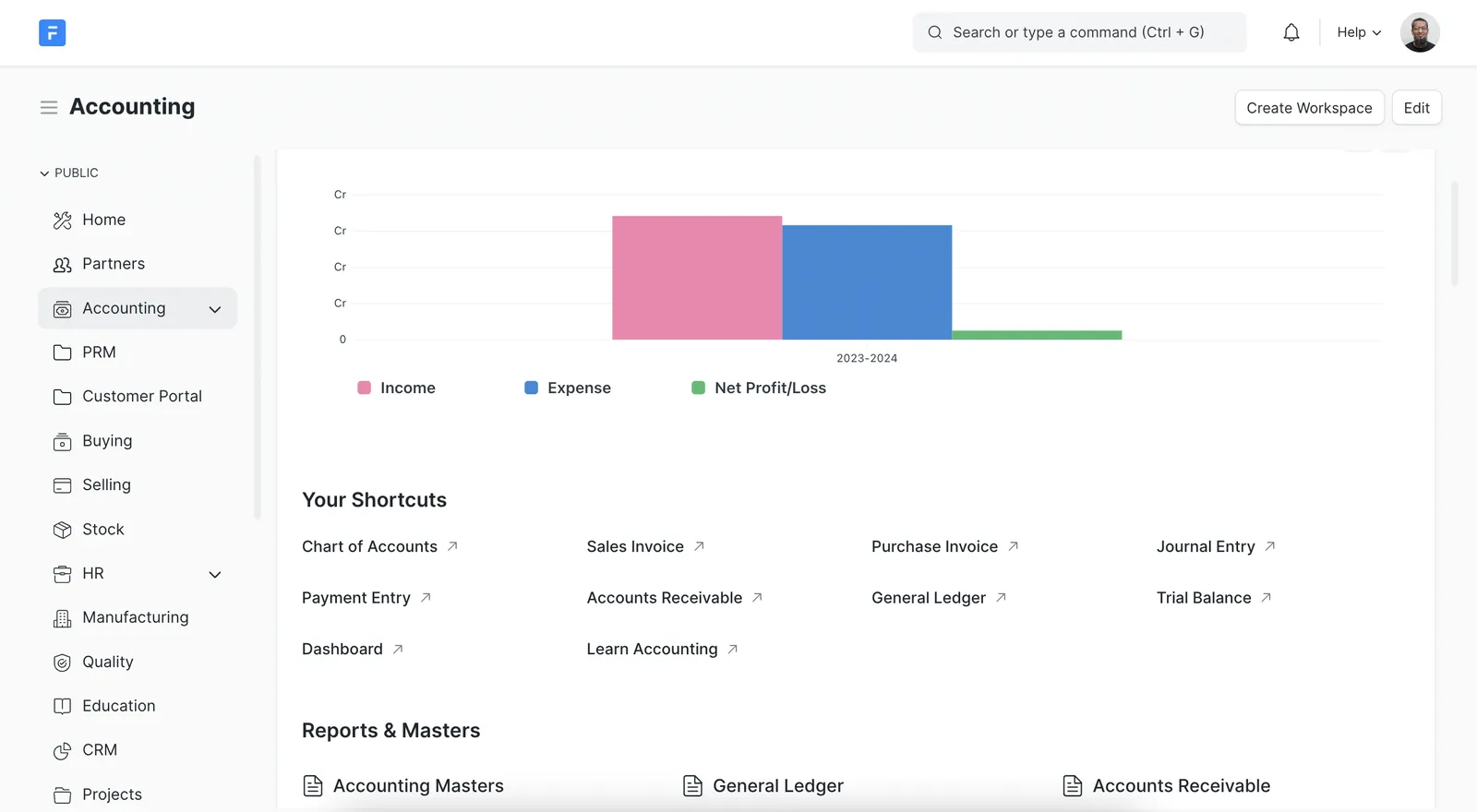
One screen with the numbers a small business owner checks daily: cash, sales, receivables and stock.
We configure ERPNext to support these rules. Confirm your obligations with your tax advisor.
Registration is mandatory once taxable supplies exceed AED 375,000 over 12 months, and voluntary from AED 187,500. ERPNext tax templates apply 5% VAT and print tax invoices with your TRN and required fields.
Corporate tax is 0% up to AED 375,000 of taxable income and 9% above. Small Business Relief for revenue up to AED 3 million applies to tax periods ending on or before 31 December 2026. Clean ERPNext books make the return easier; your advisor decides eligibility.
Businesses below AED 50 million revenue are expected to appoint an Accredited Service Provider by 31 March 2027 and send PINT AE e-invoices from 1 July 2027. Check the latest Ministry of Finance and FTA guidance, since dates have changed before.
General information, not tax or legal advice. Rules change; confirm current FTA, MOHRE and Ministry of Finance guidance with your advisor.
Small setups move fast because there are fewer people and processes. Durations below are typical ranges, not guarantees.
Durations are typical ranges; your plan is agreed after discovery.
We walk through how you quote, sell, buy and get paid, and agree what to switch on.
Company, chart of accounts, VAT templates, print formats, users and roles.
Customers, suppliers, items, opening stock and opening balances from Excel or your old tool.
Short sessions per role, then a supported first week of live invoicing.
We review the first VAT report with your accountant before filing.
Compare platforms and plan your first ERP.
We configure the system for the rules UAE businesses report against, and test it before go-live.
General information, not tax or legal advice. Confirm current requirements with the FTA, MOHRE or your advisor. See all UAE compliance guides.
On-site workshops in Dubai, Abu Dhabi and Sharjah, and remote or on-site delivery across the Northern Emirates and free zones.
Official sources and references
Facts on this page were checked against these sources in October 2026. Rules change, so confirm current requirements before acting.
Still have a question? Our consultants are happy to help.
Ask an ExpertNot if it is set up narrowly. We disable modules you do not need and simplify forms, so staff see only selling, buying, stock and accounts. The full system is still there when you grow.
There is no licence fee. You pay for hosting, either Frappe Cloud or a server, plus implementation and support. We quote after a short discovery call because scope varies a lot between businesses.
Yes. We import masters, opening balances and open invoices at a cut-off date. Historical transactions can be kept as reports or imported if needed.
ERPNext supports Arabic and right-to-left layouts, and we build bilingual print formats for tax invoices and quotations.
No. With Frappe Cloud or our managed hosting, updates and backups are handled for you, and our support team handles questions and changes.
Related Solutions
Related Industries
Related ERP Platforms
Tell us what you sell and how you invoice today, and we will propose a lean ERPNext setup for your business.
Dubai, United Arab Emirates