L
O
A
D
I
N
G


Zoho, Odoo, ERPNext, Dynamics 365 and custom ERP, delivered by one accountable team.

Schedule deliveries against real vehicle capacity, send drivers out with digital delivery notes and get signed proof of delivery and cash back into the ERP the same day.
ERP delivery management in the UAE covers everything between packing and customer signature: agreeing delivery dates on the order, planning trips by area and vehicle capacity, sending drivers out with digital delivery notes, capturing signed proof of delivery and photos, and reconciling cash or cheques the same day. Failed deliveries are recorded with a reason, and invoices move straight to collection.
An ERP for delivery management in the UAE covers what happens after goods are packed and before the customer signs: booking a delivery date or slot, grouping orders into trips, assigning vehicles and drivers, tracking progress, capturing proof of delivery, collecting cash or cheques, and dealing with deliveries that fail. For companies running their own vans and pickups, this is often where the most money leaks.
A typical picture in Dubai, Sharjah or Ajman: the sales team promises "tomorrow morning" on WhatsApp, the dispatcher builds the route on a whiteboard, drivers carry printed delivery notes that come back days later with coffee stains and missing stamps, and the accountant chases cash on delivery from drivers at the end of the week. Customers dispute deliveries and there is no signed copy to show.
This page is about managing deliveries made by your own fleet or by a contracted transporter for B2B and B2C orders. High-volume parcel operations are covered in ERP for last mile delivery, vehicle costs and maintenance in ERP for fleet management, and the warehouse steps before loading in pick, pack and ship.
These issues show up as customer complaints, unpaid invoices and drivers who work long hours without delivering more.
Salespeople promise delivery dates in calls and chats, but the warehouse plans from the order list. Urgent orders are discovered late and loaded on the wrong vehicle or not at all.
Dispatchers group orders by habit rather than by area and capacity. Vans cross between Al Quoz, Jebel Ali and Sharjah in one shift, while another vehicle returns half empty.
Signed delivery notes come back days later, unreadable or not at all. When a customer disputes receipt, finance cannot prove delivery and the invoice stays unpaid.
Drivers collect cash and cheques across many stops, then hand over a total at the end of the day or week. Short collections and missing cheques are hard to trace to a specific invoice.
The customer is closed, the site gate refuses entry or the contact does not answer. Goods come back on the truck without a reason code, stock is not returned to the system, and nobody reschedules.
A customer accepts eight of ten items because two are damaged. Unless the driver records it, the full invoice goes out and the dispute turns into a credit note later; see return management.
Each step updates the delivery note and the invoice status, so sales, dispatch, drivers and accounts work from one record.
One shared database: every step updates stock, finance and reports in real time.
Delivery management combines sales, stock, transport and cash control. These are the modules we configure.
Requested and committed dates, delivery address and time window held on the order; see sales order management.
Created from the order after packing, carrying quantities, batch or serial numbers and customer references.
Delivery trips grouping notes by area with stop sequence, vehicle and driver; map tools help sequence stops.
Vehicle capacity by weight and volume, driver assignment, and links to fleet records for fuel and service.
Stop list, navigation link, signature, photo, GPS stamp and reason codes for failed or partial deliveries.
Receipts recorded per stop against the invoice, with a driver cash account reconciled at the end of the trip.
Delivery confirmations and ETA messages by SMS, email or WhatsApp Business through an approved provider, with customer opt-in.
On-time delivery, failed delivery reasons, trips per vehicle and outstanding POD by driver.
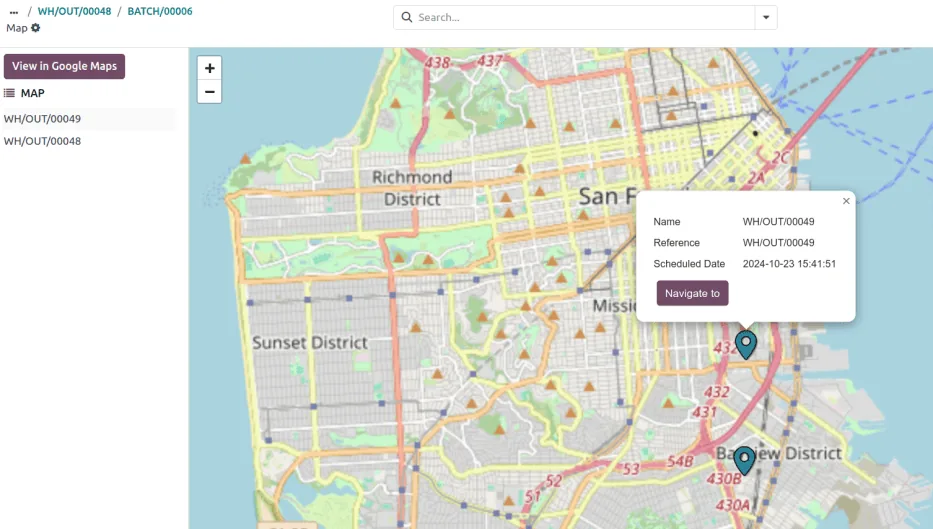
A delivery dashboard is checked twice a day: in the morning to release trips, and in the evening to close them.
All four platforms can manage delivery notes and proof of delivery. Trip planning and driver apps vary more, so check your edition and version.
| Zoho | Odoo | ERPNext | Dynamics 365 | |
|---|---|---|---|---|
| Delivery documents | Shipments with delivery status in Zoho Inventory | Delivery orders in Inventory, linked to sales orders | Delivery Note linked to Sales Order and Sales Invoice | Sales shipments in Business Central; shipments and loads in Supply Chain Management |
| Trip planning | Usually via a route planning app or a Zoho Creator extension | Batch transfers with dispatch management in recent versions; deeper routing via apps | Delivery Trip with driver, vehicle, stops and route optimization through a maps API | Shipping agents in Business Central; transportation management with load and route planning in SCM |
| Driver mobile app | Zoho Inventory mobile app or a custom Creator app | Mobile barcode and delivery validation; signature on delivery orders | Mobile-friendly Delivery Trip and Delivery Note, often extended | Power Apps or partner apps commonly used |
| Proof of delivery | Delivery status with attachments; signatures via an extension | Customer signature can be captured on the delivery order | Signature and photo via custom fields or apps | Typically via Power Apps or ISV solutions |
| Cash on delivery | Payments recorded in Zoho Books against invoices | Payments against invoices; driver cash journals configurable | Payment Entry per stop; driver cash account reconciliation | Cash receipt journals per driver |
| Customer notifications | Zoho workflows with email, SMS or WhatsApp providers | Automated emails; SMS and WhatsApp via apps | Notifications plus WhatsApp or SMS through integrations | Power Automate flows with messaging providers |
Capabilities change between releases. We confirm the fit on a sample of your real delivery routes before recommending a platform.
Delivery systems pull in maps, messaging and partners outside the ERP.
Delivery records support VAT, e-invoicing and customer data obligations. Confirm specifics with your tax advisor.
For goods, the date of supply is generally linked to delivery, invoice or payment, whichever comes first, so delivery dates matter for which VAT return a sale falls in. Keep the delivery date accurate in the ERP; see ERP for VAT compliance. Confirm with your tax advisor.
If invoices are raised on delivery, they will be exchanged as structured e-invoices through an accredited service provider once your company is in scope. Partial acceptance should change the invoice before it is issued. Check the latest MoF and FTA guidance for dates.
Delivery addresses, phone numbers, photos and signatures are personal data under the UAE Personal Data Protection Law. Limit driver app access to the current trip and set retention rules.
Signed delivery notes and POD records support the tax invoices and should be kept with the business records, generally for at least five years.
General information, not tax or legal advice. Rules change; confirm current FTA, MOHRE and Ministry of Finance guidance with your advisor.
Benefits come from planning with real data and closing every delivery the same day.
POD is available immediately, so disputed deliveries are settled with evidence and invoices move to collection; customer credit control works from facts.
Trips planned by area and capacity reduce empty running and overtime without adding vehicles.
Every dirham collected is linked to an invoice and a driver, so short collections surface the same day.
Customers get realistic dates and ETA messages, and failed deliveries are rescheduled rather than forgotten.
Most companies start with POD and cash control, then add trip planning. Durations are typical ranges.
Durations are typical ranges; your plan is agreed after discovery.
Map delivery areas, vehicle fleet, driver routines, COD rules and current documents.
Configure delivery notes, reason codes, driver app with signature and photo, and cash receipts.
Set vehicle capacities, delivery zones and trip templates; connect maps and notifications.
Run one area or vehicle group on the new process and compare closure time with the rest.
Extend to all drivers and review on-time and failed-delivery reports weekly.
We configure the system for the rules UAE businesses report against, and test it before go-live.
General information, not tax or legal advice. Confirm current requirements with the FTA, MOHRE or your advisor. See all UAE compliance guides.
On-site workshops in Dubai, Abu Dhabi and Sharjah, and remote or on-site delivery across the Northern Emirates and free zones.
Official sources and references
Facts on this page were checked against these sources in October 2026. Rules change, so confirm current requirements before acting.
Still have a question? Our consultants are happy to help.
Ask an ExpertIt is strongly recommended. A simple mobile app with stop list, signature and photo replaces paper delivery notes and lets finance see proof of delivery the same day. Rugged devices are only needed in harsh environments such as construction sites.
Yes. Trips can be assigned to an external transporter, with POD uploaded by them or received through their API. For parcel volumes, see ERP for courier companies and last mile options.
Record each collection against the invoice in the driver app, give each driver a cash account, and reconcile at the end of the trip against the deposit. Differences are visible per driver and per day instead of at month end.
Store site contact, gate pass requirements and time windows on the delivery address. Drivers can record gate refusals as a failed delivery reason, which helps sales agree realistic delivery windows with contractors.
Yes, through the WhatsApp Business Platform via an approved provider, using pre-approved message templates and only for customers who have opted in. Messages are triggered by trip and delivery status changes.
Basic stop sequencing is available in some platforms, such as ERPNext Delivery Trip with a maps API. For many vehicles and tight time windows, a dedicated routing service connected to the ERP usually works better.
Related Solutions
Related Industries
Related ERP Platforms
Share your delivery areas, fleet and COD rules and we will outline the trip, POD and cash process for your ERP.
Dubai, United Arab Emirates