
L
O
A
D
I
N
G


Zoho, Odoo, ERPNext, Dynamics 365 and custom ERP, delivered by one accountable team.

Leave looks simple until the balance in the HR spreadsheet, the manager's memory and the payroll deduction all disagree. A leave module built around UAE rules keeps one balance, one approval trail and one payroll effect.
UAE leave management software should apply the statutory entitlements in Federal Decree-Law No. 33 of 2021, including annual leave, tiered sick leave, maternity, parental, bereavement and study leave, plus company rules such as carry-forward caps and blackout periods. It keeps one balance, routes approvals, updates holiday calendars for Eid, and passes unpaid days to payroll before the WPS cut-off.
Leave management software in the UAE has to handle more than holiday requests. Under Federal Decree-Law No. 33 of 2021 and its implementing regulation, private-sector employees accrue annual leave (two days per month between six months and one year of service, then 30 calendar days a year), sick leave with full, half and unpaid tiers, maternity and parental leave, bereavement leave and study leave. On top of the legal minimums, most employers add their own rules: leave on joining anniversaries, blackout periods in peak season, carry-forward caps and paid annual air tickets that travel with annual leave.
In a typical Dubai trading or services company the process still runs on a paper or email form. The employee asks the line manager, the manager forwards to HR, HR updates an Excel balance sheet and, if someone remembers, payroll deducts unpaid days. Public holidays announced a few days before Eid fall on different dates each year, so leave that spans them is often counted wrongly. A proper leave module in your HR and payroll software replaces those hand-offs with a policy engine, an approval route and a balance that every party sees.
This page covers leave policies, balances, requests and approvals. The money side, paying leave salary before the employee travels or settling unused leave at exit, is covered on the leave salary calculation page, and clocking data is covered under biometric attendance integration.

These are the leave problems we see most often when UAE companies move from spreadsheets to an ERP.
The HR sheet shows 18 days, the employee's own count shows 24 and the manager approved 25. Every year-end becomes a negotiation instead of a report.
The law moves an employee from full pay to half pay to unpaid as sick days accumulate in a year. When this is tracked manually, payroll either overpays or deducts without a clear record of why.
Two storekeepers in the same warehouse get approved for the same Eid week because each manager only sees their own team. Operations find out when the shift is already short.
Leave approved by email after the payroll cut-off never reaches the payroll officer. The WPS salary file goes out at full pay and the correction lands a month later.
The flow below is the one we configure most often. Each step writes to the employee record, so the audit trail is automatic.
One shared database: every step updates stock, finance and reports in real time.
Leave touches several parts of the system. These are the modules that need to share the same employee and policy data.
Annual, sick, maternity, parental, bereavement, study, unpaid and compensatory leave with rules for accrual, eligibility and documents required.
Public holiday lists per company, emirate or site, with the option to treat holidays inside a leave period as non-deductible.
Staff check balances, apply, attach medical certificates and cancel requests from a phone. See our employee self-service portal page for the wider portal.
Routes by department, leave type and duration, with delegation when a manager is away.
Approved leave marks the day correctly, so absence without leave shows up as an exception rather than a blank.
Unpaid and half-paid days post as deductions in the right pay period, and leave salary is paid when policy requires.
Joining date, probation end, contract type and policy group drive eligibility automatically.
Balance registers, liability reports and absence trends by department, site and leave type.
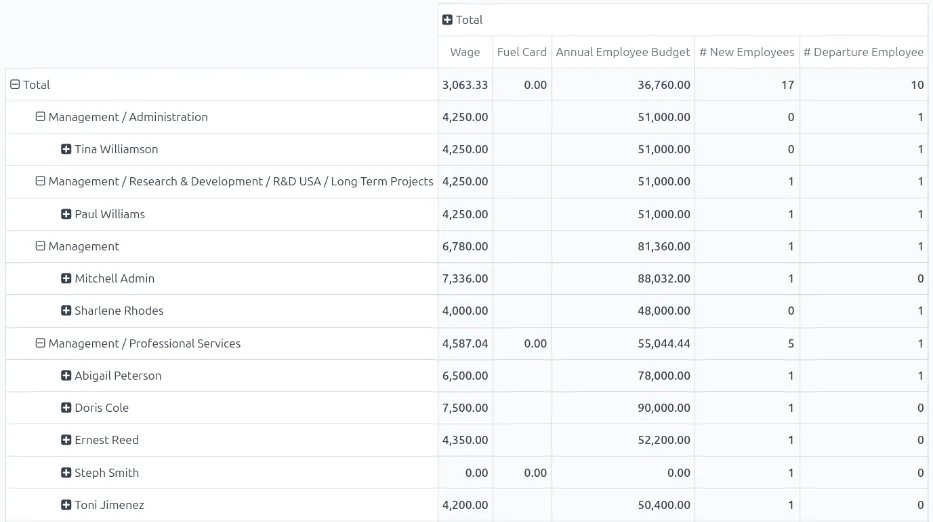
A leave dashboard should answer three questions quickly: who is away, what is pending, and how much leave liability the company is carrying.
All four platforms we implement cover the core leave process. The differences are in how policies are configured and how tightly leave links to payroll.
| Zoho | Odoo | ERPNext | Dynamics 365 | |
|---|---|---|---|---|
| Where leave lives | Zoho People (Leave module) | Time Off app | Frappe HR (Leave Application, Leave Policy) | Leave and absence in Dynamics 365 Human Resources capabilities; Business Central has basic absence registration |
| Accrual rules | Accrual and reset rules per leave type | Accrual plans with milestones and caps | Leave Policy with earned leave frequency | Leave plans with accrual schedules; confirm for your edition |
| UAE sick leave tiers | Configurable with separate leave types or custom rules | Usually configured as separate types or a small customization | Configurable via leave types and salary components | Typically configured or handled through a UAE payroll add-on |
| Approval routing | Multi-level approvals per policy | Manager and HR officer validation | Leave approver per employee or department, plus workflows | Workflow approvals; often extended with Power Automate |
| Mobile requests | Zoho People mobile app | Odoo mobile and web portal | Frappe HR mobile app and web portal | Employee self-service; Teams integration in recent versions |
| Link to payroll | Zoho Payroll in supported regions; confirm UAE scope | Odoo Payroll (Enterprise) work entries | Native Salary Slip deductions and Leave Encashment | Usually a partner payroll solution for the UAE |
Capabilities change between editions and releases. We confirm the exact fit for your version during discovery.
Leave data is only useful when the rest of the HR stack sees it.
These are the points we check with HR and, where needed, the client's legal advisor before go-live. This is configuration guidance, not legal advice.
Configure annual, sick, maternity, parental, bereavement and study leave at no less than the minimums in Federal Decree-Law No. 33 of 2021 and its implementing regulation, and record the basis for any more generous company policy.
Staff employed in DIFC or ADGM fall under those zones' own employment laws, which differ on some entitlements. Keep them in a separate policy group rather than overriding the mainland rules.
Unpaid leave and half-paid sick days change the amount in the Salary Information File. Lock the leave cut-off before the WPS run so the bank file matches the payslip.
Untaken annual leave is generally settled at exit based on basic wage. Make sure the balance the ERP holds is the one the final settlement uses, and confirm your policy with a legal advisor.
General information, not tax or legal advice. Rules change; confirm current FTA, MOHRE and Ministry of Finance guidance with your advisor.
The benefits are practical rather than dramatic, and they show up from the first payroll cycle.
Employees, managers and HR see the same accrued, taken and remaining days, which ends year-end disputes.
Unpaid and partly paid days reach payroll before the cut-off instead of in the following month.
Team calendars show overlaps before approval, so peak periods are not left short-staffed.
Finance can book the leave accrual from the system rather than estimating it at year-end.
Durations are typical ranges for a single entity; groups with several policies or entities take longer.
Durations are typical ranges; your plan is agreed after discovery.
Collect contracts, the staff handbook and current balance sheets, and agree each leave type and rule.
Set up leave types, accruals, holiday calendars, approvers and notifications.
Reconcile and import closing balances per employee, signed off by HR.
Run requests in the system while checking results against the old sheet.
Short sessions for managers and a one-page guide for staff using the mobile app.
We configure the system for the rules UAE businesses report against, and test it before go-live.
General information, not tax or legal advice. Confirm current requirements with the FTA, MOHRE or your advisor. See all UAE compliance guides.
On-site workshops in Dubai, Abu Dhabi and Sharjah, and remote or on-site delivery across the Northern Emirates and free zones.
Official sources and references
Facts on this page were checked against these sources in October 2026. Rules change, so confirm current requirements before acting.
Still have a question? Our consultants are happy to help.
Ask an ExpertYes, with the right setup. Most platforms do this by tracking sick days used in the year and mapping them to full-pay, half-pay and unpaid portions that payroll reads. Some need a small rule or customization, which we scope during discovery.
The holiday calendar is updated when the official dates are announced. Requests that span the holidays are then recalculated so those days are not deducted from annual leave.
Yes. Policies are assigned by company, location, grade or contract type, so a mainland LLC, a free zone company and DIFC or ADGM staff can each follow their own rules in one system.
The remaining balance feeds the final settlement. The calculation of what is paid is covered on our leave salary calculation page, and the wider exit process on the employee offboarding page.
No. Each platform offers a mobile app or web portal where staff apply, attach certificates and see their balance. Site workers without email can usually use a phone number login or a kiosk.
Most platforms allow approval from a notification, the mobile app or a list view. We usually set rules so short requests need one approver and long or unpaid leave goes to HR as well; see HR approval workflows for options.
Related Solutions
Related Industries
Related ERP Platforms
Share your leave policy and current balance sheet, and we will show how it would run in Zoho, Odoo, ERPNext or Dynamics 365.
Dubai, United Arab Emirates