
L
O
A
D
I
N
G


Zoho, Odoo, ERPNext, Dynamics 365 and custom ERP, delivered by one accountable team.

An employee self service portal moves payslips, leave, letters and personal data updates out of HR's inbox and onto the employee's phone, with every request routed for approval.
In a UAE employee self service portal, staff can view payslips and leave balances, apply for leave, request salary certificates, NOC and experience letters, update personal and bank details, and see visa and Emirates ID expiry dates. Requests route to line managers and HR for approval. Site workers without smartphones can use a kiosk or a supervisor-on-behalf option, and payslips must match the MOHRE WPS salary file.
In most UAE companies the HR desk spends a large part of each week answering the same questions: how many leave days do I have, can I get my payslip for the bank, when does my visa expire, can you issue a salary certificate addressed to the embassy. An employee self service portal (ESS) answers these from the system itself. The employee logs in on a phone or a shared kiosk, sees their own data, and raises requests that go straight into the approval chain.
The portal matters more here than in many markets because of the workforce mix. A Dubai contractor may have 40 office staff on laptops and 600 site workers who share a phone, read Hindi, Urdu, Malayalam or Arabic better than English, and cannot come to head office during working hours. A well-designed ESS gives both groups the same service: office staff use the web portal, site workers use a mobile app or a kiosk at the labor camp, and supervisors can raise requests on behalf of their crew.
ESS is not a separate product you bolt on. It is the front end of your HR and payroll software: leave balances come from the leave module, payslips from payroll, document expiry from the employee file. If those modules are wrong, the portal simply shows wrong data faster. That is why we scope the portal together with the HR core, not after it.

These are the patterns we see when HR requests still run on email, paper forms and WhatsApp in UAE businesses.
Salary certificates, NOC letters for travel or a new visa, and experience letters are typed in Word from a template, checked against payroll by hand and signed one by one. A request from a site worker can take a week because nobody owns the queue.
Employees keep their own count, managers keep another, and HR's spreadsheet is a third. Disputes surface at the end-of-service calculation, when the stakes are highest.
Many companies email PDF payslips from a shared mailbox or hand out printed copies at the camp. Workers without email ask HR for copies whenever a bank or landlord wants one.
Visa, Emirates ID, labor card and driving license expiry dates live in a spreadsheet. When the employee changes passport or renews a license, HR hears about it only if someone remembers to send a copy.
Advance requests, leave approvals and address changes are agreed on WhatsApp between employee and supervisor, with no record HR can audit. When the supervisor leaves, the history leaves with them.
A new bank account or IBAN arrives on a scrap of paper and is typed into the payroll sheet but not the HR file. The next WPS file is rejected or salary lands in a closed account.
This is the pattern we configure for a typical request such as a salary certificate, a leave application or a bank detail change. The same skeleton serves most request types; only the approvers and the output change.
One shared database: every step updates stock, finance and reports in real time.
The portal is only as useful as the data behind it. These are the modules we connect to it, in roughly the order a UAE company needs them.
Personal details, emergency contacts, bank and IBAN, visa sponsor and dependants, with employee-editable fields flagged for HR verification.
Live balances by leave type, team calendar and application with attachments such as a sick note, drawn from your leave management rules.
Monthly payslips, year-to-date earnings and loan balances published once payroll is locked, so nobody sees a draft.
Salary certificate, NOC, experience letter and bank letter templates merged with live data and an approved signatory.
Copies of passport, visa, Emirates ID and licenses with expiry reminders, linked to employee document management.
Employees see their punches from the biometric device and request corrections for missed punches or site work.
Claims with receipt photos and salary advance requests, recovered automatically through payroll once approved.
Push notifications for approvals, payslip availability and expiring documents, with a kiosk mode for shared devices at camps.
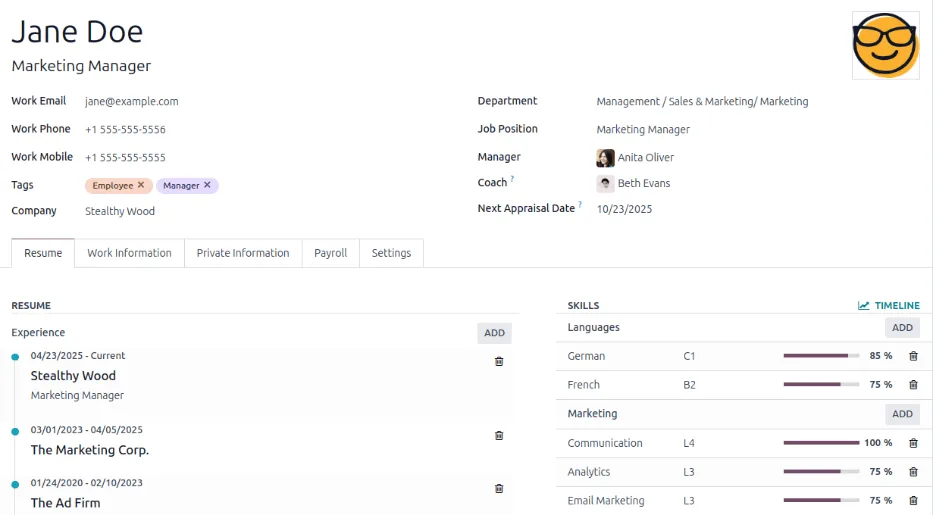
The HR team gets a queue instead of an inbox. The reports we usually set up first are listed below.
All four platforms we implement offer self service; they differ in mobile experience, licensing of portal users and how much configuration is needed for UAE letters. Confirm details for your edition before deciding.
| Zoho | Odoo | ERPNext | Dynamics 365 | |
|---|---|---|---|---|
| Where ESS lives | Zoho People web portal and mobile app, with Zoho Payroll for payslips | Employee profile, Time Off, Expenses and Payroll apps through the Odoo web and mobile interface | Frappe HR with its employee mobile app and web portal | Employee self-service workspace in Dynamics 365 human resources |
| Leave and attendance requests | Native leave and attendance requests with approval flows | Time Off and Attendances apps with manager approval | Leave application, attendance request and shift request doctypes | Leave and absence requests with workflow approval |
| Payslip access | Payslips published to employees from Zoho Payroll | Payslips visible to employees in Payroll (Enterprise) | Salary slips emailed or available in the portal | Usually depends on the payroll solution used alongside, often a partner add-on for UAE |
| UAE letters (salary certificate, NOC) | HR letters with templates; custom fields often added | Usually configured through document templates or Studio | Print formats and letter templates configured per request type | Typically configured through templates or Power Platform |
| Shared device or kiosk use | Check current kiosk options for your plan | Kiosk mode available in Attendances | Possible with a custom kiosk page | Usually through a Power Apps front end |
| User licensing for workers | Per-employee pricing on most plans | Per-user licensing; portal-style access depends on edition | Open source, no per-user license fee | Per-user licensing; check team member license fit |
Product capabilities change often. We confirm the current edition and license terms during discovery.
Self service saves the most time when requests trigger work in other systems automatically.
A portal holds personal data and produces documents that banks and authorities rely on, so a few rules shape the design.
Federal Decree-Law No. 45 of 2021 on personal data protection, and the separate DIFC and ADGM data protection regimes for companies there, call for access limited to what each person needs. Employees see only their own data, managers see their team, and HR roles are separated. See our notes on PDPL and ERP data protection.
Payslips in the portal must match the Salary Information File sent through WPS. We publish payslips only after payroll is locked so what the employee sees equals what MOHRE receives.
Approved requests, issued letters and profile changes stay in the employee file with timestamps, which supports later disputes and audits.
General information, not tax or legal advice. Rules change; confirm current FTA, MOHRE and Ministry of Finance guidance with your advisor.
We do not promise numbers before seeing your request volumes, but these are the benefits companies usually see.
Balance, payslip and document questions are answered by the portal, so HR time goes to cases that need judgment.
Salary certificates and NOCs are generated from live payroll data and approved in one queue instead of typed by hand.
Employees keep contacts and bank details current, and HR verifies the change once instead of re-keying it in several files.
Every request shows who approved it and when, which helps in labor disputes and at the end-of-service calculation.
Timelines depend on headcount, how clean your HR data is, and whether HR and payroll are being implemented at the same time.
Durations are typical ranges; your plan is agreed after discovery.
List every request type HR handles today, its approvers and its output, and decide which go live first.
Fix employee master data, leave balances and document expiry dates, because the portal will expose any error.
Set up request forms, approval routes, letter templates in English and Arabic, and role permissions.
Run with office staff and one site crew, including the kiosk or supervisor-on-behalf flow.
Activate logins in waves, run short sessions at camps, and retire the old email and paper channels.
We configure the system for the rules UAE businesses report against, and test it before go-live.
General information, not tax or legal advice. Confirm current requirements with the FTA, MOHRE or your advisor. See all UAE compliance guides.
On-site workshops in Dubai, Abu Dhabi and Sharjah, and remote or on-site delivery across the Northern Emirates and free zones.
Official sources and references
Facts on this page were checked against these sources in October 2026. Rules change, so confirm current requirements before acting.
Still have a question? Our consultants are happy to help.
Ask an ExpertYes. We usually combine a kiosk or shared tablet at the camp or site office with a supervisor-on-behalf option, so the supervisor raises a leave or advance request for a crew member. The request still sits in that employee's file.
Zoho, Odoo, ERPNext and Dynamics 365 all support Arabic interfaces, and some support further languages; check the current list for your edition. Letter templates can be produced in English and Arabic.
They can submit the change, but we route it to HR or payroll for verification before it reaches the WPS file. Direct editing of IBANs is a common source of failed salary transfers and fraud risk.
No, it supports them. New joiners can complete forms and upload documents through the portal, but the onboarding checklist itself is covered in employee onboarding software, and exit clearance in the offboarding process.
We configure delegation so requests go to a deputy while the manager is away, plus escalation if a request sits too long. The rules are described in our page on the HR approval workflow.
For around 30 employees, a simple portal for leave and payslips is often enough. Larger groups, such as an ERP for a 500-employee company, usually add letters, document expiry and expense claims in the first phase.
Related Solutions
Related Industries
Related ERP Platforms
Tell us your headcount and the requests HR handles today, and we will map a self service portal on the platform that fits.
Dubai, United Arab Emirates