L
O
A
D
I
N
G


Zoho, Odoo, ERPNext, Dynamics 365 and custom ERP, delivered by one accountable team.

A good forecast is not a single number typed by the sales director. It combines deal-level calls, repeat business and seasonality, and it is checked against what actually happened.
A UAE business should forecast sales by combining a weighted pipeline for new deals, a run-rate from ERP invoice history for repeat business, and seasonality factors for Ramadan, Eid, the summer slowdown and Q4. Salespeople tag deals as pipeline, best case or commit, managers adjust with notes, and forecast snapshots are compared with invoiced actuals each month to track accuracy by person and team.
Sales forecasting software UAE finance and sales leaders ask for usually replaces a spreadsheet that is rebuilt every month from salespeople's estimates. The result is optimistic in the first week and quietly revised in the last. Purchasing, cash flow planning and hiring all depend on that number, so a weak forecast spreads well beyond the sales team.
UAE businesses face particular patterns. Demand often shifts around Ramadan and Eid, slows for many sectors in July and August when people travel, and peaks around Q4 events and year-end budgets. Project-based suppliers depend on a few large tenders with uncertain award dates, while distributors depend on steady reorders from retail and HORECA accounts. One forecasting method rarely fits both, which is why the software must support more than one.
Forecasting sits between the sales pipeline and planning. It takes open deals and recurring business and turns them into an expected figure per month, team and product group. It is different from sales target management: the target is what you want, the forecast is what you expect, and the gap between them is what management acts on.

These problems appear in almost every forecasting review we run.
Salespeople send a figure by email and nobody can see which deals sit behind it. When the month closes short, there is no way to tell whether the error came from timing, value or lost deals.
Forecasts list only new opportunities, while most revenue for a trading company comes from existing customers reordering. The total is understated, then padded by managers to compensate.
Stage probabilities are set once and never compared with real win rates. A 60% stage that historically converts at 25% inflates every weighted forecast.
Monthly forecasts treat Ramadan or August like any other month. Purchasing orders stock for demand that arrives later, or not at all.
The forecast lives in a slide deck, so purchasing and production plan from their own assumptions. Stockouts and excess stock follow.
Without comparing the forecast with invoiced sales, nobody learns which salesperson or segment is consistently off.
The cycle combines system calculation with a human call, and keeps a snapshot so accuracy can be measured.
One shared database: every step updates stock, finance and reports in real time.
Some come with the CRM, others from the ERP or a BI tool. The combination matters more than any single feature.
Each deal tagged as pipeline, best case, commit or closed, so the forecast shows a range instead of one number.
Deal value multiplied by a stage probability that is reviewed against real win rates every quarter.
Average monthly sales per key account or product group from ERP invoices, adjusted for known changes.
Month-by-month factors from past years so Ramadan, summer and Q4 patterns are built in rather than guessed.
A frozen copy of each submitted forecast, so later accuracy reports compare like with like.
Forecasts rolled up from salesperson to team, branch, emirate and company, with manager overrides kept visible.
Forecast against actual by month, person and product group, showing bias toward over or under forecasting.
Forecast quantities by product group passed to purchasing or production planning in the ERP.
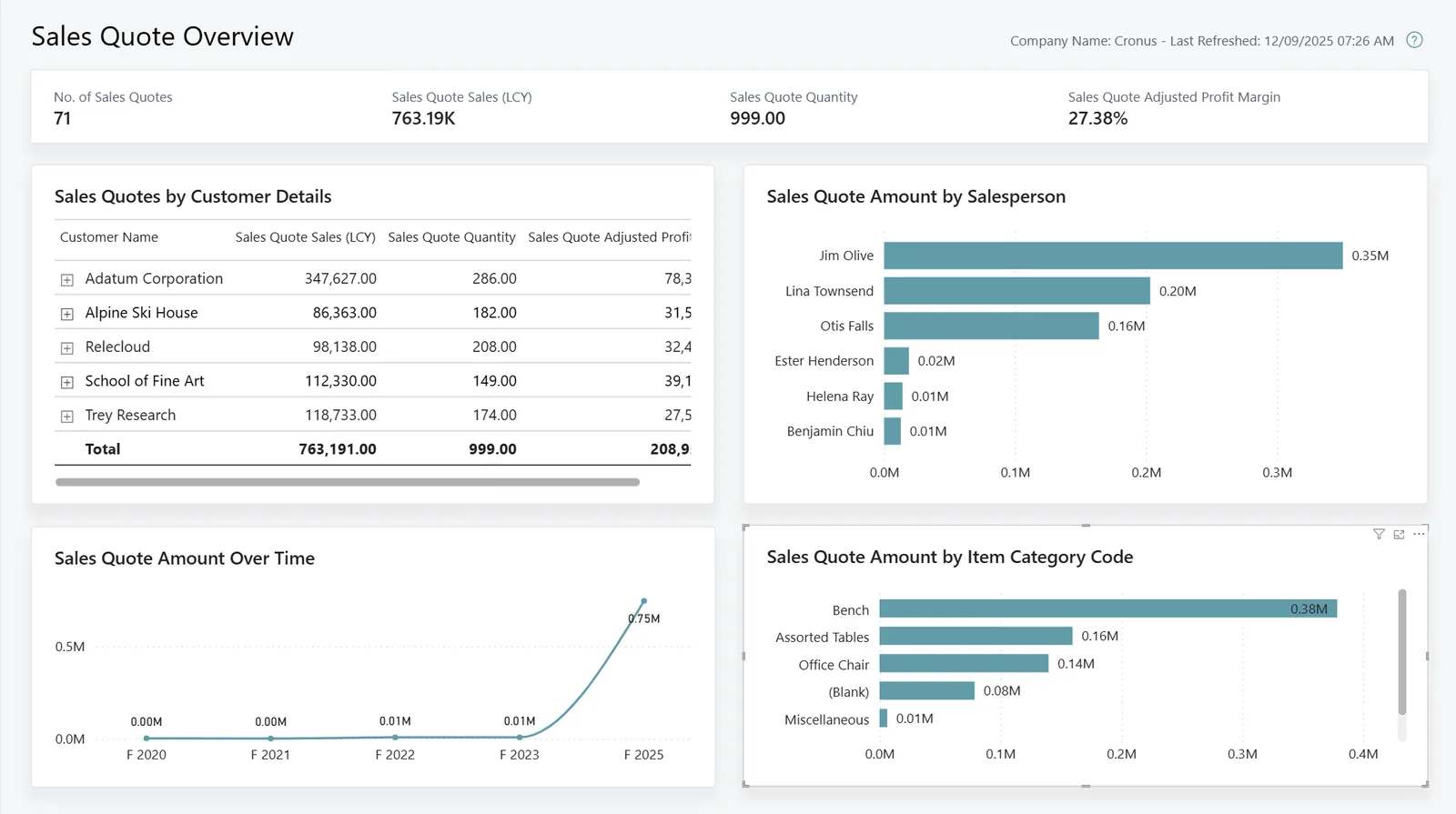
One screen showing what is expected, how confident the team is, and how good last month's call was.
Native forecasting depth varies a lot between platforms and editions. Many teams combine the CRM with a BI tool. Confirm features for your edition.
| Zoho | Odoo | ERPNext | Dynamics 365 | |
|---|---|---|---|---|
| Native forecast | Forecasts feature in Zoho CRM with targets by role or territory (higher editions) | Forecast view in CRM grouped by expected closing month | Sales Pipeline Analytics and custom reports; no full forecasting module | Forecasting in Dynamics 365 Sales; advanced options in premium tiers |
| Forecast categories | Supported through deal fields and forecast settings | Typically via custom fields or stage grouping | Custom fields on Opportunity | Forecast categories built in |
| Run-rate from invoices | Zoho Analytics on Zoho Books or Inventory data | Sales analysis and spreadsheet reporting on invoices (Enterprise spreadsheets) | Sales Analytics and query reports on invoices | Power BI on Business Central or finance data |
| Snapshots | Forecast periods stored in the forecast module | Usually exported or captured with a custom model | Custom doctype or scheduled export | Forecast snapshots available in forecasting |
| AI predictions | Zia predictions in higher editions | Predictive lead scoring; forecasting AI limited | External ML or LLM tools via API | Predictive forecasting with Copilot and Sales Premium |
| BI option | Zoho Analytics | Power BI or Odoo spreadsheets | Power BI or Metabase | Power BI |
Hedged summary as of 2026; check current edition documentation.
A forecast is only as good as the data under it. These are the feeds we usually connect.
Forecasts are management information, but they draw on tax and personal data. Confirm treatment with your advisors.
Build forecasts and actuals on values excluding the 5% VAT and net of credit notes, so they reconcile with revenue in the ledger rather than gross invoice totals.
Finance often uses the sales forecast to estimate taxable income for the 9% corporate tax regime and to check whether thresholds such as Small Business Relief remain relevant. Confirm positions with your tax advisor.
Forecast reports contain customer names and deal notes. Limit access by role in line with the UAE PDPL.
General information, not tax or legal advice. Rules change; confirm current FTA, MOHRE and Ministry of Finance guidance with your advisor.
We do not quote accuracy percentages. These are the improvements teams typically see once the cycle is in place.
Commit and best case ranges make shortfalls visible weeks earlier, while there is still time to act.
Purchasing plans from the same forecast as sales, so stock follows expected demand rather than habit.
Stage probabilities are recalibrated from real win rates, so weighted figures stop inflating.
Accuracy by salesperson shows who forecasts well and who needs coaching.
Indicative ranges; projects that start with a clean pipeline move faster.
Durations are typical ranges; your plan is agreed after discovery.
Agree categories, horizon, hierarchy, run-rate logic and seasonality factors with sales and finance.
Clean open deals, load two or more years of invoice history and map product groups.
Forecast settings in the CRM, snapshot process and dashboards in the CRM or BI tool.
Run the new forecast beside the old spreadsheet and compare both with actuals.
Pass forecast quantities to purchasing or production planning.
We configure the system for the rules UAE businesses report against, and test it before go-live.
General information, not tax or legal advice. Confirm current requirements with the FTA, MOHRE or your advisor. See all UAE compliance guides.
On-site workshops in Dubai, Abu Dhabi and Sharjah, and remote or on-site delivery across the Northern Emirates and free zones.
Official sources and references
Facts on this page were checked against these sources in October 2026. Rules change, so confirm current requirements before acting.
Still have a question? Our consultants are happy to help.
Ask an ExpertA weighted forecast multiplies each deal's value by its stage probability and adds them up. A commit forecast is the salesperson's judgment of which deals will definitely close. Showing both gives management a range and exposes overconfidence.
Use invoice history from the ERP to calculate a run-rate per key account or product group, adjusted for seasonality and known changes such as a lost listing. This sits beside new-deal forecasting rather than inside the pipeline.
AI models can suggest a forecast from history and pipeline signals, and are useful as a second opinion. They still need human review. Our AI sales forecasting page explains where it helps and its limits.
They overlap. Sales forecasting predicts revenue by customer and deal; demand forecasting predicts quantities by item for purchasing and production. Our forecasting software page covers the wider planning side.
Monthly for most UAE SMEs, reviewed by the sales lead as part of the routine we describe for ERP for sales managers, with a quick weekly update of the commit figure in the last weeks of each month or quarter. Project-based companies may add a quarterly review of large tenders.
Inside the CRM for salespeople and in a sales dashboard for management, often in Power BI or Zoho Analytics, alongside actual orders and invoices.
Related Solutions
Related Industries
Related ERP Platforms
We design the forecasting method with your sales and finance leads and set it up in your CRM and BI tools.
Dubai, United Arab Emirates