
L
O
A
D
I
N
G


Zoho, Odoo, ERPNext, Dynamics 365 and custom ERP, delivered by one accountable team.

A target that lives in a slide deck changes nothing. Loaded into the ERP by month, territory and product group, it becomes a number every salesperson can track every day.
UAE companies should split the annual sales budget by territory, product group, key account and salesperson, phase it by month using their own sales history for Ramadan, summer and year-end patterns, and load it into the ERP or CRM. Achievement is then measured daily from invoices net of credit notes and excluding 5% VAT, with monthly variance reviews.
Sales target management UAE companies need starts with a simple question: how does the annual sales budget become a monthly number for each salesperson, territory and product group, and how does everyone see progress against it? In many companies the answer is a spreadsheet prepared by the owner or sales director in December, emailed once, and then compared with an accounting export at month end. Salespeople do not know where they stand until the month is over.
Good target management covers four things. Setting: building the annual number top-down from the business plan and bottom-up from accounts and pipeline. Allocation: splitting it by emirate or territory, product group, key account and person. Phasing: distributing it across months to reflect Ramadan, summer and year-end patterns rather than dividing by twelve. Tracking: measuring achievement from ERP invoices net of credit notes and VAT, visible daily.
This page focuses on that target lifecycle. How performance is then scored and rewarded is covered under sales performance management, and the expected outcome, as opposed to the goal, under sales forecasting.

These issues make targets feel arbitrary to salespeople and unreliable to management.
The annual target is divided by twelve, so salespeople miss in Ramadan and summer months and overshoot in Q4. Morale drops mid-year for reasons that were predictable.
A salesperson covering the Northern Emirates gets the same number as one covering central Dubai. The target reflects headcount, not market size.
Reports count invoice totals including VAT and ignore credit notes and returns posted later. Achievement looks better than real revenue, and finance and sales argue over the numbers.
Only a total value is set, so salespeople push easy, low-margin lines. New product launches and focus brands get no attention.
When a salesperson joins, leaves or swaps territory, targets are adjusted informally. Year-to-date comparisons break and incentives are disputed.
Salespeople ask accounts for their number. By the time they know they are behind, there is no time to recover.
From annual plan to daily tracking, with a formal step for mid-year revisions.
One shared database: every step updates stock, finance and reports in real time.
Most ERP and CRM platforms store targets; the difference is in how many dimensions and how flexibly they can be phased.
Company, branch, emirate or territory, team and salesperson levels that roll up and can be compared.
Separate values or quantities for item groups or brands, so focus lines get their own number.
Targets for major customers or retail chains, tracked alongside the owning salesperson's total.
Phasing percentages per month, based on last year's pattern or set manually, applied to any target.
Net invoiced value excluding VAT, less credit notes and returns, attributed by salesperson and territory at invoice date.
New joiners, leavers and territory swaps recorded with dates so targets are pro-rated and history stays correct.
Target, achievement, variance and run-rate needed to close the gap, by any dimension.
Salespeople see month-to-date achievement on their phone, including van sales routes.
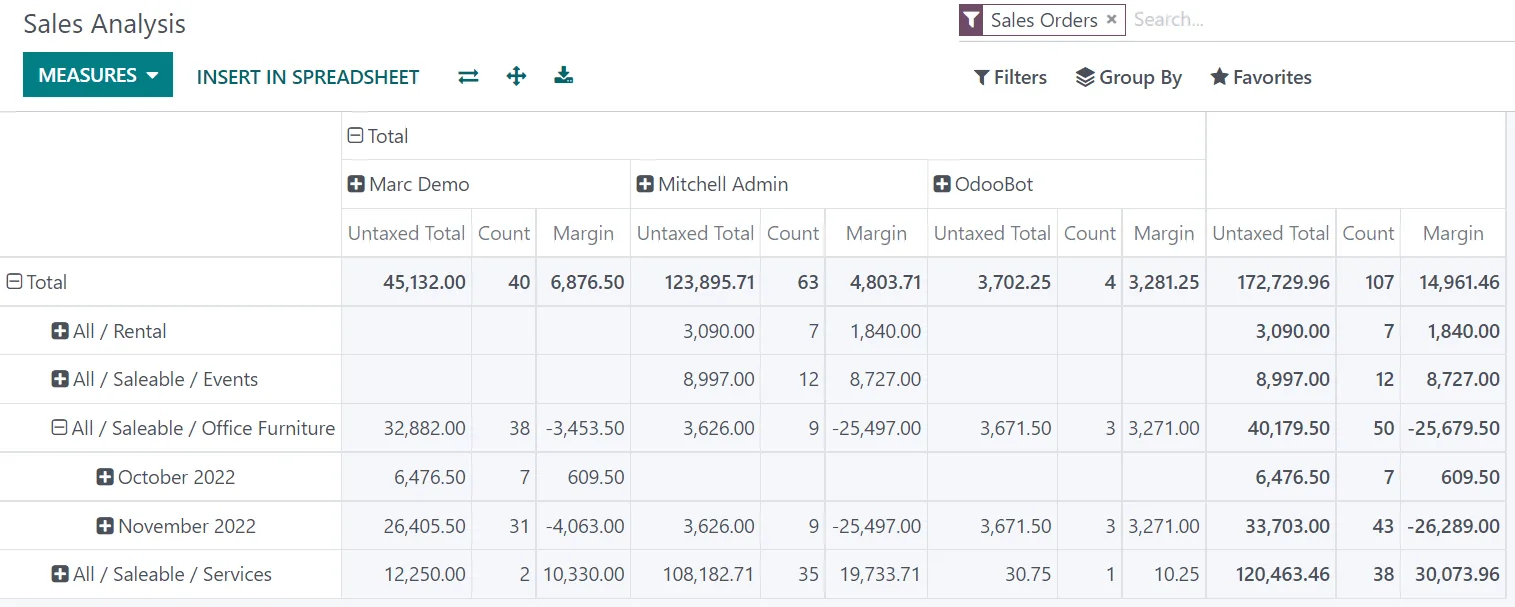
A daily view for salespeople and a monthly review view for managers, from the same data.
Target support ranges from simple goals to multi-dimension targets with monthly distribution. Confirm for your edition.
| Zoho | Odoo | ERPNext | Dynamics 365 | |
|---|---|---|---|---|
| Where targets live | Forecast targets in Zoho CRM (higher editions); Zoho Analytics for detailed targets | Invoicing target per sales team; Gamification goals per person | Targets on Sales Person, Territory and Sales Partner | Goal management on users and territories |
| Product group split | Usually in Zoho Analytics or custom modules | Custom fields or reporting layer | Target Detail by item group natively | Goal metrics with rollup queries; often Power BI |
| Monthly phasing | Forecast periods; custom for seasonal patterns | Monthly targets via goals or custom | Monthly Distribution doctype applied to targets | Goal periods; seasonal phasing via Power BI or custom |
| Achievement source | Deals won or Zoho Books invoices | Invoiced amounts in Odoo Accounting | Sales Orders or Sales Invoices, net of returns | Opportunities or Business Central invoices |
| Variance reporting | Forecast reports and Analytics dashboards | Sales team dashboard and spreadsheet reports | Sales Person Target Variance reports | Goal charts and Power BI |
| Field visibility | Zoho CRM mobile | Odoo mobile | ERPNext mobile and van sales apps | Dynamics 365 Sales mobile |
Hedged summary as of 2026; check current documentation for your version.
Targets connect planning, selling and paying incentives. These are the links we usually build.
Targets themselves are internal, but the figures behind them must reconcile with tax records. Confirm treatments with your tax advisor.
Set and measure targets on values excluding the 5% VAT, so achievement equals the revenue in the ledger and in the VAT return, not the gross amount collected.
Tax credit notes reduce both revenue and output VAT. Deduct them from achievement in the month they are issued so targets and the books stay aligned.
The sales target usually forms the revenue line of the annual budget, which finance also uses to plan for the 9% corporate tax. Keep one approved version in the system; see our budgeting software page.
General information, not tax or legal advice. Rules change; confirm current FTA, MOHRE and Ministry of Finance guidance with your advisor.
We do not promise uplift figures. These are the changes teams usually notice.
Phasing and territory potential make monthly numbers realistic, so salespeople commit to them.
Daily visibility shows a gap in the second week, not after the month closes.
Product group targets put focus lines and new launches on every salesperson's agenda.
Sales, finance and HR use the same achievement figure for reviews and incentives.
Indicative ranges; best started two or three months before the new financial year.
Durations are typical ranges; your plan is agreed after discovery.
Agree dimensions, phasing method, achievement rules and revision policy.
Assign every customer to a territory and salesperson, and every item to a product group.
Target structures, monthly distribution, variance reports and dashboards.
Upload approved targets from the budget template and check roll-ups.
Run monthly reviews from the system and refine reports.
We configure the system for the rules UAE businesses report against, and test it before go-live.
General information, not tax or legal advice. Confirm current requirements with the FTA, MOHRE or your advisor. See all UAE compliance guides.
On-site workshops in Dubai, Abu Dhabi and Sharjah, and remote or on-site delivery across the Northern Emirates and free zones.
Official sources and references
Facts on this page were checked against these sources in October 2026. Rules change, so confirm current requirements before acting.
Still have a question? Our consultants are happy to help.
Ask an ExpertUsually both. Management sets the company number from the business plan, salespeople and managers propose numbers from their accounts and pipeline, and the two are reconciled before approval. The system holds the final agreed version.
Use monthly phasing based on your own sales history rather than an equal split. Ramadan moves about eleven days earlier each year, so recalculate the phasing each budget cycle.
Most companies use invoices net of credit notes, because that matches revenue in the books. Some track orders too for an early signal; see sales order management.
Yes. Targets can be held at territory level and rolled up, with salespeople assigned to territories by date. Our sales territory management page covers territory design across the emirates.
Achievement against target often drives incentive slabs. The approved achievement feeds the commission calculation; our salesman commission software page explains the rules.
ERPNext has detailed native targets by item group with monthly distribution; Odoo uses sales team targets and goals; Zoho and Dynamics 365 often combine CRM goals with Analytics or Power BI. See Odoo Sales for one example.
Related Solutions
Related Industries
Related ERP Platforms
We design your target model and set up allocation, phasing and daily tracking in your ERP or CRM.
Dubai, United Arab Emirates