
L
O
A
D
I
N
G


Zoho, Odoo, ERPNext, Dynamics 365 and custom ERP, delivered by one accountable team.

Judging salespeople on invoiced revenue alone rewards the wrong behavior. A balanced scorecard built from CRM and ERP data shows who sells profitably and gets paid.
Sales performance management combines CRM activity and pipeline data with ERP invoices, margins, returns and collections into a balanced scorecard per salesperson. UAE companies typically weigh net sales, gross margin, collections, new accounts and activity, calculate incentives in the system rather than Excel, and often pay part or all of commission only on collected amounts, through payroll and WPS.
Sales performance management UAE companies need goes beyond a monthly sales report. It is the cycle of measuring what each salesperson and team achieves, understanding why, rewarding it fairly and coaching where results fall short. The data comes from two places: the CRM, which records activity, pipeline and win rates, and the ERP, which records invoices, margins, returns and collections.
In many UAE trading, distribution and services companies, the only measure is invoiced sales against target, pulled from accounting at month end. That rewards discounting, ignores whether the customer pays, and tells the manager nothing about how the result was achieved. A salesperson can hit the number with one large, low-margin order that is still unpaid 120 days later, while a colleague with healthy margins and prompt collections looks average.
This page covers the measurement and improvement side: scorecards, incentive rules, coaching reviews and the reports behind them. Setting and allocating the numbers themselves is covered on our sales target management page, and the commission calculation engine on salesman commission software.

These patterns cause disputes, wrong incentives and good salespeople leaving.
Salespeople are ranked on invoiced value, so discounting to close is rewarded. Margin and customer quality do not appear anywhere in the review.
Commission is calculated on billing, then the customer pays late or not at all. Recovering incentive later is awkward and damages morale.
Finance calculates commissions in Excel from exported data. Salespeople challenge credit notes, split deals and returns every month, and the payroll cut-off slips.
Managers cannot see how many visits, calls or proposals sit behind a result, so they cannot tell whether a weak month is effort, skill or territory.
Van sales and merchandising staff work across emirates with little data captured. Performance is judged on route totals with no detail on strike rate or outlet coverage.
Reviews become opinion. Without stage conversion and loss reasons by person, managers cannot pinpoint where a salesperson struggles.
A monthly cycle that runs from data capture to payout and coaching, with a sign-off step before incentives go to payroll.
One shared database: every step updates stock, finance and reports in real time.
These capabilities span CRM, ERP and payroll. The integration between them is what makes the scorecard trustworthy.
Weighted measures per role, such as net sales, gross margin, collections, new accounts and activity, shown against target.
Gross margin per invoice line using item cost from the ERP, so discounting shows in the results.
Receipts matched to invoices so incentives can be released only on collected amounts if that is your policy.
Visits, calls, meetings and proposals logged from desktop or mobile, including GPS check-ins for field staff.
Slabs, accelerators, product-group rates, split credit and clawbacks calculated by the system and shown to each salesperson.
Team and individual rankings on agreed measures, used carefully to motivate rather than embarrass.
Review notes and agreed actions stored with the scorecard, so the next review starts from last month's commitments.
Approved incentives exported as a payroll component for the WPS salary run.
Managers and salespeople should look at the same numbers, with the salesperson seeing only their own detail.
Native support differs, particularly for incentives. Many companies combine CRM data with a BI tool or a custom incentive module. Confirm for your edition.
| Zoho | Odoo | ERPNext | Dynamics 365 | |
|---|---|---|---|---|
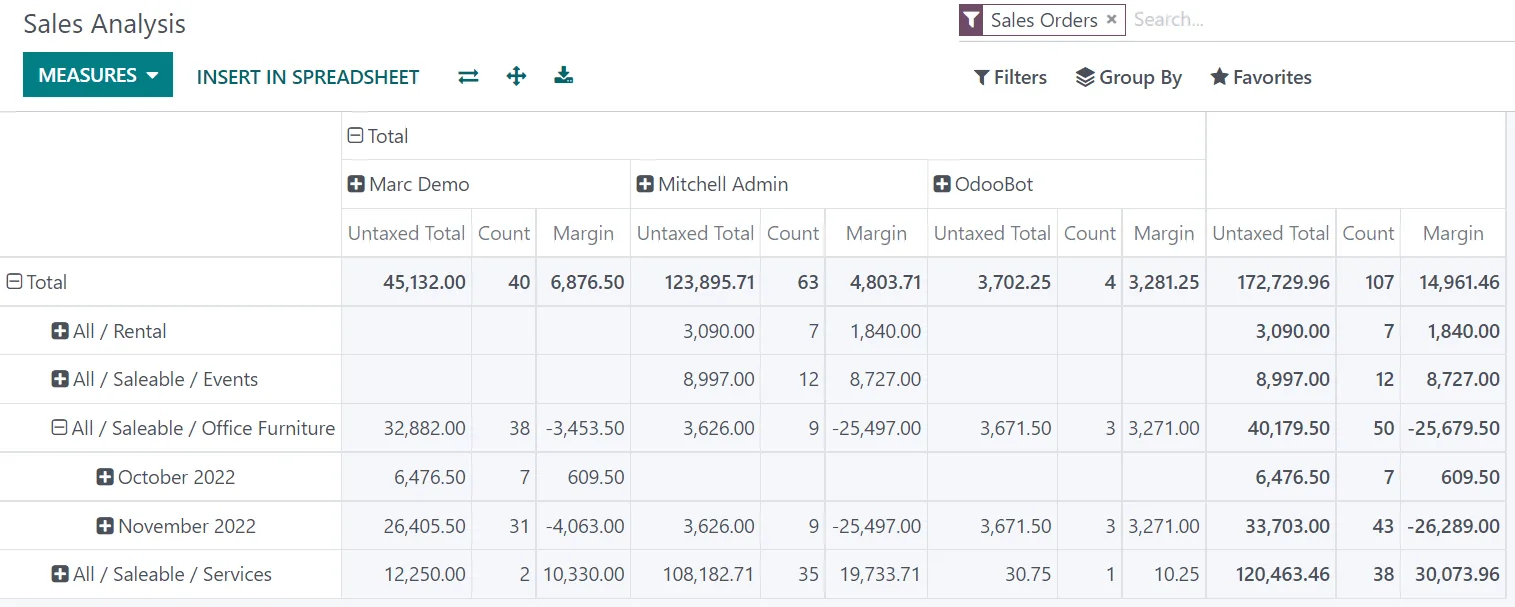
| Performance reporting | CRM reports, Zoho Analytics on CRM and Books data | Sales and invoicing analysis by salesperson; spreadsheet dashboards | Sales Person-wise Transaction Summary and target variance reports | Sales dashboards and Power BI |
| Margin by salesperson | Via Zoho Books or Inventory data in Analytics | Margin on sales orders and invoices (cost-based) | Gross Profit report filterable by sales person | Typically Power BI on Business Central data |
| Gamification and goals | Gamescope (edition dependent) | Gamification app with goals and challenges | Custom or through Sales Person targets | Goal management and Sales accelerator metrics |
| Commission calculation | Custom functions or Zoho Creator app; marketplace extensions | Commission features in recent versions; otherwise custom | Commission rate on Sales Person and Sales Partner; slabs usually custom | Usually a partner solution or Power Platform app |
| Field activity | Zoho CRM mobile with check-ins | Odoo mobile and field visits via activities | Mobile app and custom visit doctype | Dynamics 365 Sales mobile |
| Payroll link | Zoho Payroll where available, or export | Odoo Payroll inputs | HRMS payroll additional salary | Export to payroll system |
Hedged summary as of 2026; feature names and availability change between releases.
A scorecard is only accepted if every number traces back to a source document.
Practical considerations only; confirm specifics with your HR and legal advisors.
Commissions and incentives paid to employees normally form part of salary payments processed through the Wage Protection System. The approved amount should flow into the SIF of the payroll run, not be paid separately in cash.
End-of-service gratuity under Federal Decree-Law No. 33 of 2021 is based on basic wage. Write incentive terms clearly into offer letters so that commission is not confused with basic salary; confirm with your labour advisor.
Scorecards and coaching notes are personal data. Under the UAE PDPL, restrict access so salespeople see only their own detail and managers only their team.
General information, not tax or legal advice. Rules change; confirm current FTA, MOHRE and Ministry of Finance guidance with your advisor.
Outcomes depend on management follow-through. These are the improvements teams commonly describe.
When margin and collections are on the scorecard, heavy discounting stops being the easiest route to a bonus.
Salespeople see the same calculation as finance, drawn from the same invoices and credit notes.
Conversion and loss data show exactly where each person needs help.
Approved incentives arrive in payroll on time instead of after weeks of reconciliation.
Indicative ranges; incentive schemes with many exceptions take longer to automate.
Durations are typical ranges; your plan is agreed after discovery.
Agree measures, weights, incentive slabs, collection rules and clawbacks with sales, HR and finance.
Make sure every invoice carries the salesperson, cost is reliable and receipts are allocated.
Scorecards, incentive calculation, approval step and payroll export.
Run the system beside the spreadsheet and resolve differences before going live.
Review weights and slabs against results and adjust for the next period.
We configure the system for the rules UAE businesses report against, and test it before go-live.
General information, not tax or legal advice. Confirm current requirements with the FTA, MOHRE or your advisor. See all UAE compliance guides.
On-site workshops in Dubai, Abu Dhabi and Sharjah, and remote or on-site delivery across the Northern Emirates and free zones.
Official sources and references
Facts on this page were checked against these sources in October 2026. Rules change, so confirm current requirements before acting.
Still have a question? Our consultants are happy to help.
Ask an ExpertTypically four to six: net sales against target, gross margin, collections or overdue receivables, new accounts, and one or two activity or conversion measures. Weights differ by role, so a key account manager and a van salesman should not share one scorecard.
Many UAE companies pay part on invoicing and the rest on collection, or pay only on collected amounts for credit customers. The system can support either; the choice is a policy decision for management.
Through the mobile app: outlets visited against plan, strike rate, drop size and collections per route. Our van sales software and mobile sales app pages explain the data captured.
Yes, by recording territory assignments with effective dates and attributing sales by territory owner at the invoice date. See sales territory management for how to design the territory structure.
It can motivate when the measures are fair and include margin and collections. Publicly ranking only revenue often backfires. Many teams share rankings within the team and keep detailed scorecards private.
In a sales dashboard that combines CRM and ERP figures, reviewed in a monthly one-to-one with each salesperson.
Related Solutions
Related Industries
Related ERP Platforms
We help you design scorecards and incentive rules and build them on your CRM, ERP and payroll data.
Dubai, United Arab Emirates