
L
O
A
D
I
N
G


Zoho, Odoo, ERPNext, Dynamics 365 and custom ERP, delivered by one accountable team.

Every maintenance job starts as a request: a tenant on WhatsApp, a call to the helpdesk, an email from a client's admin team. If that first step is messy, the SLA is already at risk before a technician is assigned.
Service request management in the UAE gives facility and field service companies one queue for requests arriving by WhatsApp, phone, email, portal or walk-in. Each request is logged with location and asset, prioritized, acknowledged, converted into a work order, and closed only after requester sign-off. The SLA clock starts when the request arrives, so response reports reflect what actually happened.
Service request management in the UAE is the front door of facility and field service operations. It covers how a request is received, logged, classified, prioritized, acknowledged, converted into work and finally closed with the requester's confirmation. In a typical Dubai or Abu Dhabi FM company, requests arrive from residential tenants, commercial occupants, retail mall units, owners' association managers and corporate clients under an annual contract, and each group expects a fast, visible response.
The problem is rarely the technical fix. It is the gap between the call and the job. A helpdesk agent writes "AC not cooling, flat 1204" on a spreadsheet, the supervisor forwards a screenshot to a WhatsApp group, nobody records when the clock started, and three days later the client asks for a report nobody can produce. A proper request process inside the facility management software gives each request an ID, a category, a priority, a location and an owner from the first minute.
This page focuses on intake and triage. Execution of the job itself is covered on the maintenance work order software page, and contractual response and resolution targets are covered under SLA management. Here we look at the steps that decide whether those targets are even measurable.

These patterns show up in UAE FM, property and service companies that still run their helpdesk on email, phone notes and chat groups.
Tenants message the building manager's personal WhatsApp, clients email the account manager, and walk-ins tell the security guard. No single list shows how many requests are open or how old they are.
When the request is logged hours after it was received, response time looks better on paper than it was in reality. Clients who track their own complaints notice the difference and dispute the monthly report.
Five residents report the same lift fault and create five jobs, while a request that says only "water leak" gives no unit, floor or photo. Technicians waste trips confirming basics that should have been captured at intake.
Under most AMCs some requests are covered and others, such as tenant damage or upgrades, are billable. If nobody flags this at intake, the job is done for free and the quotation never goes out.
Jobs are marked complete by the technician with no requester sign-off, photo or feedback. Repeat complaints for the same fault are then logged as new requests instead of reopened ones.
A request moves through these stages, with the SLA clock and notifications driven by the system rather than by memory.
One shared database: every step updates stock, finance and reports in real time.
Service request management draws on several modules working on the same customer, location and asset records.
Ticket queue with categories, priorities, assignment rules and status history for every request.
Requesters log issues with photos, track progress and confirm closure without calling the helpdesk.
Buildings, floors, units and equipment so each request points to an exact place and asset.
Checks whether the request is covered by an AMC or service contract, or must be quoted.
Turns an approved request into a job for the right trade, with the request history attached.
Technicians see the request details and photos, and capture signatures and after-photos on site.
Chargeable requests flow to a quotation, then a VAT-compliant invoice once the work is accepted.
Request volumes, ageing, repeat faults and satisfaction scores by building, client and category.
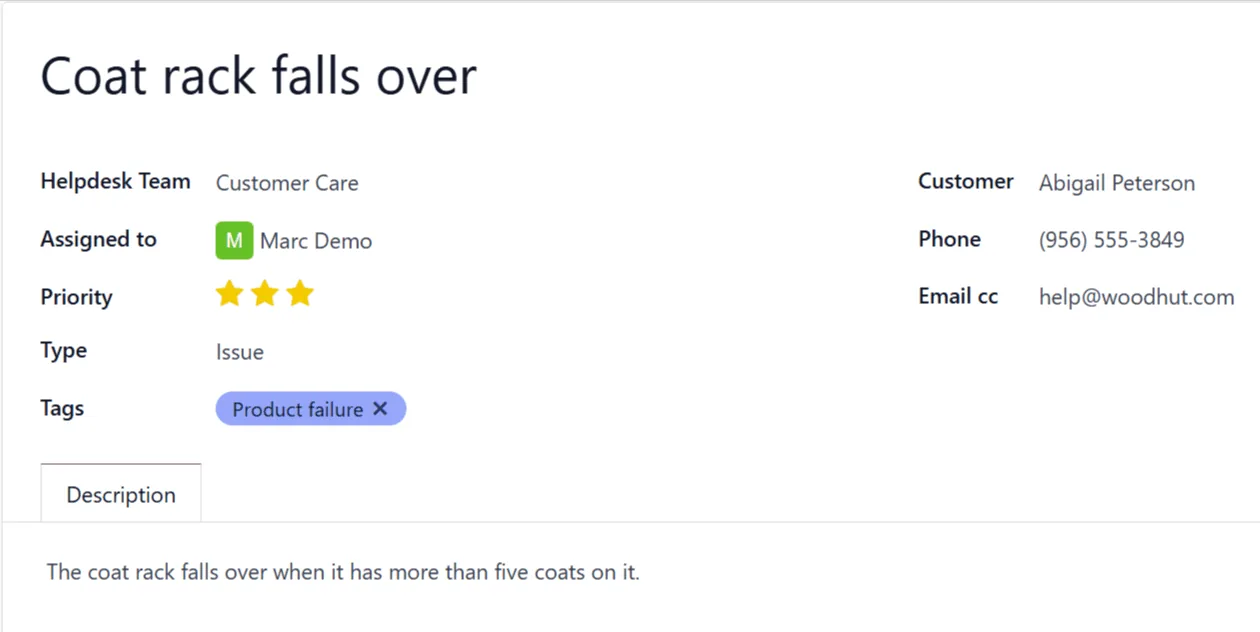
A helpdesk dashboard keeps the queue visible so supervisors can act before requests breach their targets.
All four platforms we implement can run a structured request process. The right one depends on your volumes, channels and whether you also need full field service and accounting in the same system.
| Zoho | Odoo | ERPNext | Dynamics 365 | |
|---|---|---|---|---|
| Request intake | Zoho Desk tickets from email, web forms, phone and social channels | Helpdesk app (Enterprise) with email aliases, website form and live chat | Issue doctype from email, web form and support portal | Customer Service cases from email, portal and other channels |
| Priority and SLA clock | SLA policies and escalation rules in Zoho Desk | SLA policies by team, priority and customer | Service Level Agreement settings on Issues | Entitlements and SLA KPIs on cases |
| Link to location or asset | Custom fields, or assets in Zoho FSM | Equipment from the Maintenance app or custom fields | Link to Serial No, Asset or custom location doctype | Customer assets and functional locations in Field Service |
| Convert to job | Hand-off to Zoho FSM work orders via integration | Create a Field Service task from the ticket | Create Maintenance Visit or custom job doctype | Convert case to work order in Field Service |
| Requester portal | Zoho Desk help center | Customer portal for tickets | Website portal for Issues | Power Pages portal, typically configured per project |
| Billing chargeable work | Zoho Books or Zoho Invoice | Sales and Invoicing in the same database | Sales Invoice in the same database | Invoicing via Business Central or Finance, depending on setup |
Capabilities vary by edition and licence. Confirm the current feature set for your edition before deciding.
Most requests in the UAE arrive through messaging and phone, so the integrations matter as much as the ticket screen.
Requests contain personal data and often lead to invoices, so a few UAE rules shape how the process is configured.
Requests hold names, mobile numbers, unit numbers and photos inside homes. Under the UAE Personal Data Protection Law, restrict access by role, keep only what you need, and agree retention rules with your legal advisor.
Billable work outside an AMC needs a tax invoice with your TRN and the prescribed fields at 5% VAT. Configure the request-to-invoice flow so the tax treatment is set correctly; confirm specific cases with your tax advisor.
B2B invoices raised from service requests will fall under the UAE e-invoicing model through Accredited Service Providers. Our e-invoicing guide for service companies explains the timing; check the latest Ministry of Finance and FTA guidance.
Keep request history, sign-offs and related invoices for at least 5 years (7 for real estate), in line with UAE tax record-keeping rules.
General information, not tax or legal advice. Rules change; confirm current FTA, MOHRE and Ministry of Finance guidance with your advisor.
The benefits come from visibility and from removing manual re-entry between channels and jobs.
The clock starts when the request arrives, so monthly SLA reports reflect reality and stand up to client review.
Location, asset and photos at intake mean technicians arrive with the right tools and parts the first time.
Requests outside the contract are flagged early and quoted, rather than absorbed as free work.
Automatic updates at each stage reduce "any news?" calls and give residents and clients confidence the issue is moving.
A focused service request rollout is often live in 6-10 weeks, longer if it is part of a full FM or field service implementation.
Durations are typical ranges; your plan is agreed after discovery.
Map channels, request categories, priorities, contracts and the hand-off to technicians.
Configure categories, SLA rules, locations, assets, portal and notification templates.
Connect WhatsApp, email, telephony and QR codes, and link to work orders and invoicing.
Run one building or client on the new process and tune categories and rules.
Extend to all sites, train helpdesk agents and supervisors, and review the first month's reports.
We configure the system for the rules UAE businesses report against, and test it before go-live.
General information, not tax or legal advice. Confirm current requirements with the FTA, MOHRE or your advisor. See all UAE compliance guides.
On-site workshops in Dubai, Abu Dhabi and Sharjah, and remote or on-site delivery across the Northern Emirates and free zones.
Official sources and references
Facts on this page were checked against these sources in October 2026. Rules change, so confirm current requirements before acting.
Still have a question? Our consultants are happy to help.
Ask an ExpertA service request is what the customer or occupant reports. A work order is the job your team plans and executes to resolve it. One request can create several work orders, and some requests are resolved without a visit, for example by remote reset or advice.
Yes. Through the WhatsApp Business Platform via an approved provider, incoming messages can create a ticket and send back the reference number using an approved template. Tenants must opt in to receive updates, and agents still review unclear requests before they are dispatched.
Link requests to a location and asset. When a new request is logged for an asset that already has an open request, the system can warn the agent or merge it as a child, so one job serves all reporters and each still gets updates.
If you bill chargeable work, track contract coverage and need cost per building, keeping requests in the same system as contracts and invoicing avoids double entry. A separate helpdesk can work when it is properly integrated; see our helpdesk software page for that comparison.
AI can suggest a category, detect language and summarize long messages, but a human should confirm priority for safety-related faults. Our page on AI for customer service covers realistic uses.
We implement Zoho, Odoo, ERPNext and Dynamics 365, and recommend based on your request volumes, contract model and existing systems. Larger FM operators with complex scheduling often look at Dynamics 365 Field Service, while many SMEs run well on Odoo or Zoho.
Related Solutions
Related Industries
Related ERP Platforms
Tell us how requests reach you today and we will map a request-to-closure process that fits your contracts and channels.
Dubai, United Arab Emirates