
L
O
A
D
I
N
G


Zoho, Odoo, ERPNext, Dynamics 365 and custom ERP, delivered by one accountable team.

A technician without the right capacitor, filter or contactor means a second visit and a breached SLA. A store full of parts nobody uses means cash locked on shelves. Spare parts management sits between the two.
UAE facility management, MEP and maintenance teams should manage spare parts through a parts catalogue with manufacturer numbers and alternates, stock held by main store, site container and technician van as separate locations, and every issue linked to a work order. Min-max reorder rules protect critical spares for chillers, lifts and fire pumps, while ageing reports show obsolete parts tied up on shelves.
Spare parts management in the UAE is the control of maintenance, repair and operations (MRO) parts held by facility management companies, MEP contractors, building owners, hotels, hospitals and factories. Unlike trading stock, these parts are not sold for profit. They are consumed on jobs, so the questions are different: is the critical spare available when the chiller fails, which job used this compressor, and is the cost recoverable from the client or covered by the contract?
In many UAE maintenance teams the main store is a container or room in the basement of a client building, plus stock in a dozen technician vans. Parts are bought locally in Deira, Al Quoz or Sharjah Industrial Area on cash purchase, carried straight to site and never recorded. At month-end, the storekeeper's Excel sheet does not match finance, and nobody can explain why filter consumption doubled. A spare parts process inside your inventory management software ties every part movement to a store, a technician and a job.
This page covers the parts side of maintenance: catalogue, stocking policy, issue, return and replenishment. How the job itself is planned and executed is covered in maintenance work order software, and planned servicing schedules are covered under preventive maintenance software. If you sell parts as a business, for example vehicle parts, see our page on ERP for auto parts trading instead.
These are the issues we see most often when maintenance stores run on spreadsheets or a stock module that was set up for sales.
The one spare belt for a large AHU or the controller board for a lift was used months ago and never reordered. When the asset fails in July, the lead time from the supplier becomes your downtime.
Technicians carry consumables and common spares in their vans, but the system treats the van as empty. Parts disappear, get double-counted or are bought again on petty cash while sitting in another van.
Parts are taken from the store without a work order reference. Contract profitability reports then show labor only, and chargeable parts above the AMC limit are never invoiced to the client.
The same filter exists under four names and sizes are written differently by each storekeeper. Reorder levels become meaningless and buyers order items that are already in stock.
Spares for replaced equipment stay on the shelf for years. Without age and last-movement reports, they are never returned, sold or written down, and stock valuation is overstated.
Faulty parts under supplier warranty are thrown away instead of returned, and unused parts from finished jobs stay in vans instead of going back to stock.
Parts follow the job: reserved when the work is planned, issued when it starts, and returned or charged when it closes.
One shared database: every step updates stock, finance and reports in real time.
These modules share item, location and job data so stores, technicians, buyers and finance see one version of stock.
Part numbers, manufacturer references, alternates, units of measure and the assets each part fits.
Main store, site containers and each van as separate locations with transfers between them.
Reorder levels by location and criticality, with purchase requests suggested automatically.
Requests, RFQs, POs and GRNs with supplier lead times and preferred vendors per part.
Parts planned, reserved and consumed against each job, including chargeable flags.
Scan to issue, transfer and count, from the store counter or the technician's phone.
Serial numbers for high-value spares and warranty dates for supplier claims.
Valuation, consumption cost to contracts and write-downs posted to the ledger.
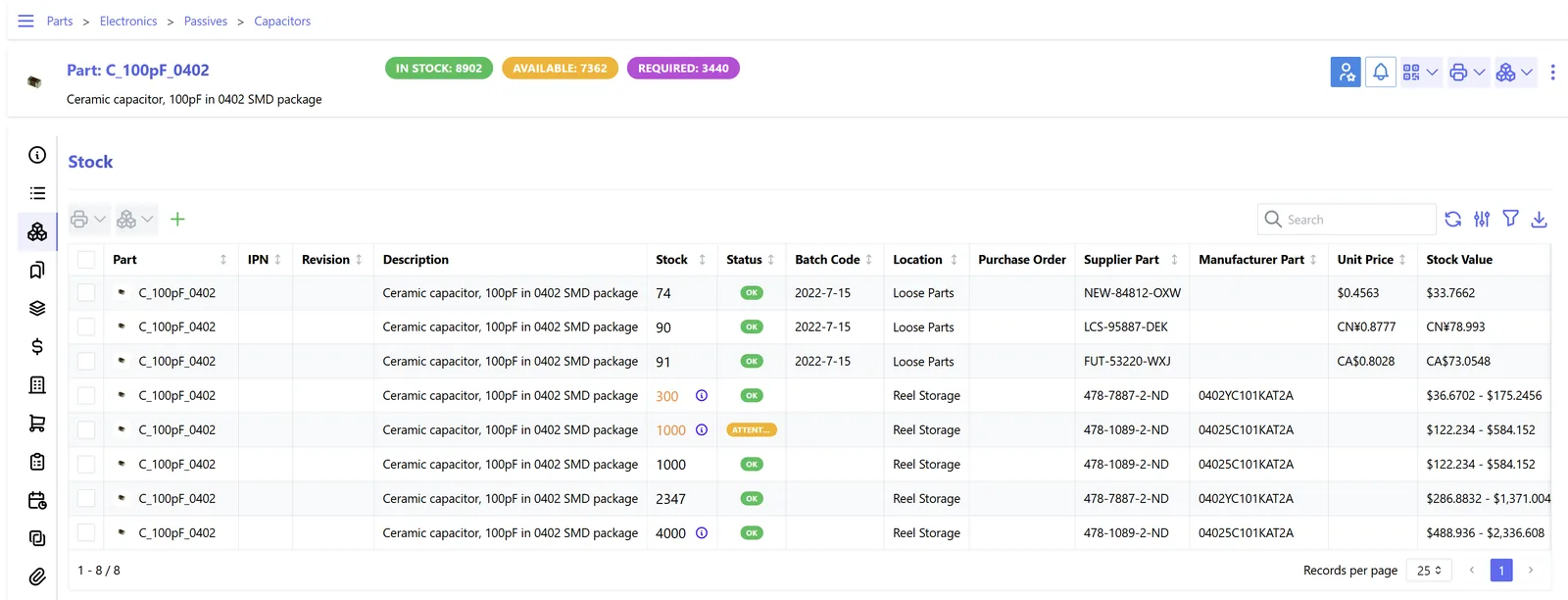
Stores supervisors and operations managers use these reports to balance availability against cash tied up in stock.
Each platform can manage maintenance stores well when configured for it. The differences are in how parts link to jobs and how much is standard versus configured.
| Zoho | Odoo | ERPNext | Dynamics 365 | |
|---|---|---|---|---|
| Multi-location stock | Zoho Inventory warehouses; vans can be set up as locations | Inventory locations and sub-locations, including vans | Warehouse tree with group and child warehouses | Warehouses and locations; technician warehouses in Field Service |
| Parts on jobs | Parts added to Zoho FSM work orders, synced with Zoho Inventory | Components on Field Service tasks or Repair orders | Items on Maintenance Visit, Asset Repair or Stock Entry | Products on work orders deduct from the assigned warehouse |
| Reordering | Reorder points with alerts | Min-max replenishment rules per location | Reorder level and quantity per warehouse, with auto Material Request | Coverage and planning settings, depending on edition |
| Serial and batch | Serial and batch tracking available | Lots and serial numbers | Serial No and Batch doctypes | Tracking dimensions for serial and batch |
| Barcode scanning | Mobile app scanning | Barcode app and mobile scanning | Barcode fields and scanning in stock forms | Warehouse mobile app, with setup |
| Cost to contract | Via FSM and Books, may need customization | Analytic accounts per contract or building | Cost centers and project costing | Financial dimensions per contract or site |
Feature names and availability depend on edition and version. Confirm details for your edition.
Parts data is only useful when it connects to the jobs that consume it and the suppliers that replenish it.
Parts are inventory for tax and accounting purposes, even though they are consumed rather than sold.
Input VAT on parts bought from VAT-registered suppliers needs valid tax invoices to be recovered. Parts recharged to clients carry 5% VAT on the invoice. Confirm specific treatments with your tax advisor.
Spares imported from overseas suppliers attract customs duty on most goods and import VAT, which VAT-registered businesses typically account for through the reverse charge on the VAT return. Keep customs declarations linked to the GRN.
Financial statements used for corporate tax should reflect slow-moving or obsolete spares properly. Ageing reports support write-down decisions; discuss the policy with your auditor.
Purchase invoices, customs documents and stock records should be kept for at least 5 years under UAE tax record-keeping rules.
General information, not tax or legal advice. Rules change; confirm current FTA, MOHRE and Ministry of Finance guidance with your advisor.
The gains show up in fewer return visits, cleaner contract margins and less cash on shelves.
Technicians know which parts are in their van and the nearest store before they leave for the job.
Every part issued carries a work order reference, so profitability reports include materials, not just labor.
Ageing and last-movement reports show which spares to return, reuse or write down.
Min-max rules on critical spares reduce cash buying at premium prices when assets fail.
Most of the effort is in cleaning the catalogue and counting stock. A focused rollout often takes 6-12 weeks.
Durations are typical ranges; your plan is agreed after discovery.
Merge duplicate items, standardize descriptions and link parts to asset types.
Define stores, site containers and vans, then set criticality and min-max levels.
Count main stores and vans with barcode labels, and load opening balances at agreed cost.
Switch issues and returns to work-order-based transactions and train storekeepers and technicians.
Adjust reorder levels using real consumption and start monthly van counts.
We configure the system for the rules UAE businesses report against, and test it before go-live.
General information, not tax or legal advice. Confirm current requirements with the FTA, MOHRE or your advisor. See all UAE compliance guides.
On-site workshops in Dubai, Abu Dhabi and Sharjah, and remote or on-site delivery across the Northern Emirates and free zones.
Official sources and references
Facts on this page were checked against these sources in October 2026. Rules change, so confirm current requirements before acting.
Still have a question? Our consultants are happy to help.
Ask an ExpertFor most FM and MEP companies, yes. Treating each van as a location makes transfers and consumption visible and allows periodic van counts. Start with high-value and frequently used parts if full van control feels heavy at first.
Look at the impact of the asset failing and the lead time to get the part. Parts for chillers, lifts, fire pumps and generators with long lead times are usually critical; common filters and fuses are not. Mark criticality on the item and set minimum levels accordingly.
The contract defines what is covered, often with a per-item or per-job threshold. When a part outside that cover is issued on a work order, it is flagged as chargeable and flows to a quotation or invoice. Our AMC management page covers the contract side.
Yes. Most platforms let technicians add parts used on the work order in the mobile app, which deducts them from van stock. Scanning a barcode reduces errors; see barcode inventory software for labeling options.
Set min-max levels per location. Vans are refilled from the main store by transfer, and the main store is refilled by purchase. Our page on inventory replenishment explains the rules in more detail.
Many CMMS tools hold parts lists but not purchasing, valuation or accounting. If parts costs must reach contracts and the ledger without re-entry, either integrate the CMMS with the ERP or run maintenance inside the ERP. See CMMS software for the trade-offs.
Related Solutions
Related Industries
Related ERP Platforms
Share how your stores and vans run today and we will show you a spare parts setup that links every part to a job.
Dubai, United Arab Emirates