
L
O
A
D
I
N
G


Zoho, Odoo, ERPNext, Dynamics 365 and custom ERP, delivered by one accountable team.

Know who your technicians are, what they are qualified to do, where their documents stand, how their hours are spent and what each one delivers, from one record linked to jobs and payroll.
Technician management software gives UAE MEP and facility management companies one record per technician, linked to jobs and payroll. It holds a skills matrix by trade and equipment brand, alerts on license, permit, visa and Emirates ID expiry, captures job timesheets and overtime for WPS payroll, and tracks van stock, tools and productivity, so only qualified, documented staff are assigned.
Technician management software in the UAE deals with the people side of field service. A typical MEP or FM company employs HVAC technicians, electricians, plumbers, BMS engineers, lift technicians, painters and helpers, most of them on employment visas, many living in company accommodation and moving between sites in company vans. Managing them means tracking trade skills, licenses and permits, visa and Emirates ID expiry, attendance and overtime, tools and van stock, training and performance.
In many companies each of these lives in a different place: HR keeps passports and visa dates in one spreadsheet, the operations manager knows who can work on a chiller, the storekeeper tracks which van has which parts, and supervisors approve overtime on paper. When a skilled technician's permit lapses or a helper is sent to a job he is not trained for, the gap shows up as a safety risk or a failed job.
This page covers the workforce record and its performance. Assigning technicians to individual jobs day by day is covered in technician scheduling software, and the device they use on site in the field technician mobile app page. Both rely on the technician master data described here.

These issues appear in UAE service companies with anything from twenty to several hundred technicians.
Only the supervisor knows who is competent on VRF systems, fire alarm panels or specific chiller brands. When that supervisor is on leave, the wrong technician is sent and a second visit follows.
Work permits, site access cards, client induction certificates and driving licenses expire without warning. A technician can be turned away at a site gate or, worse, work without valid authorization.
Overtime is approved in bulk at month-end with no link to the jobs that caused it. Management cannot tell whether overtime comes from emergencies, poor planning or padding.
Parts move from the store to vans and onto jobs without being recorded. Stock losses grow and covered parts are consumed without being charged to the right contract.
Without job times and first-time fix data per technician, performance reviews and increments are based on opinion. Good technicians leave and weak ones stay.
Refresher training for working at height, confined space and electrical safety is tracked loosely. Clients ask for evidence during audits and it takes days to compile.
The cycle that keeps technician data accurate, from onboarding to review.
One shared database: every step updates stock, finance and reports in real time.
Technician management sits between HR, operations and inventory. These modules work together.
Personal details, trade, grade, cost center, accommodation and transport group for each technician.
Trades, equipment brands, safety training and client inductions with validity dates, used to filter who can be assigned.
Passport, visa, Emirates ID, labor card, driving license and site passes with alerts before expiry.
Shift attendance plus time booked to each work order, so labor cost reaches the job and the contract.
Overtime approved against jobs, plus standby, callout and site allowances, calculated per policy.
Each van as a stock location, with tools issued to the technician and returned or recovered on exit.
Approved time and allowances flow to payroll and the Salary Information File.
Jobs completed, first-time fix, callbacks, utilization and customer feedback per technician.
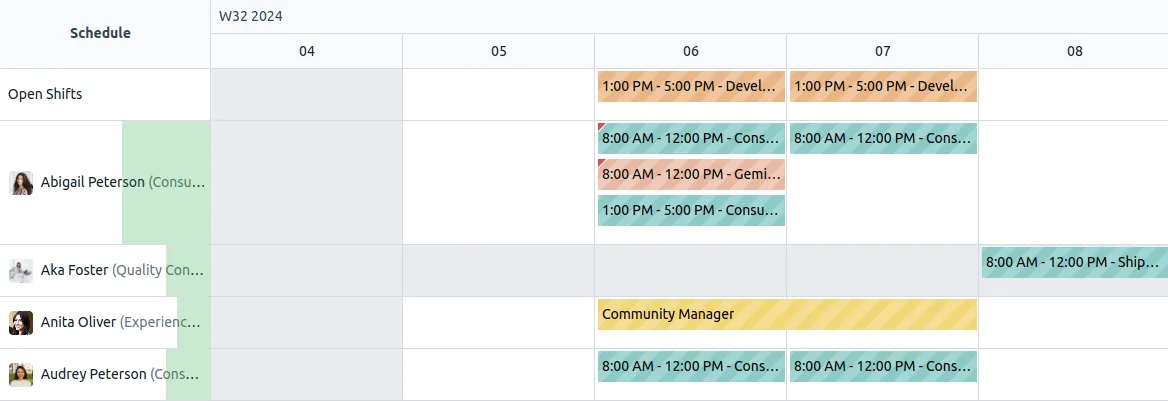
Operations managers and HR use the same technician data for different decisions: deployment, compliance and performance.
Technician data spans HR and service modules; this is how each platform typically covers it. Confirm against your edition.
| Zoho | Odoo | ERPNext | Dynamics 365 | |
|---|---|---|---|---|
| Technician record | Zoho FSM field agents linked to Zoho People employees | Employees app linked to Field Service users | Employee in HRMS linked to service users | Bookable resources in Field Service linked to HR records |
| Skills matching | Skills on field agents in Zoho FSM; confirm for your plan | Skills on employees; skill-based planning in recent editions | Employee skill map; matching usually via customization | Characteristics and ratings used by the scheduling engine |
| Document expiry | Zoho People document and expiry tracking | Employee documents with custom expiry reminders | Custom fields and notifications in HRMS | Typically via Dynamics 365 Human Resources or a custom table |
| Job timesheets | Time logs on work orders | Timesheets on Field Service tasks | Timesheets against tasks and Maintenance Visits | Time entries on bookings |
| Van stock | Zoho Inventory locations; confirm FSM parts handling for your plan | Each van as a warehouse location | Each van as a warehouse | Warehouses per technician with inventory journals |
| Payroll and WPS | Zoho Payroll UAE edition | Odoo Payroll with UAE localization and WPS export | ERPNext Payroll with a WPS SIF format | Usually a partner payroll solution |
UAE payroll and WPS formats should be validated with your bank or exchange house during implementation.
Technician data is only reliable if it comes from the source systems.
These rules apply to almost every field workforce in the UAE. Confirm specifics with your HR advisor.
Salaries are paid through the MOHRE Wage Protection System using a Salary Information File, so overtime and allowances approved in the ERP must reach payroll on time.
UAE Labour Law (Federal Decree-Law 33 of 2021) sets limits on working hours and overtime pay, and MOHRE announces a summer midday break for outdoor work each year. Job timesheets help show compliance.
Gratuity is 21 days' basic wage per year for the first five years and 30 days per year after, capped at two years' wage. Accurate basic salary and service dates in the technician record keep the accrual right.
Passport, visa and Emirates ID copies are personal data. Restrict access by role and keep only what is needed; see employee document management.
General information, not tax or legal advice. Rules change; confirm current FTA, MOHRE and Ministry of Finance guidance with your advisor.
What service companies typically aim for. Results depend on data discipline.
Assignments are filtered by skill and valid certification, cutting repeat visits.
Alerts reach HR and supervisors weeks before a visa, license or site pass expires.
Every overtime hour is tied to a job and contract, so causes can be fixed.
Productivity and quality data per technician supports increments and training decisions.
For a service company with a few dozen to a few hundred technicians. Ranges are typical, not guaranteed.
Durations are typical ranges; your plan is agreed after discovery.
Collect employee records, documents, skills and certifications; agree the skills taxonomy.
Configure employees, document alerts, overtime rules, allowances and WPS output.
Connect technicians to service users, van warehouses and job timesheets.
Run the first payroll from job-based timesheets and review the productivity reports.
We configure the system for the rules UAE businesses report against, and test it before go-live.
General information, not tax or legal advice. Confirm current requirements with the FTA, MOHRE or your advisor. See all UAE compliance guides.
On-site workshops in Dubai, Abu Dhabi and Sharjah, and remote or on-site delivery across the Northern Emirates and free zones.
Official sources and references
Facts on this page were checked against these sources in October 2026. Rules change, so confirm current requirements before acting.
Still have a question? Our consultants are happy to help.
Ask an ExpertNo. Field service management covers the whole job life cycle; technician management focuses on the workforce record, skills, time, stock and performance. In practice they are modules of the same system.
Yes, if certifications are stored with validity dates. The scheduling board can hide or warn on technicians who lack a valid certificate for the job type or the client site.
Combine utilization (job hours versus attendance), jobs completed by type, first-time fix and callbacks. Compare technicians within the same trade and job mix, not across trades.
Yes. Helpers are usually employees linked to a lead technician, and subcontracted technicians can be set up as resources with limited access, so their jobs and time are still recorded.
Each van is a stock location. Parts are transferred from the main store, consumed on jobs from the app and counted periodically. Differences are investigated per technician.
Ideally the same platform as service operations, so time and skills do not need syncing. Options include Zoho Payroll with Zoho People, Odoo HR, or ERPNext HRMS. We implement all four platforms and recommend by fit.
Related Solutions
Related Industries
Related ERP Platforms
Talk to a consultant about linking skills, documents, timesheets, van stock and payroll for your field team.
Dubai, United Arab Emirates










