
L
O
A
D
I
N
G


Zoho, Odoo, ERPNext, Dynamics 365 and custom ERP, delivered by one accountable team.

A single tower in Dubai can have hundreds of maintainable assets, from chillers and AHUs to fire pumps, lifts and water tanks. Building maintenance software keeps every one of them on a plan, with a record that survives staff changes and contractor handovers.
Building maintenance software organizes upkeep by location hierarchy, from tower and floor to unit and plant room, with an asset register, time- or meter-based PPM plans, inspection and certificate tracking, and reactive work orders. UAE buildings depend on chillers, AHUs, fire systems and lifts, so missed inspections and weak developer handovers are the main risks it addresses.
Building maintenance software in the UAE organizes the upkeep of a specific building or portfolio: residential towers, commercial offices, mixed-use developments, malls, labor accommodation and villa communities. It starts with the building itself as the structure of the data: tower, floor, zone, unit and plant room, then the systems in each, such as HVAC, electrical, plumbing, fire and life safety, vertical transport and building management system.
The UAE climate and building stock shape the work. Cooling runs almost all year, so chillers, cooling towers, AHUs and FCUs drive most of the maintenance effort. Many towers connect to district cooling, so energy transfer stations and metering also need attention. Fire alarm, sprinkler and pump systems face regular inspection by contractors approved by the emirate's Civil Defence authority, and lifts need periodic inspection and certification. A building manager has to show that all of this happened, on time, with evidence.
This page looks at maintenance from the building's point of view: the asset register, the annual plan, inspections, contractor oversight and cost per building. The underlying processes have their own pages: preventive maintenance, corrective maintenance and service request management. Companies that maintain buildings for many owners will also want to read ERP for property maintenance companies.
Most of these start at handover from the developer or when the maintenance contractor changes.
O&M manuals, as-built drawings, warranty certificates and asset lists arrive as boxes of files or PDFs. Months later, nobody knows which pump is under warranty or when the AHU filters were last changed.
The register says 240 FCUs but the floors have 263, and tag numbers on site do not match the drawings. PPM plans built on a wrong asset list miss equipment entirely.
Civil Defence-related inspections, lift certifications, water tank cleaning and cooling tower checks sit in someone's Outlook. When that person leaves, renewal dates are missed and certificates expire.
Lifts, fire systems and BMS are often maintained by specialist subcontractors. Their service reports arrive on paper, and the building manager cannot prove visits matched the contract schedule.
Labor, parts and subcontractor costs are booked to one maintenance account. Owners' associations and landlords ask for cost by building or by system, and the numbers have to be built by hand.
From handover to year-end reporting, each building follows a repeatable cycle.
One shared database: every step updates stock, finance and reports in real time.
The modules below cover the building lifecycle, from asset records to owner reporting.
Portfolio, building, floor, zone, unit and plant room, so every asset and job has an exact place.
Equipment with make, model, serial, tag, install date, warranty and linked O&M documents.
Time- or meter-based plans per asset class, generating work orders on the right dates.
Statutory and insurance inspections with due dates, responsible contractor and expiry alerts.
Reactive jobs from tenants and BMS alarms, alongside planned work in one queue.
Contracts, visit schedules, service reports and invoices from lift, fire and BMS specialists.
Drawings, manuals, method statements and certificates attached to the building or asset.
Maintenance cost by building, system and asset, compared with the annual budget.
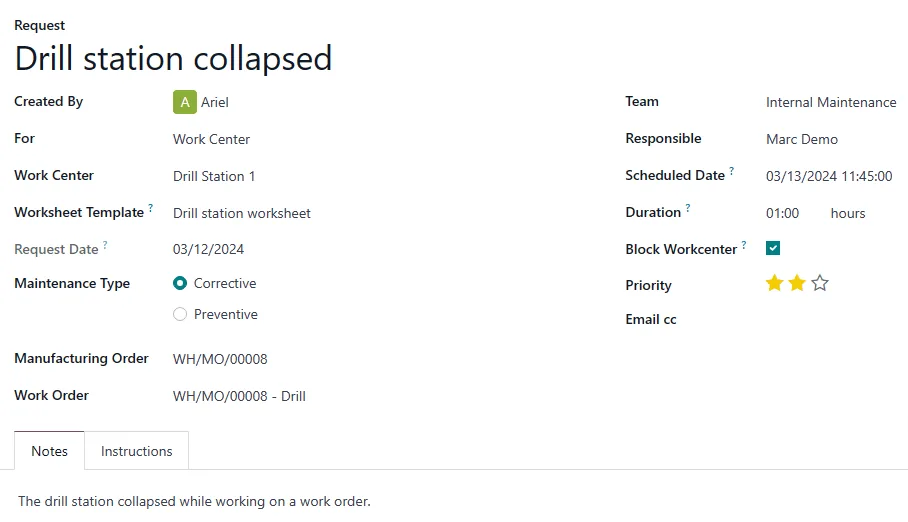
A portfolio dashboard shows compliance and workload per building at a glance.
All four platforms can run building maintenance; they differ in how much is standard and how much is configured.
| Zoho | Odoo | ERPNext | Dynamics 365 | |
|---|---|---|---|---|
| Location hierarchy | Custom modules in Zoho Creator, or service addresses in Zoho FSM | Equipment categories plus custom location fields, or work centers | Location doctype with parent-child tree | Functional locations in Field Service |
| Asset register | Assets in Zoho FSM, or a Creator app | Equipment in the Maintenance app | Asset doctype with Asset Maintenance | Customer assets with hierarchy |
| PPM scheduling | Maintenance plans in Zoho FSM, check your edition | Preventive maintenance by frequency on equipment | Asset Maintenance tasks and Maintenance Schedule | Agreements generating recurring work orders |
| Inspection tracking | Custom fields and reminders, often via Creator | Maintenance requests with custom stages | Custom doctype or Quality Inspection, configured | Inspections in Field Service, check your version |
| Cost per building | Reporting tags in Zoho Books | Analytic accounts per building | Cost centers per building | Financial dimensions per building |
| Best fit | SMEs wanting Zoho apps and a custom Creator layer | Mid-size FM teams wanting maintenance and accounting in one database | Cost-conscious operators wanting open source and full control | Large portfolios with complex scheduling and Microsoft stack |
Our Odoo Maintenance page shows one platform in detail. Confirm features for your edition.
Buildings already run several systems. The maintenance software should take data from them rather than duplicate them.
Requirements differ by emirate and building type, so confirm specifics with the relevant authority and your consultants.
Fire alarm, sprinkler and pump systems must be maintained by contractors approved by the emirate's Civil Defence authority. Keep visit reports and certificates linked to each system so they are ready for inspection.
In Dubai, service charges for jointly owned buildings are regulated by RERA, and owners expect budgets backed by actual maintenance costs. Cost per building and system supports that reporting.
Maintenance services and recharges are generally subject to 5% VAT, while some residential charges have specific treatments. Configure invoice tax codes with your tax advisor. B2B invoices will move to the e-invoicing model; check the latest MoF and FTA guidance.
Real estate-related tax records must be kept for at least 7 years, so keep maintenance invoices and supporting records for that period.
General information, not tax or legal advice. Rules change; confirm current FTA, MOHRE and Ministry of Finance guidance with your advisor.
Benefits show up in compliance, asset life and the quality of owner reporting.
Due dates and certificate expiries trigger alerts weeks ahead, independent of who is on leave.
PPM based on the real asset list, with history per asset, catches wear before breakdown.
Cost per building and system comes straight from transactions, ready for owners' associations and landlords.
History, documents and plans stay with the building, so a new contractor starts with full records.
A single-building rollout can be live in around 6-10 weeks; portfolios usually roll out building by building over a few months.
Durations are typical ranges; your plan is agreed after discovery.
Review handover documents, existing asset lists, contracts and inspection obligations.
Verify assets on site, apply QR tags and load the register by floor and system.
Configure PPM plans, inspection schedules, subcontractor contracts and cost structure.
Train building managers, technicians and the helpdesk, and run work orders live.
Add buildings in waves and introduce BMS and meter integration once data is stable.
We configure the system for the rules UAE businesses report against, and test it before go-live.
General information, not tax or legal advice. Confirm current requirements with the FTA, MOHRE or your advisor. See all UAE compliance guides.
On-site workshops in Dubai, Abu Dhabi and Sharjah, and remote or on-site delivery across the Northern Emirates and free zones.
Official sources and references
Facts on this page were checked against these sources in October 2026. Rules change, so confirm current requirements before acting.
Still have a question? Our consultants are happy to help.
Ask an ExpertCAFM is the wider category, covering space, moves, helpdesk and assets across facilities. Building maintenance software focuses on keeping a building's assets and systems maintained and compliant. In practice the same platform often does both; our facility management software page explains the full scope.
Not necessarily. Start with assets that carry PPM, inspection or warranty obligations, such as chillers, AHUs, pumps, lifts and fire systems. Smaller items like light fittings can be grouped by floor or zone and added later.
Often yes, through the BMS vendor's API or an integration layer. Alarms can create reactive work orders and runtime hours can trigger meter-based PPM. The approach depends on the BMS make, so we assess it during discovery.
Record the subcontract, its visit schedule and the assets covered. Each visit becomes a work order assigned to the subcontractor, and their service report and certificate are attached when it is closed, so the building keeps one history.
Yes, through a portal with controlled access. Tenants see their own requests, and owners or association managers can see summary reports and costs for their building.
A single owner with a few buildings often does well with Odoo or ERPNext. An FM company maintaining many clients' buildings needs strong contracts and scheduling, which may point to Dynamics 365 or a well-configured Odoo. We implement all four platforms and recommend by fit.
Related Solutions
Related Industries
Related ERP Platforms
Send us your asset list or handover pack and we will show how your buildings would look in a structured maintenance system.
Dubai, United Arab Emirates










