L
O
A
D
I
N
G


Zoho, Odoo, ERPNext, Dynamics 365 and custom ERP, delivered by one accountable team.

Most CRM projects do not fail on software. They fail when stages are vague, data arrives dirty and salespeople keep their real pipeline in a notebook. A planned rollout fixes that from week one.
A CRM implementation in the UAE involves mapping the sales process and pipeline stages, configuring lead sources, loading cleaned customer and deal data, connecting email, phone and WhatsApp, linking quotations with 5% VAT to the ERP or accounting system, training users and measuring adoption after go-live. A focused rollout for one sales team often takes 6-10 weeks from discovery to go-live.
CRM implementation in the UAE is the project of turning a CRM subscription into the system your sales team runs on every day. It covers defining the sales process, configuring lead sources and pipeline stages, loading customers and open deals, connecting email, phone and WhatsApp, linking quotations to the accounting or ERP system, training users and then checking for several weeks that the system is really being used.
In a typical Dubai trading or services company, the starting point is a mix of Excel lead sheets, a shared inbox, quotation templates in Word and a sales manager who asks for pipeline updates on Sunday morning. The new CRM has to absorb all of that without slowing down the people who bring in revenue. That is why we treat implementation as a sales operations project first and a software project second. If you are still choosing a platform, start with our overview of CRM solutions in the UAE and come back once the shortlist is clear.
We implement CRM on Zoho, Odoo, ERPNext and Microsoft Dynamics 365. The method is the same across platforms; the configuration tools differ. A platform-specific plan is available for Zoho CRM implementation, and the same discipline applies when CRM is part of a wider ERP implementation.

These are the problems we see most when a CRM was set up quickly and left to the sales team to figure out.
One salesperson moves a deal to 'Negotiation' when the client asks for a discount, another when a PO is promised. The pipeline report then mixes very different probabilities and the forecast becomes meaningless.
Contacts are copied from three Excel files and an old phone export, with the same company spelled four ways. Users find duplicates on day one and stop believing the system.
If quotes are still prepared in Word with manual VAT lines, the CRM never knows the deal value and finance re-keys the order. The CRM becomes a contact list rather than a sales system.
Much UAE selling happens on WhatsApp. When those chats are not linked to the lead record, history leaves with the salesperson and managers cannot see what was promised.
A single two-hour session before go-live is not enough. Without role-based guides and follow-up clinics, usage drops within a month and the old spreadsheets return.
Every CRM implementation is built around the real path from first enquiry to handover to finance. This is the default path we design and then adjust per business.
One shared database: every step updates stock, finance and reports in real time.
Not every module goes live on day one. These are the components most UAE implementations include in the first phase.
Web forms, portals, events and referrals tagged at entry so marketing spend can be compared by source.
Company records with TRN, emirate, free zone or mainland status and multiple contacts per account.
Stages with entry and exit criteria, expected close date and probability, shown as a kanban board.
Product or service lines, price lists, 5% VAT, discount approval and PDF output in your branding.
Calls, meetings and follow-up tasks logged against the deal, synced with Outlook or Google calendar.
Mailbox sync and a WhatsApp Business Platform connection so client conversations sit on the record.
Pipeline by stage, owner and source; won and lost analysis; activity per salesperson.
Salespeople see their own deals, managers see their team, finance sees won orders only.
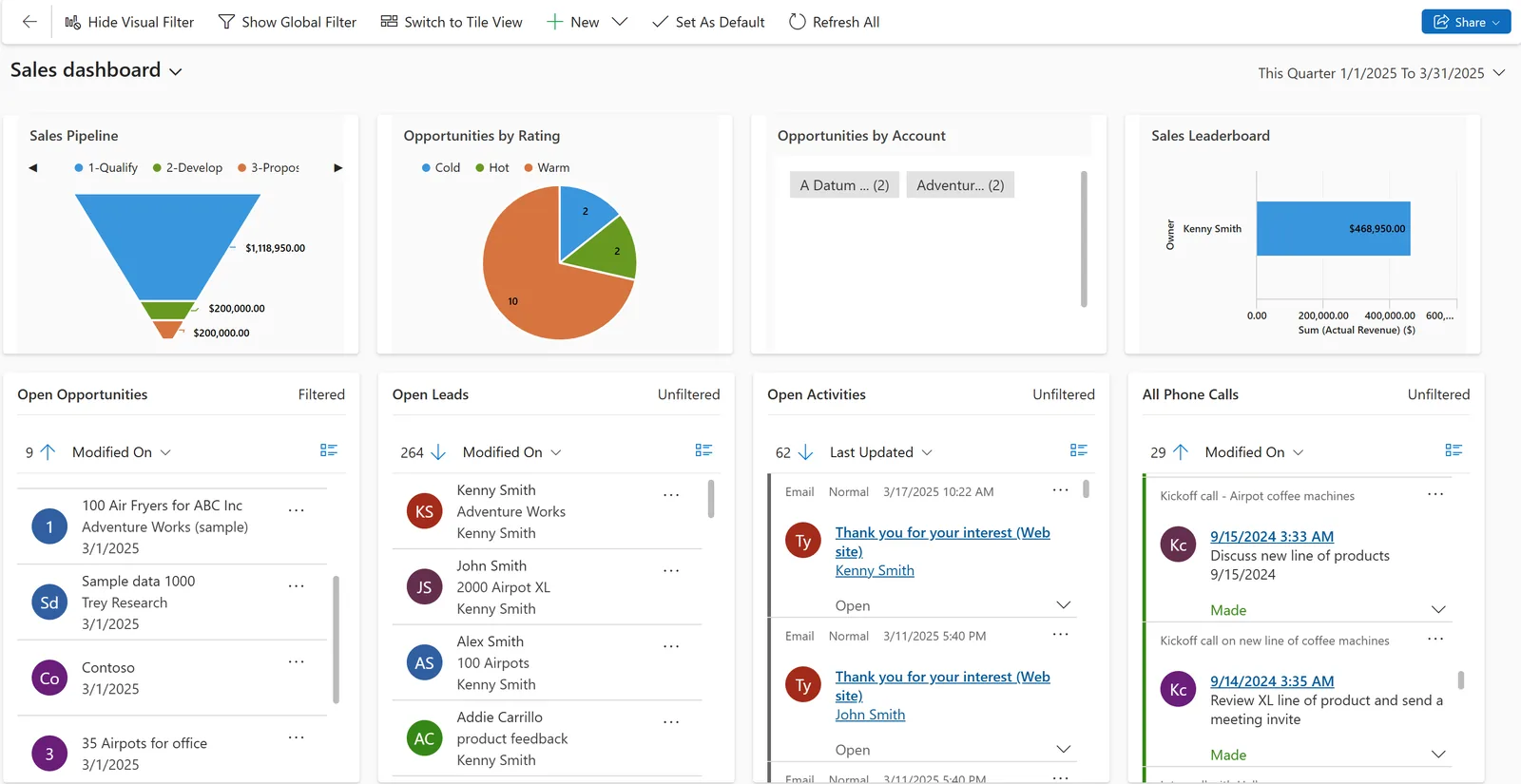
A CRM implementation is judged by whether the Sunday pipeline meeting can run from the system instead of from a spreadsheet.
All four platforms can run a professional sales process. They differ in how much is configured versus developed, and how closely CRM sits with accounting.
| Zoho | Odoo | ERPNext | Dynamics 365 | |
|---|---|---|---|---|
| Pipeline setup | Layouts, stages and Blueprint process rules configured in the admin console | CRM app kanban stages, teams and activities configured in settings | Lead, Opportunity and Quotation doctypes with configurable status and workflow | Dynamics 365 Sales with business process flows on Dataverse |
| Quotation to order | Quotes and sales orders in CRM, or handled in Zoho Books / Inventory | Quotation in the Sales app becomes the sales order in the same database | Quotation converts to Sales Order natively | Quote and order in Sales; finance often in Business Central or Finance |
| Data import | Import wizard with field mapping; migration tools for common CRM sources | CSV/XLSX import with field matching | Data Import tool with templates per doctype | Dataverse import and Configuration Migration tooling |
| Email and calendar | Mailbox and calendar sync for Outlook and Google | Mail gateway and calendar sync | Email accounts linked to documents; calendar sync available | Strong Outlook and Teams integration |
| Typical effort | Mostly configuration, scripting for edge cases | Configuration; Studio or code for custom fields and logic | Configuration plus scripts or custom app where needed | Configuration plus Power Platform; larger projects need more governance |
| Best fit | Sales-led SMEs that want a dedicated CRM with many add-on apps | Companies wanting CRM, sales, stock and accounts in one system | Cost-conscious firms comfortable with open source | Microsoft-centric companies and larger sales teams |
Feature availability depends on edition and version; confirm for your plan.
Integrations are scoped early so that the CRM is not an island at go-live.
A CRM is not a tax system, but the data it holds flows into invoices and customer records that are. Confirm the details with your tax advisor.
Quotations that become tax invoices need correct 5% VAT treatment, customer TRN and zero-rated or exempt handling where it applies. We set tax rules on products and customers so the downstream invoice is right.
UAE e-invoicing under the PINT AE specification will rely on accurate buyer details such as TRN and legal name. Cleaning these at CRM implementation saves rework later; check the latest MoF/FTA guidance for required fields.
Messages sent through the WhatsApp Business Platform require opt-in and approved templates. We record opt-in status on the contact so campaigns respect it.
General information, not tax or legal advice. Rules change; confirm current FTA, MOHRE and Ministry of Finance guidance with your advisor.
The benefits come from discipline in the process, not from the software alone.
Clear stage criteria mean weighted pipeline and forecast reflect reality, so targets and hiring decisions rest on real numbers.
Price lists, templates and approval rules inside the CRM remove the copy-paste work between Excel, Word and email.
Emails, calls and WhatsApp threads on the account record mean a new salesperson can pick up a client without starting from zero.
Won deals create sales orders or invoices with correct customer and VAT details, so accounts stop re-keying orders.
Durations are typical ranges for a focused rollout of 10-50 users; your scope, integrations and data quality change them.
Durations are typical ranges; your plan is agreed after discovery.
Workshops with sales, marketing and finance to define lead sources, stages, qualification rules and approval limits.
Fields, layouts, pipelines, quotation templates, roles and automation built in a test environment.
Accounts, contacts and open deals cleaned and loaded; email, telephony, WhatsApp and accounting connections tested.
Role-based training for salespeople, managers and admins, with users testing real scenarios before sign-off.
Floor support, weekly adoption reports and quick fixes while the team settles into the new routine.
We configure the system for the rules UAE businesses report against, and test it before go-live.
General information, not tax or legal advice. Confirm current requirements with the FTA, MOHRE or your advisor. See all UAE compliance guides.
On-site workshops in Dubai, Abu Dhabi and Sharjah, and remote or on-site delivery across the Northern Emirates and free zones.
Official sources and references
Facts on this page were checked against these sources in October 2026. Rules change, so confirm current requirements before acting.
Still have a question? Our consultants are happy to help.
Ask an ExpertA focused rollout for one sales team often takes 6-10 weeks from discovery to go-live. Multi-branch teams, several integrations or a migration from another CRM can extend that. We give a phased plan after discovery rather than a fixed promise up front.
If your main pain is lead follow-up and pipeline visibility, a CRM-first project makes sense. If quotes, stock availability and invoicing are tightly linked, implementing CRM with the ERP avoids double entry. Our ERP vs CRM guide explains the trade-off.
Usually active accounts, contacts, open opportunities and recent activities. Closed deals older than a few years are often archived rather than migrated. Complex moves from another CRM are covered on our CRM migration page.
We keep the first version simple, involve senior salespeople in design, and remove the old spreadsheets at go-live. After launch we track logins, activities logged and deals updated per user and run short clinics where usage drops.
Yes. We are based in Dubai and support teams across all seven emirates on-site and remotely, with territories, branches and permissions configured per location.
We provide a hypercare period and then ongoing support. Further changes such as new modules or custom logic are planned as small releases, often under CRM customization.
Related Solutions
Related Industries
Related ERP Platforms
Share your current sales process and tools, and we will outline phases, scope and the right platform for your CRM implementation.
Dubai, United Arab Emirates