L
O
A
D
I
N
G


Zoho, Odoo, ERPNext, Dynamics 365 and custom ERP, delivered by one accountable team.

Large UAE groups need one system of record across companies, currencies and countries, with the controls their boards and auditors expect. Dynamics 365 Finance and Supply Chain is built for that scale.
Dynamics 365 for enterprise groups in the UAE usually means Dynamics 365 Finance and Supply Chain Management, running many legal entities on one database with shared customers and products, intercompany trade, currency translation, eliminations and consolidation. It suits family holdings and regional groups across the GCC; groups with a few entities and simpler operations may be better served by Business Central.
Dynamics 365 for enterprise in the UAE typically means Dynamics 365 Finance and Dynamics 365 Supply Chain Management, sometimes together with Sales, Customer Service and Project Operations. These apps serve diversified groups: a family holding with trading, contracting and hospitality arms; a regional distributor with entities in Dubai, Abu Dhabi, Saudi Arabia and Oman; or a manufacturer with plants in KEZAD and sales offices across the GCC.
What sets these businesses apart is not just size. It is the number of legal entities, the volume of intercompany trading, shared service centers that process transactions for many companies, and boards that expect consolidated results within days of month-end. They also face scrutiny from external auditors, lenders and, increasingly, transfer pricing and corporate tax reviews.
Finance and Supply Chain handles this with legal entities on one shared database, global address book and shared products, intercompany trade, financial consolidation, workflow approvals and a security model built on duties and privileges. Some groups with simpler needs are better served by Business Central with multi-company setup, and we will tell you if that is your case. See our Dynamics 365 Finance and multi company ERP pages.

These issues usually trigger an enterprise ERP program rather than a single-system replacement.
Each acquired company kept its own ERP or accounting package. Group finance consolidates by exporting trial balances into Excel every month.
Intercompany balances between UAE and GCC entities rarely agree at month-end. Teams spend days chasing differences in currency, timing and coding.
Groups must assess tax groups, qualifying free zone entities, related-party pricing and adjustments across many companies. Data has to be consistent to support that work.
Approval limits and segregation of duties are enforced by policy documents, not the system. Internal audit raises the same findings each year.
Stock moves between Jebel Ali, KEZAD and GCC warehouses with transit times and customs steps. Planning based on stale data leads to excess stock in one place and shortages in another.
Entities with revenue of AED 50 million or more face the earliest UAE e-invoicing deadlines. Large groups need a coordinated plan across all their UAE companies.
For enterprises, the backbone process is closing many entities and reporting one set of group results.
One shared database: every step updates stock, finance and reports in real time.
An enterprise program usually combines several apps on the same Dataverse and Azure foundation.
General ledger, accounts payable and receivable, budgeting, fixed assets, cash and bank management and consolidation across legal entities.
Procurement, inventory, warehouse management, master planning, transportation and production for complex operations.
Intercompany sales and purchase chains that mirror documents between entities and reduce reconciliation work.
Centralized payments and invoice processing for many legal entities from one team.
Configurable approval workflows and a role, duty and privilege model with segregation of duties rules.
Project contracts, resourcing and project accounting for contracting and services subsidiaries.
CRM on Dataverse, linked to Finance and Supply Chain through Dual-write.
Group reporting using Power BI, with data exported to Azure for analytics across entities.
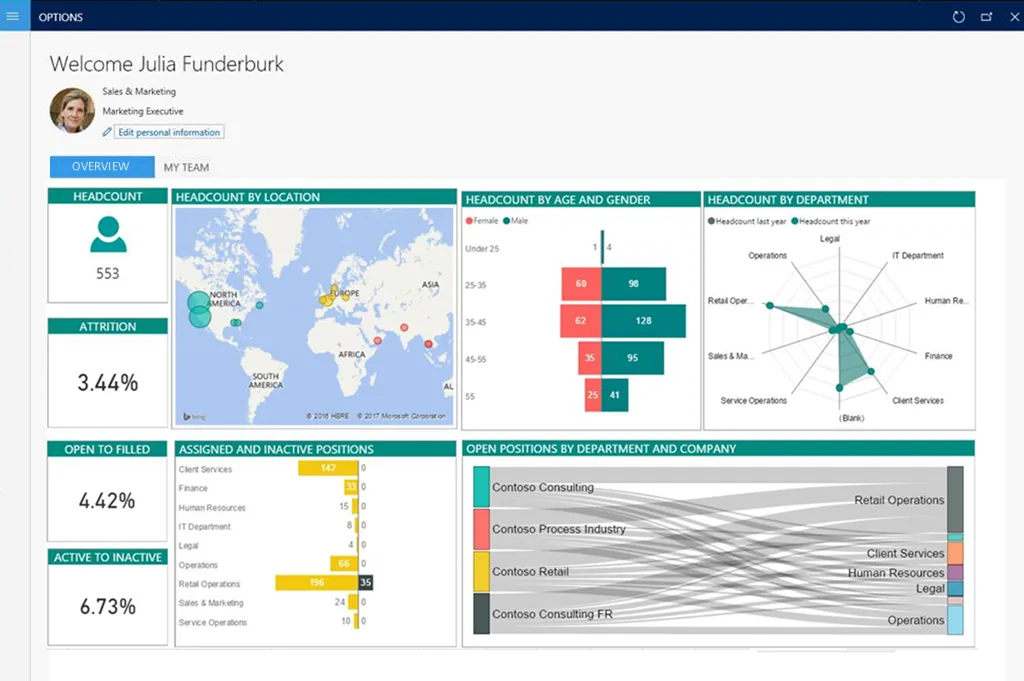
We design group-level reporting so leadership can compare entities on a consistent basis.
We configure Finance and Supply Chain to support these obligations. Tax positions should be confirmed with your tax advisor.
Federal Decree-Law No. 47 of 2022 applies 9% on taxable income above AED 375,000. We structure legal entities, dimensions and related-party tagging so tax teams can prepare computations, including for any Qualifying Free Zone Persons.
Sales tax codes and groups support standard, zero-rated and exempt supplies, and reports can be produced per TRN, including VAT groups that file together.
Businesses with revenue of AED 50 million or more must appoint an ASP by 30 October 2026, with e-invoicing mandatory from 1 January 2027. We plan PINT AE mapping and ASP connectivity per entity. Check the latest Ministry of Finance and FTA guidance.
Database logging, workflow history and segregation of duties reports give auditors evidence of who did what and when.
General information, not tax or legal advice. Rules change; confirm current FTA, MOHRE and Ministry of Finance guidance with your advisor.
Enterprise programs are usually phased by entity or region. Durations below are typical ranges, not commitments.
Durations are typical ranges; your plan is agreed after discovery.
Group-wide process design, chart of accounts, entity structure, data ownership and integration architecture.
Configuration, extensions and integrations for the first entity or business line.
Data migration, user acceptance testing, training and cutover for the pilot.
Additional entities or countries adopt the template with local adjustments.
Automation, analytics and continuous improvement after the core rollout.
Explore related platforms and services.
We configure the system for the rules UAE businesses report against, and test it before go-live.
General information, not tax or legal advice. Confirm current requirements with the FTA, MOHRE or your advisor. See all UAE compliance guides.
On-site workshops in Dubai, Abu Dhabi and Sharjah, and remote or on-site delivery across the Northern Emirates and free zones.
Official sources and references
Facts on this page were checked against these sources in October 2026. Rules change, so confirm current requirements before acting.
Still have a question? Our consultants are happy to help.
Ask an ExpertFinance and Supply Chain suits groups with many entities, complex supply chains, shared services or heavy compliance needs. Business Central can work for groups with a few entities and simpler operations at a lower cost. We assess entity count, transaction volumes and processes before recommending.
Yes. Finance supports currency translation, eliminations and consolidation across legal entities, and many groups add Power BI or a dedicated consolidation tool for board packs.
We build a global template with the shared chart of accounts, processes and controls, go live with a pilot entity, then roll out to others with only the local differences configured.
We compare honestly, but we do not implement SAP, Oracle or NetSuite. Our recommendation is limited to whether Dynamics 365 fits your requirements, and we will say if it does not.
Dynamics 365 runs in Microsoft's cloud. Microsoft operates data center regions in the UAE, and availability for specific apps can change, so we confirm current region options with Microsoft during planning.
Related Solutions
Related Industries
Related ERP Platforms
Talk to our Dubai team about your entity structure and we will outline a phased approach.
Dubai, United Arab Emirates