L
O
A
D
I
N
G


Zoho, Odoo, ERPNext, Dynamics 365 and custom ERP, delivered by one accountable team.

When spreadsheets, Tally or entry-level cloud accounting stop keeping up, Business Central gives UAE SMEs proper finance, inventory and reporting inside the Microsoft tools they already use.
For UAE SMEs, Dynamics 365 almost always means Business Central, Microsoft's ERP covering finance, sales, purchasing, inventory and projects, with manufacturing and service management in the Premium edition. It suits companies outgrowing Tally or entry-level accounting that need multi-location stock, multi-currency purchasing and approvals, especially teams committed to Microsoft 365, though Zoho, Odoo or ERPNext may cost less overall.
Dynamics 365 for SMEs in the UAE almost always means Dynamics 365 Business Central. It is Microsoft's ERP for small and mid-sized organizations, covering finance, sales, purchasing, inventory, projects and, in the Premium edition, manufacturing and service management. The larger Finance and Supply Chain Management apps are built for enterprises and are rarely the right first step for an SME.
The typical SME that chooses Business Central has between ten and a few hundred staff, perhaps two or three legal entities across the mainland and a free zone, and a finance team that lives in Excel and Outlook. They have outgrown entry-level accounting software because they need stock control across locations, multi-currency purchasing, approval rules and reports the owner can trust without waiting for month-end.
Business Central is not the cheapest option, and we say so. Zoho, Odoo and ERPNext can suit many SMEs at a lower total cost, and we implement those too. Business Central stands out when the team is committed to Microsoft 365, wants Excel and Teams integration, or expects to grow into a larger group structure. Compare options on our Zoho vs Dynamics 365 for SMEs page.

These are the pressures that usually push an SME to look at Dynamics 365.
Cash position, receivables and gross margin are only known after the accountant builds a spreadsheet. Decisions on stock purchases or hiring wait for that report.
Inventory sits in a store in Al Barsha, a small warehouse in Al Quoz and with a supplier in Sharjah. The accounting system knows the total value but not where items are.
Since corporate tax began, SMEs need clean records of non-deductible expenses, related-party transactions and adjustments. Basic tools make that hard to track by entity.
A free zone entity was set up for a new line of business. Now there are two sets of books, intercompany invoices and a combined report built by hand.
Purchase requests and discounts are approved in chat messages. There is no record of who approved what, and auditors ask questions.
For most SMEs, the first priority is getting sales, stock and receivables into one flow so the numbers update as work happens.
One shared database: every step updates stock, finance and reports in real time.
Business Central is one application with role-based areas. These are the ones UAE SMEs typically switch on first.
General ledger, dimensions, budgets, bank reconciliation and fixed assets, with posting groups that keep VAT and accounts consistent.
Quotes, orders, invoices, credit limits, price lists and customer statements, with reminders for overdue balances.
Purchase orders, approvals, vendor invoices and payment proposals, with item charges for freight and duty.
Items, multiple locations, transfers, units of measure and stock valuation on FIFO, average or standard cost.
Budgets, time and expense posting, and invoicing for service or installation work.
Separate companies in one tenant, with intercompany postings and consolidation for group reporting.
Built-in approval workflows for purchase orders, payments and customer credit, with email and Teams notifications.
Ready-made Power BI reports and Excel editing of lists and journals so finance can work in a familiar way.
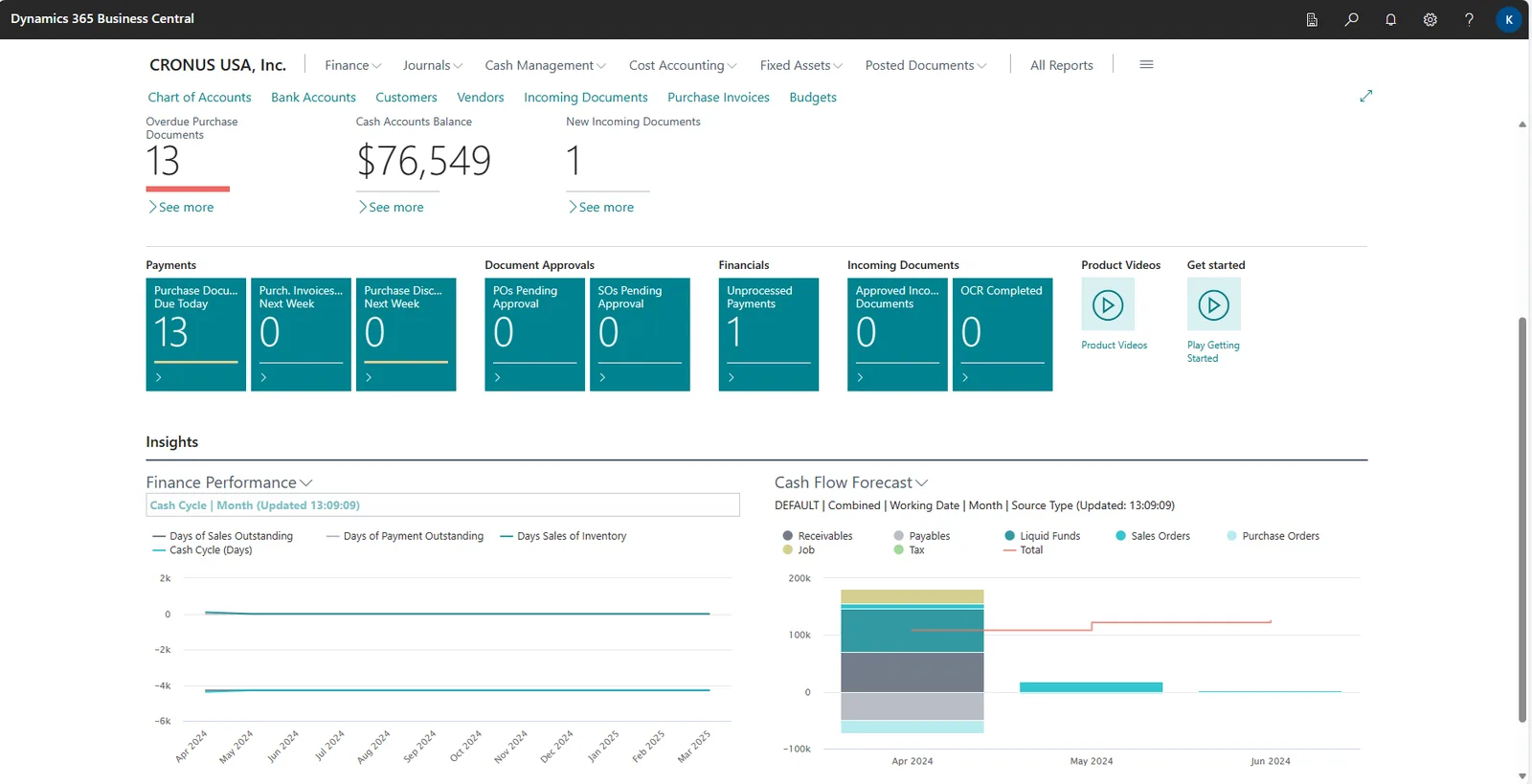
The Business Manager role center gives owners and finance managers a live view without building spreadsheets.
We configure Business Central so routine compliance work becomes a report rather than a project. Confirm tax treatments with your tax advisor.
VAT business and product posting groups handle 5% standard, zero-rated and exempt supplies. Tax invoices show both TRNs and prescribed fields, and VAT reports map to EmaraTax return boxes.
Dimensions and G/L account setup separate non-deductible items and related-party transactions. SMEs considering Small Business Relief, which applies to tax periods ending on or before 31 December 2026, should confirm eligibility with their advisor.
Businesses below AED 50 million in revenue are expected to appoint an Accredited Service Provider by 31 March 2027, with e-invoicing mandatory from 1 July 2027. Check the latest Ministry of Finance and FTA guidance.
We set up the audit trail and data exports needed for FTA requests. If you need accredited software, check the FTA's current Tax Accounting Software Register for the specific product.
General information, not tax or legal advice. Rules change; confirm current FTA, MOHRE and Ministry of Finance guidance with your advisor.
A focused SME implementation often runs 6-12 weeks. These ranges are typical, not guaranteed.
Durations are typical ranges; your plan is agreed after discovery.
Process walk-throughs with the owner, finance and operations, plus a data review.
Chart of accounts, posting groups, VAT setup, locations, approvals and document layouts.
Customers, vendors, items and opening balances loaded and reconciled.
Role-based training and a test run of a full month of transactions.
Close support through the first month-end and first VAT return.
More resources for small and mid-sized UAE businesses.
We configure the system for the rules UAE businesses report against, and test it before go-live.
General information, not tax or legal advice. Confirm current requirements with the FTA, MOHRE or your advisor. See all UAE compliance guides.
On-site workshops in Dubai, Abu Dhabi and Sharjah, and remote or on-site delivery across the Northern Emirates and free zones.
Official sources and references
Facts on this page were checked against these sources in October 2026. Rules change, so confirm current requirements before acting.
Still have a question? Our consultants are happy to help.
Ask an ExpertFinance and Supply Chain Management usually is. Business Central is designed for SMEs and works well for companies with a handful of finance users up to a few hundred staff. Very small businesses with simple needs may be better served by lighter tools.
Essentials covers finance, sales, purchasing, inventory, projects and warehousing. Premium adds manufacturing and service management. Most trading and service SMEs start on Essentials.
No. Staff who mainly view data, approve documents or make light edits can often use Team Members licenses. We review roles to avoid paying for full licenses that are not needed.
Zoho and Odoo can be lower-cost and very capable for many SMEs. Business Central fits best when you are deeply invested in Microsoft 365 and expect more complex accounting or group structures. We implement all three and will tell you which fits.
Yes. Each legal entity is set up as a separate company with its own VAT and corporate tax settings, and intercompany transactions and consolidation bring them together.
Related Solutions
Related Industries
Related ERP Platforms
Book a call and we will review your processes and tell you honestly whether Dynamics 365 or another platform suits you better.
Dubai, United Arab Emirates