
L
O
A
D
I
N
G


Zoho, Odoo, ERPNext, Dynamics 365 and custom ERP, delivered by one accountable team.

HR analytics turns the data already in your HR and payroll system into answers on cost, turnover, compliance and risk, by entity, site and nationality.
HR analytics uses existing HR, payroll, attendance and finance data to answer workforce questions: headcount by entity and visa sponsor, attrition by exit type, overtime cost by site or project, Emiratisation ratios, end-of-service gratuity liability and upcoming visa expiries. UAE companies get most value by agreeing measure definitions, joining data on one employee key and reviewing a small set of measures monthly.
HR analytics is the practice of answering workforce questions with data: why people leave, where overtime cost comes from, how the Emiratisation ratio is trending, how large the end-of-service liability has grown, and which visas expire next quarter. For most UAE companies the data already exists in the HR and payroll system. What is missing is a model that joins it and a habit of reviewing it.
The UAE adds dimensions that generic HR analytics templates ignore. Headcount is split by visa sponsor and entity, often across mainland and free zone licenses. Nationality mix matters for Emiratisation targets and for travel and leave patterns. Accommodation, transport and air ticket entitlements are significant costs for blue-collar staff. Gratuity is an unfunded liability that grows every month and has to be reported to the owner and the auditor.
This page covers the analysis itself: which questions to ask, which data to join and which tools to use. The ready-made screen layouts are covered on our HR dashboard page, and the role-specific view in ERP for HR managers.

Before analytics can help, these data problems usually need to be fixed.
HR counts visas, payroll counts people paid, and operations counts people on site including agency labor. Without agreed definitions every report starts an argument.
Resignations, terminations, absconding cases and contract ends are recorded as a single status. Attrition analysis is impossible when the reason field is empty or free text.
Overtime is paid but not tagged to a project, department or cause. Management sees the total but cannot tell whether it is planned work or poor scheduling.
The end-of-service provision is worked out in a spreadsheet for the auditor. During the year nobody sees how hiring, salary changes or long-serving staff move the number.
An HR officer exports data from three systems, fixes it in Excel and emails a file. The logic lives in that person's head, and the report stops when they go on leave.
This is the analytics pipeline we set up. Most of the effort is in the first three steps.
One shared database: every step updates stock, finance and reports in real time.
Each source answers a different set of questions. We connect them on the employee ID so measures can be cut by entity, department, grade and nationality.
Join date, grade, department, entity, visa sponsor and nationality, with effective-dated history so transfers and promotions are not lost.
Gross pay, allowances, overtime and deductions by month, the basis for cost per head and cost trends.
Punch data and project timesheets for absenteeism, lateness and overtime by site or project.
Leave taken by type and balance carried, which affects both absence trends and leave salary liability.
Requisitions, candidates, offers and joining dates for time-to-hire and offer acceptance.
Exit type and reason, notice served and final settlement amounts for attrition and cost of turnover.
Visa, Emirates ID, labor card and permit expiry dates for compliance risk reporting.
Approved headcount and salary budget by department to compare actual against plan.
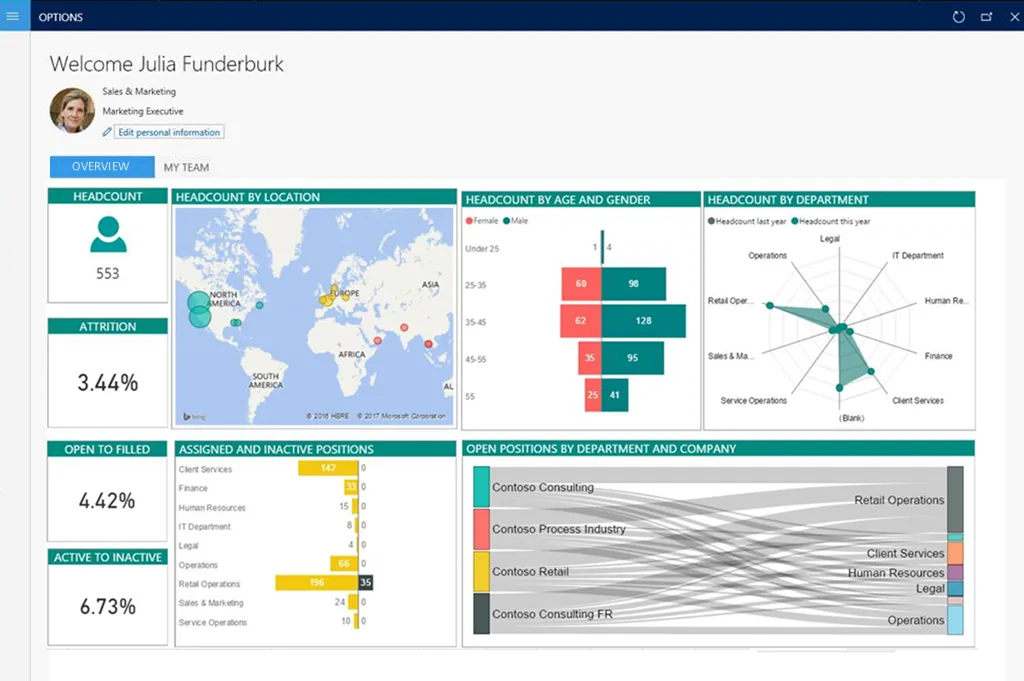
These are the analyses we usually build first. They cover cost, people movement and compliance.
Each platform has built-in reporting, and each can feed an external BI tool. Confirm features and licensing for your edition.
| Zoho | Odoo | ERPNext | Dynamics 365 | |
|---|---|---|---|---|
| Built-in HR reports | Zoho People reports on leave, attendance, headcount and more | Pivot and graph views in Employees, Time Off, Payroll and Recruitment | Standard HR and payroll reports plus custom query and script reports | Workspaces and standard human resources reports |
| Dedicated BI tool | Zoho Analytics with connectors to Zoho People and Zoho Payroll | Odoo spreadsheets and dashboards (Enterprise); external BI via database or API | Insights app or external BI via database or API | Power BI with embedded analytics and data export options |
| Effective-dated history | Field history on employee records; check depth for your plan | Employee history and contract records; some history needs custom fields | Internal work history and version log on employee | Effective-dated position and assignment records |
| Cross-module joins | Straightforward inside Zoho Analytics across Zoho apps | Possible in spreadsheets; complex joins often go to external BI | SQL-based reports join any doctypes | Data model in Power BI across HR and finance |
| Typical approach for SMEs | Zoho Analytics on top of People and Payroll | Native pivots first, external BI when groups grow | Custom reports, Insights or Metabase-style BI | Power BI dashboards from the start |
HR analytics usually pulls from more systems than the HR module alone.
Some measures are compliance indicators, not just management information. Confirm current targets with MOHRE and your advisors.
Private sector companies with 50 or more employees have annual Emiratisation targets for skilled roles, and some smaller companies in specified sectors have hiring requirements. Track the ratio by entity and month; Emiratisation HR software covers the operational side.
Gratuity under Federal Decree-Law No. 33 of 2021 is 21 days' basic wage per year for the first five years and 30 days per year after, capped at two years' wage. Reporting the accrued liability monthly avoids surprises at year end.
Analytics often combines salary, nationality and health-related absence data. Limit access by role under the UAE personal data protection law, and use aggregated views where individual data is not needed.
Expired visas, labor cards or Emirates IDs expose the employer to fines and work stoppage. An expiry pipeline report is one of the most practical analytics outputs.
General information, not tax or legal advice. Rules change; confirm current FTA, MOHRE and Ministry of Finance guidance with your advisor.
We do not quote improvement figures; the value comes from decisions taken on the numbers.
Overtime, allowances and headcount cost broken down by cause, so management can act on the drivers.
Departments and tenure bands with rising exits become visible while there is still time to respond.
Emiratisation ratio and document expiries tracked monthly rather than discovered during an inspection.
One model replaces monthly Excel rebuilds, and approval bottlenecks from the HR approval workflow can be measured too.
Typical durations for a company that already has an HR and payroll system. Groups with several systems need longer.
Durations are typical ranges; your plan is agreed after discovery.
Agree the ten to fifteen questions management wants answered and the definition behind each measure.
Fix exit reasons, department history, nationality and cost center tags in the HR system.
Build the data model and first views in the chosen tool, including the Zoho Analytics integration or Power BI connection.
Run the monthly review, drop measures nobody uses and add the ones the meeting asks for.
We configure the system for the rules UAE businesses report against, and test it before go-live.
General information, not tax or legal advice. Confirm current requirements with the FTA, MOHRE or your advisor. See all UAE compliance guides.
On-site workshops in Dubai, Abu Dhabi and Sharjah, and remote or on-site delivery across the Northern Emirates and free zones.
Official sources and references
Facts on this page were checked against these sources in October 2026. Rules change, so confirm current requirements before acting.
Still have a question? Our consultants are happy to help.
Ask an ExpertNot always. Smaller companies get far with the reporting built into Odoo HR, Zoho People or ERPNext. A BI tool becomes worthwhile when you need to join HR with finance, projects or several entities.
We separate voluntary resignations, involuntary terminations and planned contract completions, then calculate rates on average headcount. Mixing them hides the real retention problem.
Yes, if they are recorded, for example as contingent workers or through timesheets. Many construction and facility companies need both own staff and agency labor in headcount and cost views.
We calculate the accrued amount per employee from basic salary and service under the Labour Law rules, then total by entity and department. Your auditor may also require an actuarial valuation under IFRS; confirm the approach with them.
Usually HR leadership, finance and senior management only. Department heads often see headcount and cost in aggregate for their own area. We set this through row-level permissions in the reporting tool.
A dashboard displays agreed measures. Analytics is the work of defining them, joining data and investigating causes. Most projects deliver both, starting with the questions.
Related Solutions
Related Industries
Related ERP Platforms
Related Guides
Send us the workforce questions management keeps asking, and we will show how to answer them from your ERP.
Dubai, United Arab Emirates










