L
O
A
D
I
N
G


Zoho, Odoo, ERPNext, Dynamics 365 and custom ERP, delivered by one accountable team.

Turn your purchasing policy from a PDF nobody reads into rules the ERP checks on every requisition, PO, receipt and bill.
An ERP enforces procurement policy by turning written rules into system checks: budget availability before a PO is confirmed, quotation requirements by value band, approval by amount and category, and a three-way match of PO, goods receipt and supplier bill before payment. Ordering, receiving and paying are separated between different users, so no single person can complete a purchase alone.
Most UAE companies already have a procurement policy: three quotations above a limit, buy only from approved suppliers, no PO without budget, no payment without a GRN. The problem is enforcement. When the process runs on email, Excel and a basic accounting package, every rule depends on someone remembering to check it. An ERP for procurement control in the UAE moves those checks into the system, so a PO that breaks policy simply cannot be confirmed without an override that is logged.
Procurement control is the policy layer across the whole procure-to-pay cycle. It covers budget availability, quotation and tender rules, the approved vendor list, price tolerances, three-way matching of PO, GRN and bill, and segregation of duties between the person who orders, the person who receives and the person who pays. The approval chain itself is one part of it, covered in detail in ERP for purchase approval.
This matters most for contracting, trading, facility management and manufacturing businesses where purchasing is a large share of cost and is spread across sites, projects and buyers. It is also what auditors test first when they review internal controls.

These are the gaps we find most often during process reviews.
Goods are ordered by phone and the PO is created later to match the supplier invoice. The PO becomes paperwork, not a control, and budgets are exceeded before anyone notices.
The policy says three quotes above a threshold, but buyers attach one quote or split a large order into smaller POs. Nobody checks systematically because the data is in email attachments.
Accounts pay against the supplier invoice because the GRN is in the storekeeper's book or never made it to finance. Short deliveries and price differences are paid in full.
Finance sees actual spend only after bills are posted. Open POs are invisible, so a project or department looks within budget when it is already overcommitted.
In small teams the same buyer creates the supplier, raises the PO, receives the goods and requests payment. That is exactly the pattern auditors flag as a fraud risk.
Teams buy from non-approved suppliers or ignore framework prices. The company loses negotiated discounts and cannot report total spend by category.
Each arrow is a system check. The human step is the exception: an authorized manager can override a failed check, and the override is recorded with a reason.
One shared database: every step updates stock, finance and reports in real time.
Controls only work if the data each rule needs is captured in the same system.
Budgets by cost center, project or account, with open POs counted as commitments so remaining budget is accurate.
Every purchase starts as a request with a reason and cost center; see ERP for purchase requisition.
Requests for quotation sent to several suppliers, with a comparison sheet stored on the record.
POs with approval rules by amount, category and project, pulling prices from agreed price lists.
GRNs against the PO, with inspection results for regulated or high-value items.
Bills matched to PO and GRN quantities and prices, with tolerances and a hold on mismatches.
Role design that separates vendor creation, ordering, receiving and payment.
Logs of every approval, override and edit, feeding a procurement dashboard.
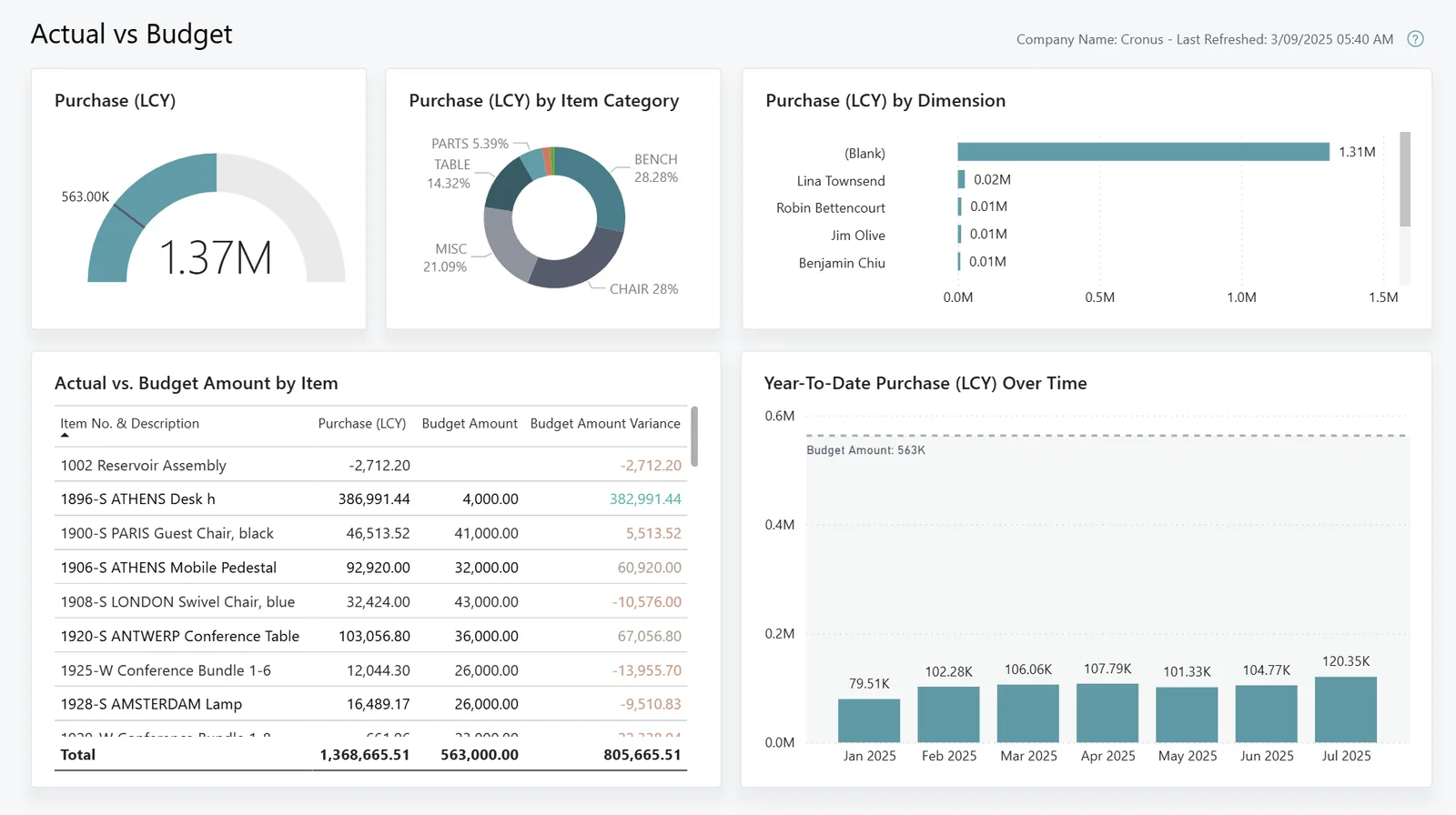
Controls need monitoring. These reports show where policy is being followed and where it is bypassed.
All four can enforce the core controls. The depth of budget control and matching differs; confirm features for your edition.
| Zoho | Odoo | ERPNext | Dynamics 365 | |
|---|---|---|---|---|
| Budget check on purchases | Budgets and budget vs actual in Zoho Books; hard stops usually via custom functions or Zoho Creator | Budgets in Accounting (Enterprise) with analytic accounts; blocking typically needs configuration | Budget against cost center or project with stop or warn on Material Request and PO | Budget control in Finance and SCM; Business Central uses budgets plus approval workflows |
| PO approval rules | Multi-level approvals on purchase orders and bills | Purchase order double validation above an amount, plus Approvals app | Workflow with states and roles by amount or category | Purchase approval workflows with limits per approver |
| RFQ and quote comparison | Usually handled with draft POs, Zoho Creator or a procurement add-on | RFQs native; call for tenders through purchase agreements | Request for Quotation and Supplier Quotation comparison report | Purchase quotes in Business Central; RFQ process in Finance and SCM |
| Three-way matching | Bills linked to POs and receives in Zoho Inventory; matching checks often added by custom logic | Bill control policy based on ordered or received quantities | Purchase Invoice against Purchase Receipt with over-billing tolerance | Matching policies in Finance and SCM; Business Central via receipt-based invoicing |
| Segregation of duties | Role-based permissions per module | Access groups and record rules | Role permissions per doctype and action | Permission sets and security roles |
| Audit trail | Audit logs and record history | Chatter history and tracked fields | Version history on documents | Change log and workflow history |
We do not implement SAP or NetSuite; if you are moving from one of them, we map your existing control matrix to the new platform.
Some controls depend on data from outside the ERP.
Controls are mainly about internal governance, but several UAE rules depend on them. Confirm specifics with your tax advisor.
Matching bills to POs and verified suppliers ensures input VAT is claimed only on proper tax invoices with the correct TRN and amounts.
From the phased 2027 start dates, in-scope supplier invoices arrive as structured e-invoices through ASPs. A PO-based matching process lets the ERP validate them automatically; check the latest MoF / FTA guidance.
Purchases from related parties must be at arm's length. Tagging related-party vendors and keeping quotation evidence supports your documentation.
Approval logs, quotations and GRNs should be kept with the invoices for at least five years under Cabinet Decision 74 of 2023.
General information, not tax or legal advice. Rules change; confirm current FTA, MOHRE and Ministry of Finance guidance with your advisor.
These are the outcomes buyers, finance managers and auditors notice first.
Commitments are visible when the PO is raised, not weeks later when the bill arrives, which supports project budget control as well.
Short deliveries and price differences are caught at matching instead of being paid and chased later.
Auditors can test controls from system logs instead of sampling email chains.
Consolidated spend by category and supplier gives buyers hard facts for the next negotiation round, and complements expense control on non-PO spend.
Typical ranges for a mid-sized UAE company; multi-entity groups take longer.
Durations are typical ranges; your plan is agreed after discovery.
Turn the written policy into rules: thresholds, quotation bands, approvers, tolerances and role separation.
Load budgets by cost center or project, clean the vendor list and define approved suppliers.
Build approvals, budget checks, matching tolerances and permissions, then test with real past transactions.
Run one department or project first, review overrides weekly, then roll out to all buyers.
Review exception reports and adjust thresholds based on actual override patterns.
We configure the system for the rules UAE businesses report against, and test it before go-live.
General information, not tax or legal advice. Confirm current requirements with the FTA, MOHRE or your advisor. See all UAE compliance guides.
On-site workshops in Dubai, Abu Dhabi and Sharjah, and remote or on-site delivery across the Northern Emirates and free zones.
Official sources and references
Facts on this page were checked against these sources in October 2026. Rules change, so confirm current requirements before acting.
Still have a question? Our consultants are happy to help.
Ask an ExpertPurchase approval is the chain of people who sign off a PO. Procurement control is the full set of rules around it: budgets, quotations, approved vendors, matching and role separation. Approval is one control among several.
Many UAE companies start with a warning plus a mandatory reason, then move to a hard stop for specific cost centers once budgets are reliable. Blocking too early with poor budgets just creates override noise.
There is no universal figure. Companies usually set a small percentage or fixed amount for price differences and zero tolerance on quantity for stock items. Your auditor and finance manager should agree the values.
Partly. Where one person must do several steps, use compensating controls: manager approval of vendor changes, a monthly review of POs created after invoice date, and dual approval on payment runs.
Yes. Budgets are held by project and cost code, and site requisitions feed the same controls. See project procurement software for project-specific detail.
Usually the finance manager owns the rules and the procurement manager owns daily operation. The role is described further on our page for procurement managers.
Related Solutions
Related Industries
Related ERP Platforms
We will review your purchasing policy against how your team actually buys and show which controls the ERP can enforce.
Dubai, United Arab Emirates