L
O
A
D
I
N
G


Zoho, Odoo, ERPNext, Dynamics 365 and custom ERP, delivered by one accountable team.

Replace scattered vendor files, WhatsApp price quotes and unverified bank details with one controlled supplier record that buyers, stores and accounts all trust.
An ERP for supplier management in the UAE keeps one controlled vendor record behind every purchase: legal identity with trade license, TRN and emirate or free zone, bank details such as IBAN and currency, credit terms, price lists, lead times and performance scores. Onboarding includes document and TRN checks before approval, and scorecard reviews decide whether a supplier is renewed or blocked, reducing duplicates and expired licenses.
An ERP for supplier management in the UAE is not just a list of vendor names. It is the controlled record behind every purchase: who the supplier legally is (trade license, TRN, emirate or free zone), how you pay them (IBAN, currency, credit terms), what they sell you at what price, how long they take to deliver, and how well they have performed. When that record is wrong, every PO, GRN and bill built on it inherits the error.
Most UAE SMEs we meet hold this information in four places at once: a vendor sheet in Excel, supplier quotations in the buyer's WhatsApp and email, bank letters in a shared folder, and the accounting system's vendor list with half the fields empty. Duplicate vendors appear (Al Noor Trading LLC and Al Noor Trdg), expired trade licenses go unnoticed, and nobody can say which supplier is late most often.
This page covers the vendor lifecycle: onboarding, master data, pricing, performance and relationship review. The approval of individual purchases is covered in ERP for purchase approval, and the wider policy layer in ERP for procurement control.

These issues rarely look serious one by one. Together they create overpayments, input VAT problems and payment fraud risk.
The same supplier exists two or three times with different spellings and credit terms. Payments, statements and spend reports are split, so nobody sees the true balance or volume.
Accounts post bills without checking that the supplier's TRN is valid and matches the legal name. Input VAT on an invalid tax invoice may not be recoverable, which only surfaces during an FTA review.
An email arrives asking to pay a new IBAN, and someone updates the vendor record directly. Without a second approver and a call-back check, one changed field can redirect a large payment.
Buyers negotiate rates on calls and WhatsApp but the system still holds last year's price. Bills come in higher than agreed and nobody can prove what the agreed rate was.
Opinions about which vendor is reliable depend on who you ask. Late deliveries, short supplies and quality rejections are not counted, so the same poor supplier keeps winning orders.
Trade licenses, ISO certificates, insurance and framework agreements expire silently. Auditors and main contractors ask for them, and the procurement team spends days collecting copies.
Each step leaves a record in the ERP, so the vendor file is complete before the first PO is raised and stays current afterward.
One shared database: every step updates stock, finance and reports in real time.
Supplier management touches purchasing, stores and finance, so the vendor record must be shared across all three rather than copied.
Legal name as per trade license, TRN, address by emirate, payment terms, currency and default accounts. Mandatory fields stop half-finished records.
A request form with document uploads and a review step, often automated as described in vendor onboarding automation.
Supplier-specific prices, minimum order quantities and validity dates; see supplier price list software for the detail.
RFQs, POs and blanket agreements that pull terms and prices from the vendor master instead of retyping them.
GRNs record what actually arrived, when, and in what condition, which is the raw data for on-time and in-full scoring.
Incoming inspection results and rejection reasons are linked to the supplier and the batch.
Bills, debit notes, advances and statements per vendor, with matching against POs and receipts.
Trade license, VAT certificate, bank letter and contracts stored on the vendor record with expiry reminders.
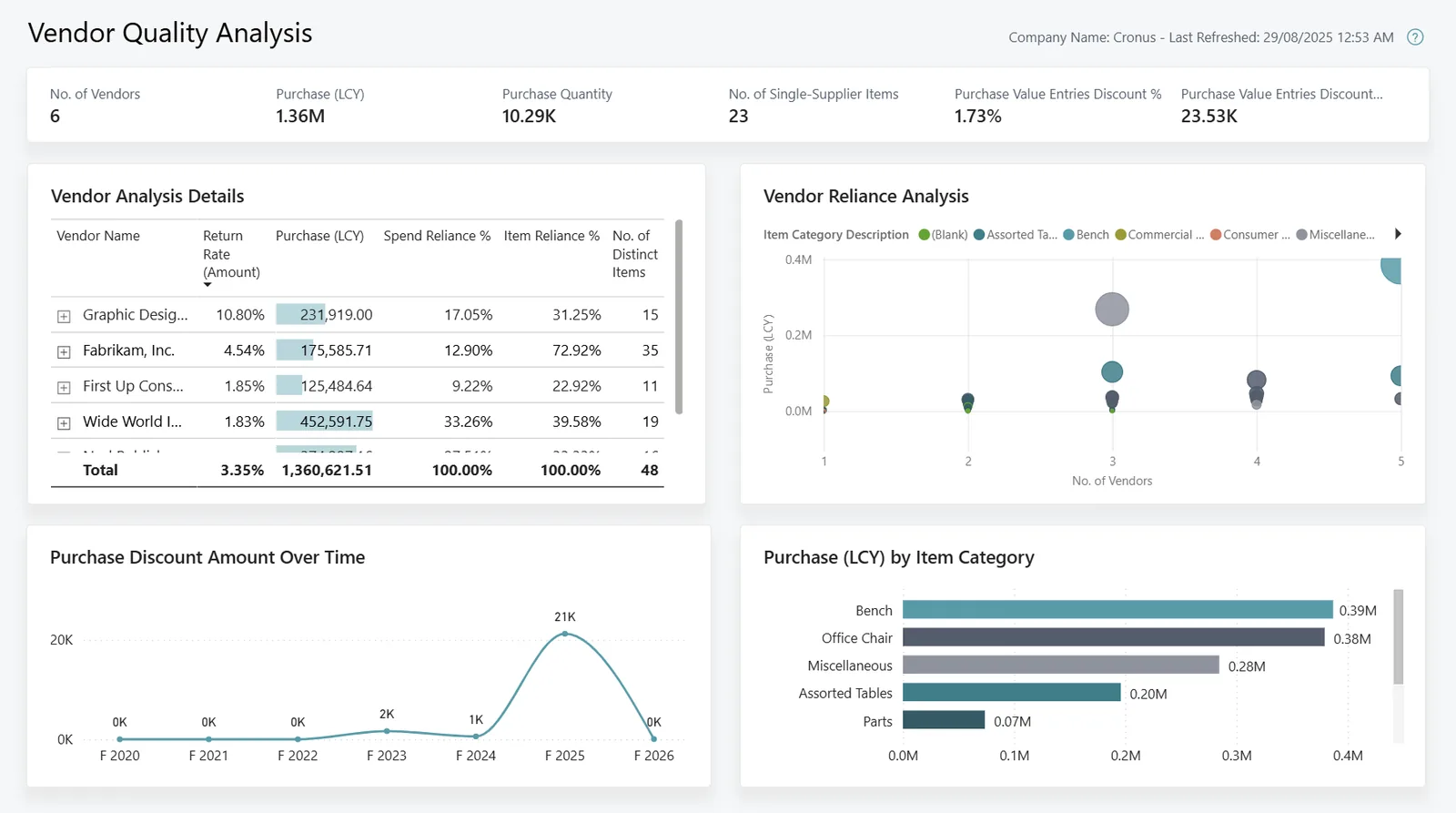
A purchasing dashboard built on actual receipts and bills gives a fact-based view of each vendor.
All four platforms we implement can hold a controlled vendor master. They differ in onboarding, scoring and portal options; confirm details for your edition.
| Zoho | Odoo | ERPNext | Dynamics 365 | |
|---|---|---|---|---|
| Vendor master and custom fields | Vendors in Zoho Books and Zoho Inventory with custom fields for TRN, license number and expiry | Contacts flagged as vendors, with custom fields via Studio | Supplier doctype with custom fields and naming series | Vendor card in Business Central; fuller vendor management in Finance and SCM |
| Onboarding approval | Typically a Zoho Creator or Zoho Forms intake with approval, then sync to Books | Approvals app or Studio-based workflow, depending on edition | Workflow on the Supplier doctype with approval states | Approval workflows for vendor creation and changes in Business Central |
| Supplier price lists | Purchase price lists in Zoho Inventory and Books | Vendor pricelists on products with quantity breaks and validity dates | Buying price lists and Item Price per supplier | Purchase prices and discounts per vendor and item |
| Performance scoring | Reports in Zoho Analytics built from receipts and bills | Vendor on-time delivery figures in Purchase reporting; deeper scoring via reports | Built-in Supplier Scorecard with weighted criteria | Vendor performance via reports in Business Central; vendor evaluation in Finance and SCM |
| Supplier self-service | Vendor portal in Zoho Books in recent editions; confirm for your plan | Supplier portal access to RFQs and POs | Supplier portal for RFQs, quotes and orders | Vendor collaboration in Finance and SCM; Business Central usually via add-ons |
| Bank detail change control | Approval and audit log on vendor edits, plus process control | Field tracking in chatter and approval rules | Version history and workflow on bank account records | Change log and approval workflow on vendor bank accounts |
Capabilities change between releases. We confirm the exact edition features during discovery.
The vendor master is more useful when it connects to the tools your buyers and accountants already use.
Supplier data feeds your VAT return and audit file, so the record must support the rules. Confirm specifics with your tax advisor.
Input VAT recovery depends on holding a valid tax invoice showing the supplier's TRN. Store the TRN on the vendor record, verify it against the FTA's TRN verification service at onboarding, and flag vendors that are not VAT registered.
Overseas suppliers and imported goods usually trigger reverse charge accounting for VAT-registered businesses. Tagging vendors by country and tax treatment helps the ERP post the right tax codes.
Under the UAE e-invoicing model, supplier invoices in scope will arrive as structured PINT AE documents through Accredited Service Providers. Clean vendor TRNs and identifiers make matching easier; see UAE e-invoicing and check the latest MoF / FTA guidance.
Keep supplier invoices and contracts for at least five years under Cabinet Decision 74 of 2023 (longer for real estate). Flag related-party suppliers so corporate tax arm's length reviews have the data they need.
General information, not tax or legal advice. Rules change; confirm current FTA, MOHRE and Ministry of Finance guidance with your advisor.
The benefits come from fewer errors and better buying decisions, not from more paperwork.
Bank detail changes need a second approver and leave an audit trail, so a single spoofed email cannot redirect a payment.
Bills are posted against verified suppliers with correct tax treatment, which reduces corrections at return time.
Buyers choose suppliers on recorded delivery and quality history, not on memory or relationships alone.
One record per vendor makes supplier statement reconciliation and advance tracking straightforward.
Supplier management is often delivered as part of a purchasing rollout. Durations are typical ranges and depend on data quality.
Durations are typical ranges; your plan is agreed after discovery.
Export all vendor lists, find duplicates, and agree the mandatory fields and naming rules.
Merge duplicates, collect missing TRNs, licenses and bank letters, and mark inactive vendors.
Build the request form, approval steps, bank change control and document expiry alerts.
Load agreed prices and lead times, define scoring criteria and build the supplier dashboard.
Run the first quarterly supplier review using real GRN and bill data, then adjust criteria.
We configure the system for the rules UAE businesses report against, and test it before go-live.
General information, not tax or legal advice. Confirm current requirements with the FTA, MOHRE or your advisor. See all UAE compliance guides.
On-site workshops in Dubai, Abu Dhabi and Sharjah, and remote or on-site delivery across the Northern Emirates and free zones.
Official sources and references
Facts on this page were checked against these sources in October 2026. Rules change, so confirm current requirements before acting.
Still have a question? Our consultants are happy to help.
Ask an ExpertAt minimum: legal name exactly as on the trade license, license number and expiry, issuing authority or free zone, TRN and VAT status, address, payment terms, currency, IBAN and SWIFT, and contact persons. Add category, lead time and approved status so purchasing can filter correctly.
Restrict vendor creation to a small master data role, make TRN and license number unique fields where the platform allows, and route new vendor requests through an approval step. Run a duplicate check report monthly during the first year.
Yes, if receipts and inspections are recorded properly. ERPNext has a built-in Supplier Scorecard; on Zoho, Odoo and Dynamics 365 we usually build scoring reports from GRN dates, rejected quantities and price variances.
A portal helps when you send many RFQs or want suppliers to confirm POs and upload invoices themselves. For a small vendor base, email with PDF POs is often enough. We decide based on volume and supplier readiness.
Yes. Supplier management controls who you are allowed to buy from and on what terms. Purchase approval controls whether a specific PO can go out. They work together, and the approved vendor list is usually one of the checks in the approval rules.
It depends on your size and the rest of your processes. We implement Zoho, Odoo, ERPNext and Dynamics 365, and recommend based on purchasing volume, number of suppliers, inventory needs and budget, often after a short procurement software review.
Related Solutions
Related Industries
Related ERP Platforms
Related Guides
Share your current supplier list and we will show you how it would look as a clean, controlled vendor master in your ERP.
Dubai, United Arab Emirates