
L
O
A
D
I
N
G


Zoho, Odoo, ERPNext, Dynamics 365 and custom ERP, delivered by one accountable team.

Every month your suppliers send statements that rarely agree with your books. We configure ERP so the AP team can match each vendor statement, explain every difference and act on it.
Supplier statement reconciliation in an ERP works by importing the vendor's statement of account, matching each line to bills, payments and debit notes in the accounts payable ledger, then classifying every difference with a reason code and an owner. Common UAE differences include invoices stuck in approval, goods received not invoiced, unaccepted debit notes, payments or PDCs in transit and exchange rate mismatches.
An ERP for supplier statement UAE setup solves a recurring month-end job: comparing the statement of account a vendor sends you with the vendor's balance in your accounts payable ledger, then explaining the difference. In UAE trading and contracting companies with hundreds of active suppliers, this is often done for only the top twenty vendors, in Excel, after a supplier has already put the account on hold.
The differences are almost always the same types. The supplier has invoiced goods your storekeeper has received but the invoice is still in someone's inbox. You have raised a debit note for short supply or rejected material that the supplier has not booked. A payment or PDC you issued is in transit. The supplier has charged a price that does not match the PO, or the invoice is in USD and both sides used different exchange rates.
This page is about the reconciliation of the supplier's statement against your books. Paying suppliers, approvals and three-way matching belong to ERP for accounts payable, and the customer-facing equivalent is our customer statement page.

These are the reconciling items we find most often in UAE companies, and why they stay unresolved without a system.
Supplier invoices sit with site engineers or purchasers waiting for approval. The supplier shows them as due while your ledger does not know they exist.
GRNs posted in the warehouse with no matching bill create a GRNI balance. Without a report by supplier, nobody knows which statement lines these explain.
Returns, short deliveries and quality rejections are recorded as debit notes on your side, but the supplier has not issued a matching credit note, so balances differ by those amounts.
A transfer made on the 30th or a PDC dated next month appears in your ledger but not on the supplier's statement. Teams waste time chasing differences that are only timing.
When the invoice price differs from the PO or the delivered quantity, the balances diverge. These need to go back to procurement, not stay with accounts.
Import suppliers bill in USD or EUR. Different rates on invoice and payment dates leave small residual balances that never clear.
A monthly cycle that turns each vendor statement into a list of explained, owned differences.
One shared database: every step updates stock, finance and reports in real time.
The reconciliation is only as good as the purchase-to-pay data behind it.
Vendor bills, payments, debit notes and allocations, by supplier and currency.
PO prices and received quantities that explain price and quantity differences on the statement.
Goods received not invoiced, by supplier and age, to explain statement lines your ledger has not booked.
Returns and claims raised against suppliers, with status: sent, acknowledged, credit note received.
Outgoing transfers and cheques with value dates, so timing differences can be identified automatically.
Exchange rates by date and realized or unrealized gain and loss postings for foreign suppliers.
OCR or email-in capture of supplier invoices so bills reach the ledger before the statement arrives.
Routes unrecorded invoices and disputed lines to the right approver with a deadline.
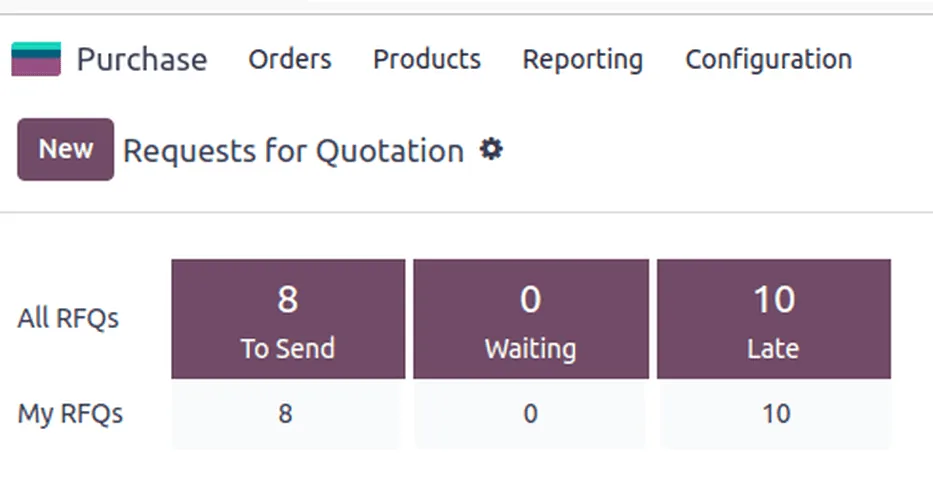
A purchase-side dashboard that shows where your books and your suppliers disagree.
None of the four platforms is built only for statement matching, so the setup combines standard reports with a light reconciliation tool. Confirm features for your edition.
| Zoho | Odoo | ERPNext | Dynamics 365 | |
|---|---|---|---|---|
| Vendor ledger | Vendor balance and transaction reports in Zoho Books | Partner ledger filtered to payables | General Ledger and Accounts Payable reports by supplier | Vendor ledger entries in Business Central |
| GRNI visibility | Limited without Zoho Inventory; bills linked to purchase receives | Bills-to-receive and stock interim accounts | Purchase Receipt Trends and stock received not billed account | Receipt lines not invoiced and the related G/L account |
| Statement import | Usually via CSV and a custom module or Zoho Creator app | Custom module or import into a reconciliation model | Custom doctype with data import | Configuration package or extension |
| Auto-matching | By invoice number through custom logic | Matching rules can be adapted from bank reconciliation patterns | Server script or custom app | Extension or Power Automate flow |
| Debit notes | Vendor credits | Vendor refunds and credit notes | Debit Note via return purchase invoice | Purchase credit memos |
| FX differences | Exchange gain or loss on payment | Automatic exchange difference entries | Exchange rate revaluation | Adjust exchange rates batch job |
We usually build a small matching tool on top of the standard ledger; it is a configuration, not a replacement for the AP module.
The fewer documents typed by hand, the fewer differences you have to explain.
Supplier balances feed your VAT input claim and your corporate tax deductions. Confirm specific treatment with your tax advisor.
Input VAT is generally recoverable when you hold a valid tax invoice. Invoices on the supplier's statement that you never booked may mean input VAT not yet claimed; supplier credit notes reduce it.
Once UAE e-invoicing applies to your business, supplier invoices in scope arrive through your Accredited Service Provider in PINT AE format, which should reduce missing invoices. Check the latest MoF and FTA guidance on dates.
Expenses must be supported by records to be deductible. A reconciled supplier ledger supports accrued costs at year end.
Keep supplier statements and signed reconciliations with your tax records, generally for at least 5 years (7 for real estate).
General information, not tax or legal advice. Rules change; confirm current FTA, MOHRE and Ministry of Finance guidance with your advisor.
Results depend on how disciplined GRN and bill posting is upstream.
Differences are found and settled before a vendor stops supply.
Unbooked invoices and GRNI are visible, so month-end cost accruals are complete.
Debit notes are tracked until the supplier issues a credit note.
Signed reconciliations are attached to each supplier, ready for confirmation testing.
Usually delivered as part of a purchase-to-pay project; hedged ranges for a focused rollout.
Durations are typical ranges; your plan is agreed after discovery.
Review top supplier statements and classify current differences.
Enforce GRN posting, invoice capture and debit note workflow.
Statement import, matching rules, reason codes and sign-off.
Start with top suppliers by spend, then extend to all active vendors.
We configure the system for the rules UAE businesses report against, and test it before go-live.
General information, not tax or legal advice. Confirm current requirements with the FTA, MOHRE or your advisor. See all UAE compliance guides.
On-site workshops in Dubai, Abu Dhabi and Sharjah, and remote or on-site delivery across the Northern Emirates and free zones.
Official sources and references
Facts on this page were checked against these sources in October 2026. Rules change, so confirm current requirements before acting.
Still have a question? Our consultants are happy to help.
Ask an ExpertMost companies reconcile high-spend and import suppliers monthly and the rest quarterly or on request. The ERP dashboard shows which suppliers have not been reconciled so nobody is missed for a year.
Invoices that the supplier has issued but that are stuck in approval on your side, followed by GRNI and unaccepted debit notes. Fixing invoice capture and approvals removes much of the work.
Advances paid before delivery should sit on a separate account until applied to the bill. Our supplier advance management page covers how to hold and apply them so they match the supplier's view.
Yes. Matching invoices to PO prices and agreed rates at the time of booking catches most of them. Keeping current rates in supplier price lists helps buyers raise POs at the right price.
Reconciliation is a finance task, but its results feed supplier evaluation: repeated invoicing errors are a supplier performance issue. See ERP for supplier management.
All four can support it with a modest configuration. The choice usually depends on your wider finance and procurement needs, which we compare on our ERP finance and accounting page.
Related Solutions
Related Industries
Related ERP Platforms
Send us a few recent supplier statements and we will show which differences your ERP could explain automatically.
Dubai, United Arab Emirates










