L
O
A
D
I
N
G


Zoho, Odoo, ERPNext, Dynamics 365 and custom ERP, delivered by one accountable team.

CAFM ties every building, space, asset, contract and service request in your portfolio to one record, so the helpdesk, the supervisors and finance work from the same data.
CAFM (computer-aided facility management) software runs an FM portfolio from one record: sites, buildings, units and assets, hard services such as MEP, HVAC and fire safety, and soft services such as cleaning and security. In the UAE it combines a helpdesk, PPM and reactive work orders, contract SLAs, mobile job completion, cost tracking and monthly client reports per building.
CAFM software (computer-aided facility management) is the system an FM operation uses to run its whole portfolio: the sites, buildings, floors and units, the assets in them, the hard services (MEP, HVAC, plumbing, fire and life safety, lifts) and the soft services (cleaning, security, pest control, landscaping, waste). In the UAE that portfolio might be a dozen residential towers in JVC and Business Bay, a school group across Abu Dhabi and Al Ain, or a retail estate split between Dubai and Sharjah.
The difference between CAFM and a pure maintenance tool is scope. CMMS software looks inward at equipment reliability. CAFM looks outward at the client and the building: who reported the leak, which unit it is in, which contract covers it, whether the cleaning team visited the lobby on schedule, and what the monthly report to the owners association or landlord should say. It sits in the middle of the facility management software picture.
Many UAE FM companies today run CAFM as a standalone tool and keep finance, payroll and stores in a separate accounting package. That split is where the trouble starts: completed jobs are re-typed into invoices, parts are issued without a work order, and contract profitability is only known at year end. Running CAFM on, or tightly integrated with, an ERP closes that gap.

These are the problems we see most often in UAE FM contractors and in-house property teams that run on spreadsheets or a basic ticketing tool.
Each site supervisor keeps a separate Excel file of assets and jobs. Head office cannot see open jobs, overdue PPM or SLA breaches across all buildings without asking for reports.
Cleaning, security and pest control are tracked on paper attendance sheets. When the client disputes a missed visit, there is no time-stamped proof.
Tenants phone the building manager, email the FM company and send WhatsApp messages to a supervisor. Requests are lost or duplicated, and the SLA clock is never started properly.
Technicians do not know whether a job is inside the AMC or chargeable. Work outside scope is done for free, or the client is billed for something they already paid for.
Contract managers spend the first week of each month compiling job counts, PPM completion and KPI tables by hand for each client meeting.
Labour hours, parts and subcontractor costs are not linked to the contract, so loss-making buildings are only spotted when the contract is up for renewal.
The process diagram below is the backbone we configure for FM contractors. Each step creates a record linked to the building, asset and contract.
One shared database: every step updates stock, finance and reports in real time.
A CAFM built on ERP uses standard modules, configured for FM.
Hierarchy of sites, buildings, floors, units and assets with make, model, serial, location, warranty and QR tag.
One queue for portal, email, phone and WhatsApp requests, with categories for hard and soft services and priority rules.
Reactive jobs, PPM visits and soft-service rounds dispatched to teams with checklists and mobile completion.
Contract scope, covered assets, response and resolution targets, and penalty or credit terms per client.
Spare parts and consumables by store and van, purchase requests for non-stock parts, issue against jobs.
Technician and cleaner rosters, skills, trade documents and hours booked against each job and site.
Recurring contract invoices, chargeable works invoices, VAT and job costing posted to the right cost centre.
Per-building KPIs, PPM completion and SLA performance shared with clients through a portal or scheduled report.
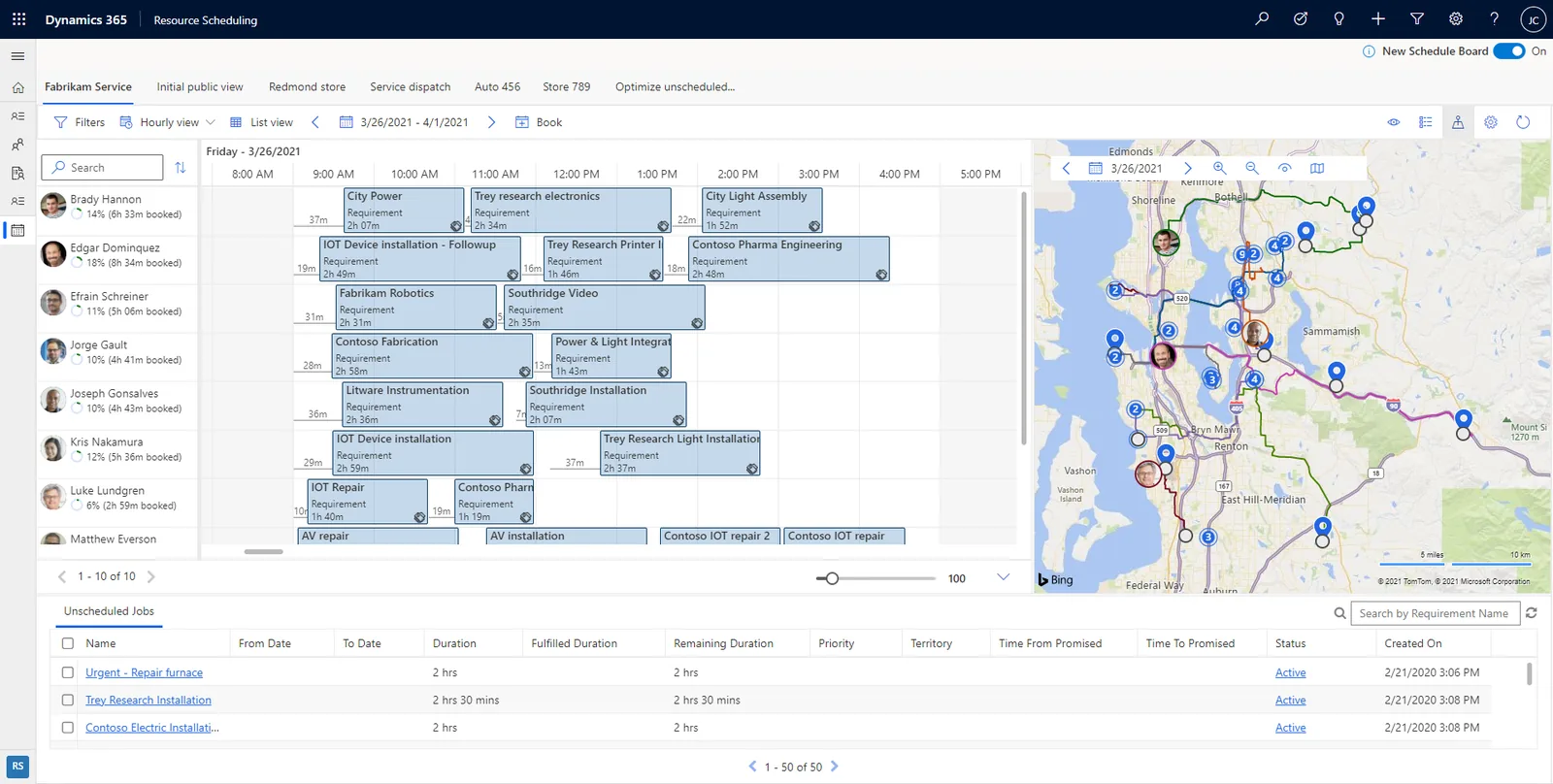
The FM operations manager and each contract manager use the same dashboard, filtered by client or building.
A hedged summary. None of the four is a dedicated CAFM product out of the box; each covers CAFM processes through standard apps plus configuration. Confirm features for your edition.
| Zoho | Odoo | ERPNext | Dynamics 365 | |
|---|---|---|---|---|
| Asset and location hierarchy | Assets in Zoho FSM linked to customers and service addresses; deeper hierarchies often built in Zoho Creator | Equipment records in Maintenance, linked to locations; building hierarchy usually added by configuration | Asset and Location doctypes with parent-child locations | Customer assets in Field Service with parent-child relationships and functional locations |
| Helpdesk and requests | Zoho Desk tickets, converted to FSM requests | Helpdesk (Enterprise) with SLA policies and customer portal | Issue doctype with Service Level Agreement and portal | Customer Service cases with entitlements and SLAs |
| Field jobs and mobile | Zoho FSM work orders and mobile app | Odoo Field Service tasks with worksheets and mobile access (Enterprise) | Maintenance Visit and custom mobile forms; mobile app options vary | Field Service work orders and mobile app |
| Planned maintenance | Maintenance plans in Zoho FSM; confirm for your edition | Preventive maintenance by frequency in Maintenance | Maintenance Schedule and Asset Maintenance tasks | Agreements generating recurring work orders |
| Contracts and billing | Contracts tracked in FSM or Creator, invoiced through Zoho Books | Subscriptions (Enterprise) for recurring AMC billing; invoices in Accounting | Contracts plus Subscription for recurring invoices | Agreements with invoice setups; billing via Finance or Business Central |
| Soft services | Recurring work orders or Creator forms for rounds | Recurring field service tasks or Planning | Recurring tasks or custom doctypes | Recurring work orders and scheduling |
| Best fit | Small to mid FM contractors already on Zoho | Mid-size contractors wanting one database for FM, stores and accounting | Cost-conscious contractors with in-house technical staff | Large multi-entity FM groups on Microsoft |
CAFM sits between the client, the field and finance, so most projects include several of these.
CAFM records support several obligations. Confirm the specific requirements for your contracts and buildings with your advisors and the relevant authority.
AMC and FM service invoices carry 5% VAT with your TRN and the prescribed tax invoice fields. Periodic contract billing affects the date of supply, so agree the invoicing pattern with your tax advisor.
B2B invoices to building owners and corporate clients will move to PINT AE e-invoices through an Accredited Service Provider: from 1 January 2027 for businesses with revenue of AED 50 million or more and from 1 July 2027 for others. Check the latest Ministry of Finance and FTA guidance.
Civil defence authorities expect fire and life safety systems to be maintained and inspected, typically by approved contractors. CAFM keeps the visit history, checklists and certificates per building.
Service requests hold names, unit numbers and phone numbers. The UAE Personal Data Protection Law (Federal Decree-Law 45 of 2021) and client contracts call for access control and sensible retention.
General information, not tax or legal advice. Rules change; confirm current FTA, MOHRE and Ministry of Finance guidance with your advisor.
Benefits we aim for in every CAFM rollout; actual results depend on your starting point.
Head office sees every open job, overdue PPM and SLA risk across all buildings without asking sites for reports.
Monthly KPI packs are generated from live data instead of compiled by hand before each client meeting.
Chargeable works and out-of-scope jobs are flagged at dispatch and flow straight to invoicing.
Labour, parts and subcontractor costs post against each contract, so renewal pricing is based on facts.
Indicative ranges for an FM contractor with a few hundred assets per site; larger portfolios take longer.
Durations are typical ranges; your plan is agreed after discovery.
Map contracts, service lines, request channels, SLAs and the client reporting each contract requires.
Build the site and building hierarchy, import assets, tag key equipment with QR codes.
Helpdesk, work order types, PPM plans, contract and SLA rules, mobile forms and billing.
Go live on one or two contracts, refine checklists and dispatch rules with supervisors.
Add remaining contracts in waves, then switch on client portals and dashboards.
We configure the system for the rules UAE businesses report against, and test it before go-live.
General information, not tax or legal advice. Confirm current requirements with the FTA, MOHRE or your advisor. See all UAE compliance guides.
On-site workshops in Dubai, Abu Dhabi and Sharjah, and remote or on-site delivery across the Northern Emirates and free zones.
Official sources and references
Facts on this page were checked against these sources in October 2026. Rules change, so confirm current requirements before acting.
No. CMMS concentrates on maintaining equipment: asset records, preventive schedules, failure history and spare parts. CAFM covers the wider facility: spaces, hard and soft services, helpdesk, contracts and client reporting. A CAFM usually includes CMMS functions, not the other way round.
Yes, and it should. Cleaning rounds, security patrols and pest control visits are set up as recurring jobs with checklists, so you get the same proof of visit for soft services as for MEP maintenance.
Not necessarily. If the CAFM works well for operations, we often integrate it with the ERP so completed jobs, parts and timesheets flow into billing and costing. Replacement makes sense when the CAFM and finance data constantly disagree or licence costs grow with every site.
Each job is linked to the contract that covers the building or asset. The contract defines scope, response and resolution targets and whether work is chargeable. Our FM contract software and SLA management guides go into the detail.
Through a portal, email, phone or WhatsApp; all land in one helpdesk queue. Our service request management guide covers categories, priorities and acknowledgements.
Yes. That is the main reason UAE FM companies choose an ERP-based CAFM. See ERP for facility management companies for how finance, HR and WPS payroll fit around the FM operation.
Related Solutions
Related Industries
Related ERP Platforms
Share a sample of your buildings, contracts and request types and we will show the workflow configured on the platform that fits.
Dubai, United Arab Emirates