L
O
A
D
I
N
G


Zoho, Odoo, ERPNext, Dynamics 365 and custom ERP, delivered by one accountable team.

Corrective work is where FM teams win or lose client trust. The software has to get the right technician to the fault fast, control what is chargeable and stop the same failure coming back.
Corrective maintenance software manages unplanned repair work after a failure, such as an AC unit not cooling or a water leak in a UAE building. It takes in fault reports, sets priority from impact and urgency, dispatches the nearest qualified technician, checks whether the job is inside the AMC or chargeable, gets quotes approved, and records root cause to prevent repeats.
Corrective maintenance is the work done after something has failed or is found faulty: an AC unit not cooling in a JLT apartment in August, a tripped pump in a Sharjah warehouse, a water leak from a ceiling in a Business Bay office, or a defect spotted during a PPM visit. Corrective maintenance software handles that unplanned work, from the first fault report to the root cause recorded at close.
It has three jobs the planned side does not. It must triage quickly, because a total loss of cooling in summer or a failed fire pump cannot wait for tomorrow's schedule. It must control cost and scope, because many corrective jobs fall outside the AMC and need a chargeable works quote. And it must learn from each failure so the same fault does not come back next month. Planned work belongs to preventive maintenance software; the shared job record is the maintenance work order.
Corrective maintenance comes in two flavours: immediate (fix it now, for example an emergency or a safety issue) and deferred (the fault is logged and repaired in a planned slot, often after parts or approval arrive). Good software treats them differently instead of putting every fault into the same queue.

The issues that drive complaints and erode margin on reactive work.
Every call is treated the same, so a leaking ceiling over a server room waits behind a squeaky door. Response targets for urgent faults are missed even when technicians are available.
Technicians replace a damaged part caused by tenant misuse without a quote, because nobody told them it is chargeable. The cost is absorbed by the AMC.
A make-safe repair is done at night, the job is closed, and the permanent repair is never scheduled. The fault returns and the client loses confidence.
Jobs sit open while parts are sourced, but the system only shows "in progress". The client keeps calling and the coordinator has no update.
The same FCU is visited five times in a quarter by different technicians. Without cause codes and asset history, nobody spots the pattern or escalates it.
From fault report to root cause, with a decision point on scope before the cost is incurred.
One shared database: every step updates stock, finance and reports in real time.
The building blocks we configure for reactive work.
Portal, email, phone, WhatsApp and BMS alarm feeds creating a fault record with location, asset and photos.
Priority set from impact and urgency, with response and fix targets and out-of-hours rules.
Nearest available technician with the right trade, including on-call rosters for nights and Fridays.
Contract check on the asset, and a quote sent for approval when work is outside the AMC.
Parts reserved from store or van, or a purchase request raised with the job on hold for parts.
Make-safe, temporary and permanent repair tracked as linked jobs so the follow-up cannot be forgotten.
Standard cause codes (wear, misuse, power, water ingress, design) and remedies captured at close.
Flags assets with several corrective jobs in a set period and routes them to an engineer for review.
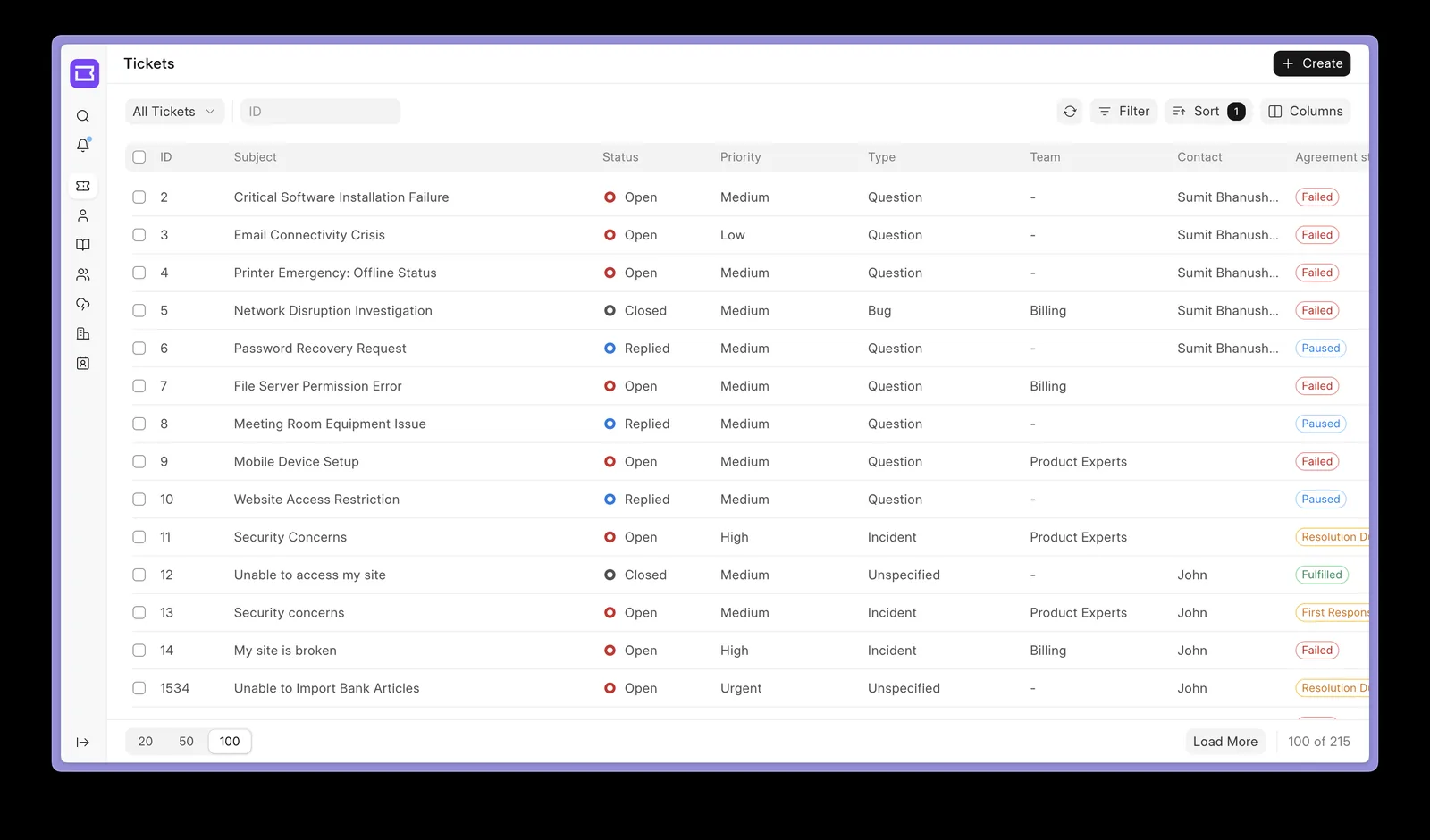
The helpdesk supervisor's live view of reactive work.
A hedged view; confirm the details for your edition and version.
| Zoho | Odoo | ERPNext | Dynamics 365 | |
|---|---|---|---|---|
| Fault intake | Zoho Desk tickets or FSM requests from portal, email and forms | Helpdesk tickets (Enterprise) or corrective requests in the Maintenance app | Issue or Warranty Claim, plus web forms | Cases in Customer Service, converted to work orders |
| Priority and SLA | SLA rules in Zoho Desk | SLA policies in Helpdesk | Service Level Agreement doctype on Issue | Entitlements and SLA KPIs |
| Dispatch | FSM dispatch console | Field Service planning (Enterprise) | Assignment rules; dispatch boards often customised | Schedule board; optimisation add-on available |
| Chargeable quotes | Estimates in FSM, invoiced via Zoho Books | Quotations from Sales linked to the job | Quotation linked to Issue or job | Quotes from work orders or Sales |
| Cause codes | Custom fields and picklists | Custom fields or tags on requests | Custom fields on Asset Repair or Issue | Incident types and resolution codes |
| Repeat-failure reporting | Zoho Analytics reports | Equipment request history and reporting | Report builder on repair history | Power BI or asset reports |
The faster a fault reaches the right technician, the better the response time.
Points that affect how reactive work is recorded and billed. Confirm specifics with your tax advisor and the relevant authority.
Out-of-scope repairs are separate supplies and need their own tax invoice at 5% VAT, with the quote and work order as support.
Chargeable invoices to corporate clients and owners associations will move to PINT AE e-invoices through an Accredited Service Provider from 2027, depending on your revenue band. Check the latest MoF and FTA guidance.
Faults on fire alarm, sprinkler or emergency lighting systems may need to be reported and rectified within timeframes set by the civil defence authority or the building's approvals. Record times and evidence on the job.
Night and Friday call-outs create overtime. Recording hours on the job feeds payroll, which pays salaries through the Wage Protection System (WPS).
General information, not tax or legal advice. Rules change; confirm current FTA, MOHRE and Ministry of Finance guidance with your advisor.
What teams usually gain when reactive work runs through a controlled process.
Triage puts life safety and loss-of-service faults first, with the right technician dispatched immediately.
Out-of-scope work is quoted and approved before it starts, so it is billed instead of absorbed.
Make-safe and permanent repairs are linked, so temporary fixes do not become the final answer.
Cause codes and repeat flags send problem assets to engineering review, and feed PPM interval changes.
Indicative ranges; the work overlaps with work order and helpdesk setup if those are done together.
Durations are typical ranges; your plan is agreed after discovery.
Agree priority matrix, response and fix targets, out-of-hours rules and escalation contacts.
Map contract scope per client and asset, set quote approval limits and chargeable rates.
Intake channels, dispatch rules, linked jobs, cause codes, quotes and dashboards.
Train the helpdesk on triage, technicians on cause coding and supervisors on hold reasons.
Review repeat failures and breaches, and adjust PPM plans and spares.
We configure the system for the rules UAE businesses report against, and test it before go-live.
General information, not tax or legal advice. Confirm current requirements with the FTA, MOHRE or your advisor. See all UAE compliance guides.
On-site workshops in Dubai, Abu Dhabi and Sharjah, and remote or on-site delivery across the Northern Emirates and free zones.
Official sources and references
Facts on this page were checked against these sources in October 2026. Rules change, so confirm current requirements before acting.
Still have a question? Our consultants are happy to help.
Ask an ExpertPreventive maintenance is planned before failure on a schedule. Corrective maintenance restores an asset after a failure or a detected defect. Most UAE FM operations aim to shift effort from corrective to preventive, and the corrective data shows where that shift is needed most.
Record contract scope against each building and asset class (for example, labour included, parts up to a value, exclusions for misuse). The system checks the job against these rules at triage and prompts a quote when the work falls outside them.
The clock starts when the fault is logged and stops at technician arrival (response) and at service restoration (fix), with pauses for agreed reasons such as no access. SLA management software covers clocks, pauses and breach reporting in detail.
Put it on hold with the reason, link the purchase request, and notify the client of the expected date. Holding critical spares in stock reduces these waits; see spare parts management.
Set a rule, such as three corrective jobs on one asset within 90 days, that flags the asset for engineering review. Cause codes then show whether the fix is a part replacement, a PPM change or a design issue.
Yes. Each fault is linked to the owner, building and contract, so chargeable works are quoted and billed to the right party. See ERP for property maintenance companies and building maintenance software.
Related Solutions
Related Industries
Related ERP Platforms
We will review your fault intake, triage and chargeable works process and show where response time and revenue are being lost.
Dubai, United Arab Emirates