
L
O
A
D
I
N
G


Zoho, Odoo, ERPNext, Dynamics 365 and custom ERP, delivered by one accountable team.

Recognize revenue when it is earned, not when it is invoiced. We configure revenue schedules, deferred revenue and contract reporting in Zoho, Odoo, ERPNext and Dynamics 365.
An ERP handles revenue recognition by posting invoices for contracts, subscriptions or maintenance agreements to deferred revenue and releasing them to income on a schedule as performance obligations are satisfied, in line with IFRS 15. It also records unbilled revenue and reconciles deferred balances to the ledger monthly. In the UAE, VAT still follows tax point rules, not the recognition schedule.
Under IFRS 15, revenue is recognized when a performance obligation is satisfied, which is often different from when you invoice or get paid. A software company bills a 12-month license upfront, a facility management firm invoices an annual maintenance contract quarterly in advance, a training provider sells course packages, and a contractor bills progress. ERP for revenue recognition in the UAE turns each of those contracts into a schedule that releases revenue month by month from the deferred revenue account.
Most finance teams we meet manage this in a spreadsheet: a list of invoices with start and end dates and a formula for each month. It works until the contract is renewed early, upgraded mid-term, cancelled or credited. Then the sheet and the ledger diverge, and auditors ask for a reconciliation.
Revenue recognition matters more since corporate tax: taxable income starts from accounting profit, so the timing of revenue affects the tax return. It is also separate from VAT, which follows the tax point rules, not the accounting schedule. For contract-level job costing, see project accounting.

These issues are common when schedules live outside the ERP.
Renewals, upgrades and early terminations are not reflected in the sheet, so the deferred revenue balance stops matching the ledger.
A sale of hardware, installation and a two-year support contract is booked as one line. The support element should be deferred, but the invoice does not show it separately.
When a customer is credited mid-term, the schedule keeps releasing revenue that no longer exists, overstating income for months.
Services delivered in March but invoiced in April are not accrued, so March revenue and margin are understated.
Teams try to align VAT with accounting revenue, or delay invoices to match recognition. VAT follows its own tax point rules, and mixing the two causes errors in both.
This flow is how we configure revenue schedules so they follow every change to the contract.
One shared database: every step updates stock, finance and reports in real time.
Revenue recognition sits between billing and the general ledger.
Contract records with term, billing frequency, renewal date and linked products.
Items flagged as deferred with a default recognition period, such as 12-month support or annual licenses.
Invoice lines carrying service start and end dates so the deferral is calculated automatically.
Monthly or daily schedules generated from each line, with journal entries posted at period end.
Unbilled revenue entries for delivered work, reversed when the invoice is raised.
Deferred revenue, unbilled revenue and revenue accounts by stream for reporting and audit.
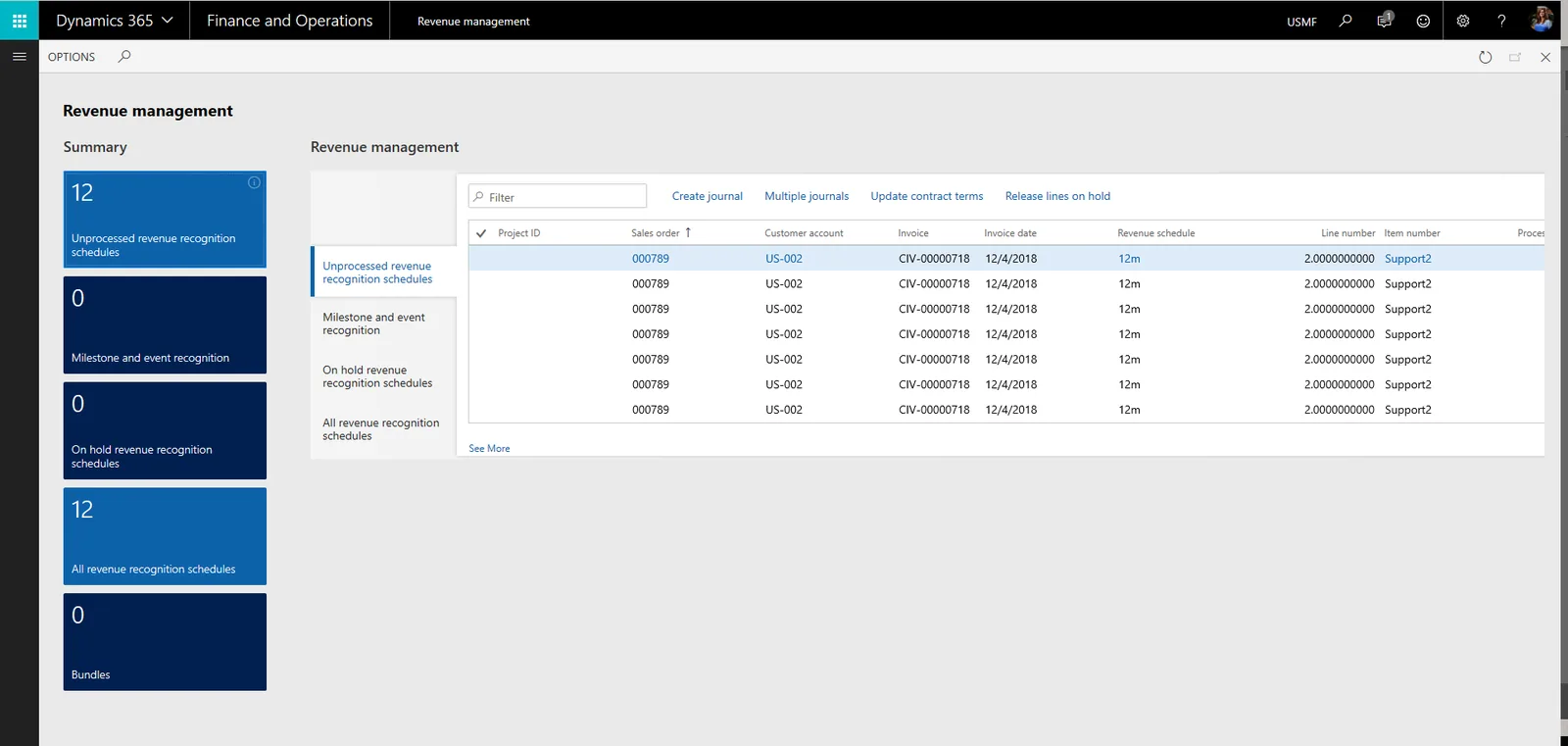
These reports support month-end and the annual audit.
Native support varies by product and edition. Confirm current features before deciding.
| Zoho | Odoo | ERPNext | Dynamics 365 | |
|---|---|---|---|---|
| Deferred revenue on invoices | Revenue recognition available in Zoho Billing in recent editions; Zoho Books often needs journals or custom logic | Start and end dates on invoice lines create deferred entries in recent Enterprise versions | Enable Deferred Revenue on item with service start and end dates on sales invoice | Deferral templates in Business Central; revenue recognition features in Finance |
| Subscriptions and renewals | Zoho Billing for plans, renewals and proration | Odoo Subscriptions app | Subscription doctype for recurring invoices | Subscription billing capabilities; confirm edition |
| Bundles and price allocation | Usually manual | Separate invoice lines per obligation | Separate lines per item | More advanced allocation in Finance; Business Central via lines |
| Project and milestone revenue | Zoho Projects with Books billing | Milestone and timesheet invoicing | Project billing with sales invoices | Business Central Jobs WIP methods; Project Operations |
| Reporting | Reports and Zoho Analytics | Deferred revenue reports | Deferred revenue entries and ledgers | Deferral summaries and Power BI |
For recurring billing operations, see subscription management software.
Contract data often originates outside finance.
These points link accounting revenue with UAE tax rules; confirm your position with your tax advisor and auditor.
Taxable income begins with accounting net profit under IFRS, or IFRS for SMEs where revenue does not exceed AED 50 million. Revenue timing therefore flows into the corporate tax return; see corporate tax ERP.
VAT is due based on the date of supply rules, generally the earlier of invoice, payment or delivery, with specific rules for periodic supplies. A deferred revenue schedule does not delay VAT on an invoice already issued.
Businesses using Small Business Relief test eligibility on revenue. Consistent recognition supports the figure used.
Keep contracts, schedules and reconciliations for at least five years under the tax record rules, and longer where other laws apply.
General information, not tax or legal advice. Rules change; confirm current FTA, MOHRE and Ministry of Finance guidance with your advisor.
The improvements come from schedules that follow the contract automatically.
The roll-forward ties to the ledger every month without manual adjustments.
Revenue matches the period in which work is delivered.
Future releases give a reliable view of revenue already contracted. See the project revenue dashboard.
Each recognized amount links to an invoice line, contract and schedule.
Indicative timings; companies with many contract types or bundles need longer design.
Durations are typical ranges; your plan is agreed after discovery.
Confirm revenue streams, performance obligations and recognition methods with finance and the auditor.
Set up deferred items, schedules, accounts and accrual rules.
Load contracts with remaining deferred balances and future release dates.
Run the ERP schedules alongside the spreadsheet for one or two closes before retiring it.
We configure the system for the rules UAE businesses report against, and test it before go-live.
General information, not tax or legal advice. Confirm current requirements with the FTA, MOHRE or your advisor. See all UAE compliance guides.
On-site workshops in Dubai, Abu Dhabi and Sharjah, and remote or on-site delivery across the Northern Emirates and free zones.
Official sources and references
Facts on this page were checked against these sources in October 2026. Rules change, so confirm current requirements before acting.
Still have a question? Our consultants are happy to help.
Ask an ExpertIt is money invoiced or received for goods or services not yet delivered. It sits on the balance sheet as a liability and is released to revenue as you deliver.
No. VAT follows the tax point rules, so an invoice issued today carries VAT in the period it is issued, even if revenue is recognized over twelve months.
Software and SaaS companies, AMC and facility management providers, training institutes, schools collecting fees in advance, gyms selling memberships and contractors with long projects. See ERP for software companies for one example.
Yes, if the schedule is linked to the contract or invoice line. Credit notes and amendments adjust the remaining schedule rather than leaving it running.
No. Recognition decides when revenue enters the ledger; reporting presents it. Profit and loss reporting uses the recognized figures.
IFRS for SMEs has simpler revenue rules, and companies with revenue up to AED 50 million may use it for corporate tax purposes. Your auditor will confirm which framework applies.
Related Solutions
Related Industries
Related ERP Platforms
Related Guides
We review your contracts and billing, then show how revenue schedules would run in your ERP.
Dubai, United Arab Emirates










