L
O
A
D
I
N
G


Zoho, Odoo, ERPNext, Dynamics 365 and custom ERP, delivered by one accountable team.

A balance sheet is only useful if each number is backed by a sub-ledger, a bank statement or a schedule. We configure ERP so balances reconcile each month, not just at audit time.
An accurate balance sheet in an ERP depends on every line being supported by a sub-ledger, bank statement or schedule. UAE companies should lock control accounts to sub-ledgers, reconcile banks and post-dated cheques monthly, recalculate gratuity provisions from current salaries, agree VAT accounts to returns filed on EmaraTax, and match intercompany balances before signing off and locking each period.
Choosing an ERP for balance sheet reporting UAE companies can depend on means looking past the report itself. Any accounting system prints a statement of financial position. The hard part is whether each line is supported: does the receivables control account equal the customer ageing, does inventory equal the stock valuation report, does the VAT payable account agree with the return filed on EmaraTax, and is the gratuity provision based on current basic salaries?
In UAE companies we often find balance sheets carrying old suspense balances from a migration, PDCs received but recorded as cash, retention receivable from contracts finished years ago, staff advances never recovered, and intercompany balances with a sister company in a free zone that do not agree. None of this shows on the P&L, but banks, auditors and buyers of the business look at it closely.
This page focuses on balance sheet integrity and the monthly review. For the income statement, see profit and loss reporting; for combining several entities into one group balance sheet, see financial consolidation.

These items cause qualified audit opinions, bank queries and painful due diligence.
Manual journals posted directly to receivables, payables or inventory accounts make the general ledger disagree with the sub-ledger. The difference is then carried forward for years.
Opening balances migrated from Tally, QuickBooks or Excel include suspense and clearing accounts nobody can explain.
Post-dated cheques received or issued are recorded as bank movements, so the bank balance never matches the statement until the cheque date.
End-of-service gratuity is calculated once a year on old salary data, so the liability is wrong for most of the year.
Output and input VAT accounts carry adjustments that were made on the return but never posted, so the VAT payable balance cannot be traced to EmaraTax filings.
Balances with related companies differ on each side because of timing, currency or unrecorded recharges.
A repeatable review, owned account by account.
One shared database: every step updates stock, finance and reports in real time.
Each major balance should be owned by a module that produces its supporting schedule.
Bank reconciliation with statement import, plus a PDC register for cheques in hand and issued.
Sub-ledgers whose ageing reports must equal the control accounts at period end.
Stock valuation by warehouse that ties to the inventory account, including goods in transit.
Cost, accumulated depreciation and net book value by asset, tied to the asset accounts.
Gratuity, leave and air ticket liabilities recalculated monthly from employee master data.
VAT input, output and payable accounts mapped to return boxes; corporate tax provision accounts.
Due-to and due-from accounts per related entity with matching reports.
Tasks per account with owner, due date, evidence attached and reviewer sign-off.
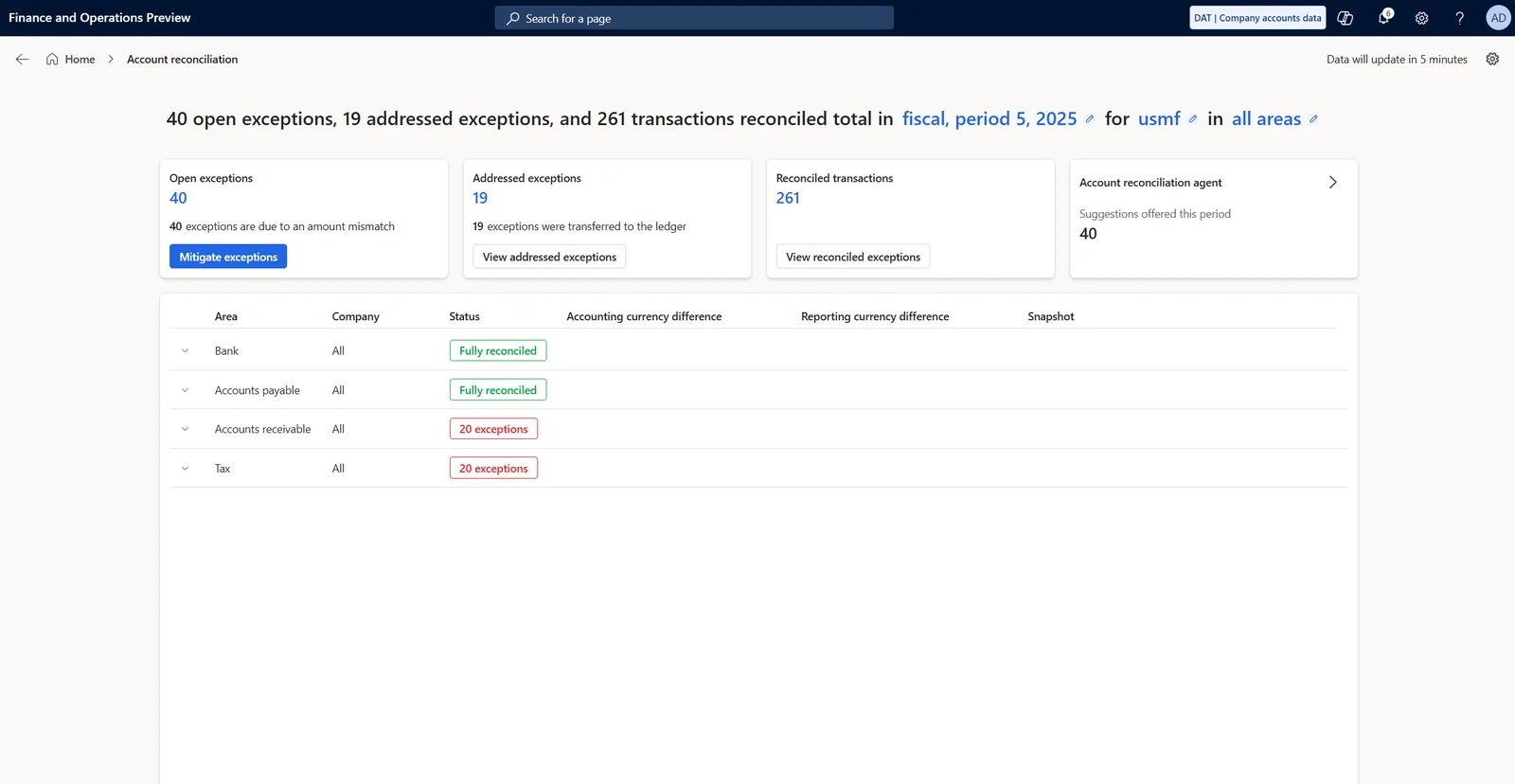
Finance managers see which accounts are reconciled and which still carry unexplained differences.
All four produce a balance sheet. What matters is control account protection and reconciliation tooling. Confirm for your edition.
| Zoho | Odoo | ERPNext | Dynamics 365 | |
|---|---|---|---|---|
| Balance sheet report | Balance Sheet in Zoho Books with comparisons | Balance Sheet in Accounting reporting | Balance Sheet report with periodicity | Balance sheet via Financial Reports |
| Control account protection | Receivable and payable accounts are system-controlled | Receivable and payable account types restrict reconciliation behavior | Party type required on receivable and payable accounts | Direct posting can be blocked per G/L account |
| Bank reconciliation | Bank feeds and matching rules | Bank statement import and reconciliation models | Bank Reconciliation Tool | Bank account reconciliation with statement import |
| Provision calculation | Usually via Zoho Payroll postings or journals | Payroll localisation or custom rules | Payroll entries; gratuity via Gratuity doctype in HRMS | Typically partner payroll or journal templates |
| Close and lock | Transaction locking by date | Lock dates for all users or non-advisers | Accounting period closing and frozen dates | Allow posting from/to dates and period close |
| Comparatives | Previous period and year | Comparison filters | Multiple periods | Column definitions for prior year |
PDC handling and UAE gratuity rules often need localisation or configuration; we confirm this in a demo.
Automated feeds remove the manual postings that usually break reconciliations.
These balances carry legal or tax requirements. Confirm treatment with your auditor and tax advisor.
VAT balances should reconcile to returns filed through EmaraTax, with any voluntary disclosures or adjustments posted in the ledger.
Under Federal Decree-Law 47 of 2022, companies accrue corporate tax at 9% on taxable income above AED 375,000. A current tax liability, and deferred tax where applicable, will appear on the balance sheet.
Under Federal Decree-Law 33 of 2021, gratuity is 21 days' basic wage per year for the first 5 years and 30 days per year after, capped at 2 years' wage. The provision should be recalculated as salaries and service change.
Records supporting balances must generally be kept for at least 5 years (7 for real estate) under Cabinet Decision 74 of 2023.
General information, not tax or legal advice. Rules change; confirm current FTA, MOHRE and Ministry of Finance guidance with your advisor.
These depend on consistent month-end ownership.
Auditors receive reconciliations and schedules instead of asking for them.
Working capital figures in facility reviews are supported and consistent.
VAT and corporate tax liabilities agree to filings.
Investors and buyers see supported balances, not suspense accounts.
Clean-up time depends heavily on the condition of historical balances.
Durations are typical ranges; your plan is agreed after discovery.
Analyze every balance sheet account and identify unsupported items.
Clear suspense, write off or correct with approval, and fix opening balances.
Block direct posting, set lock dates and build the close checklist.
Run monthly reviews until every account is signed off on time.
We configure the system for the rules UAE businesses report against, and test it before go-live.
General information, not tax or legal advice. Confirm current requirements with the FTA, MOHRE or your advisor. See all UAE compliance guides.
On-site workshops in Dubai, Abu Dhabi and Sharjah, and remote or on-site delivery across the Northern Emirates and free zones.
Official sources and references
Facts on this page were checked against these sources in October 2026. Rules change, so confirm current requirements before acting.
Still have a question? Our consultants are happy to help.
Ask an ExpertUsually because of manual journals posted directly to the control account or receipts posted without a customer. Blocking direct posting and clearing historical differences fixes it.
PDCs received are not cash until the cheque date and clearance. Many companies hold them in a PDC receivable account or off-balance-sheet register; agree the treatment with your auditor. Bank balances then match bank reconciliation.
Management usually wants a summarized balance sheet with working capital KPIs. That belongs in the management reporting pack.
Most payroll modules or localisations can calculate gratuity from basic salary and service dates. We test the calculation against UAE Labour Law rules during setup.
Yes, through consolidation with intercompany elimination. See intercompany accounting for matching balances before consolidation.
The ERP produces the trial balance and supporting schedules; auditors and finance teams prepare the IFRS notes. Our financial reporting page covers the full set.
Related Solutions
Related Industries
Related ERP Platforms
We review your balance sheet accounts and show which ones the ERP can reconcile automatically.
Dubai, United Arab Emirates