L
O
A
D
I
N
G


Zoho, Odoo, ERPNext, Dynamics 365 and custom ERP, delivered by one accountable team.

Scrap is money leaving the factory in a skip. Record it at the machine, understand why it happens and recover what you can from recyclers.
UAE manufacturers track scrap in an ERP by recording it at the machine or work order with a reason code and quantity, moving it to a scrap or remnant location, and deciding whether to rework, regrind, reuse or sell it. BOM scrap factors set expected losses, scrap sales to recyclers are invoiced, and cost and variance postings show which line, product or shift generated the waste.
An ERP for scrap management in the UAE treats scrap as a measured, costed output of production instead of an unexplained stock loss. Every plant produces it: offcuts from steel and aluminum profiles, edge trims and startup waste on extrusion and film lines, rejected bakery batches, broken tiles, overspray and leftover paint. Some of it can be reworked, some reground and reused, some sold to recyclers in Sharjah or Dubai Industrial City, and the rest disposed of through licensed waste contractors.
In most UAE SMEs, scrap is recorded only when the yard is cleared and a recycler pays cash or issues a weight slip. Nobody knows which line, product or shift generated it, the material cost behind it is buried in a stock adjustment, and the income from scrap sales sometimes never reaches the accounts. The result is that management sees a material variance at year end but cannot act on it.
This page covers capturing, classifying, valuing and disposing of scrap. Expected losses are planned in the bill of materials, and the inspection that decides whether an item is scrap or rework is described in manufacturing quality control.
Most plants know scrap is high; very few can say where, why and how much it costs.
Waste is weighed only when the yard is cleared, weeks after it was produced. The link to machine, product, operator and shift is lost, so nobody can fix the cause.
A rejected roll might come from a setup change, a material defect, a power trip or an operator error. Without reason codes, the same problem repeats every week.
Usable remnants of sheet, profile or fabric are thrown in the scrap bin because they are not in the system. New full lengths are cut for small jobs instead.
Recyclers pay cash or collect without a proper invoice. Scrap sales are under-recorded, VAT may not be accounted for, and there is an opening for theft.
Expected trim loss and unexpected batch failures land in the same variance. Product costs absorb losses that should be investigated separately.
Solvents, chemical residues and contaminated packaging need licensed disposal and records. Without a document trail, the plant is exposed during inspections.
Scrap is captured where it happens and then follows one of four paths: rework, reuse, sale or disposal.
One shared database: every step updates stock, finance and reports in real time.
Scrap touches production, inventory, quality, sales and finance, so all of them must use the same reason codes and locations.
Planned loss percentages per component or operation, so expected scrap is built into material requirements.
Scrap quantities posted against the manufacturing order or work center by operators or supervisors.
A short, fixed list such as setup, material defect, machine fault, operator error and changeover.
Separate stock locations for saleable scrap, reusable offcuts, regrind and items awaiting disposal.
Orders that bring defective items back to standard, with their own material and labor cost.
Scrap defined as an item with a recovery value, so stock and sales can be recorded by grade.
Sales orders and tax invoices to recyclers based on weighbridge slips.
Scrap cost charged to the order or to an abnormal loss account, feeding production costing.
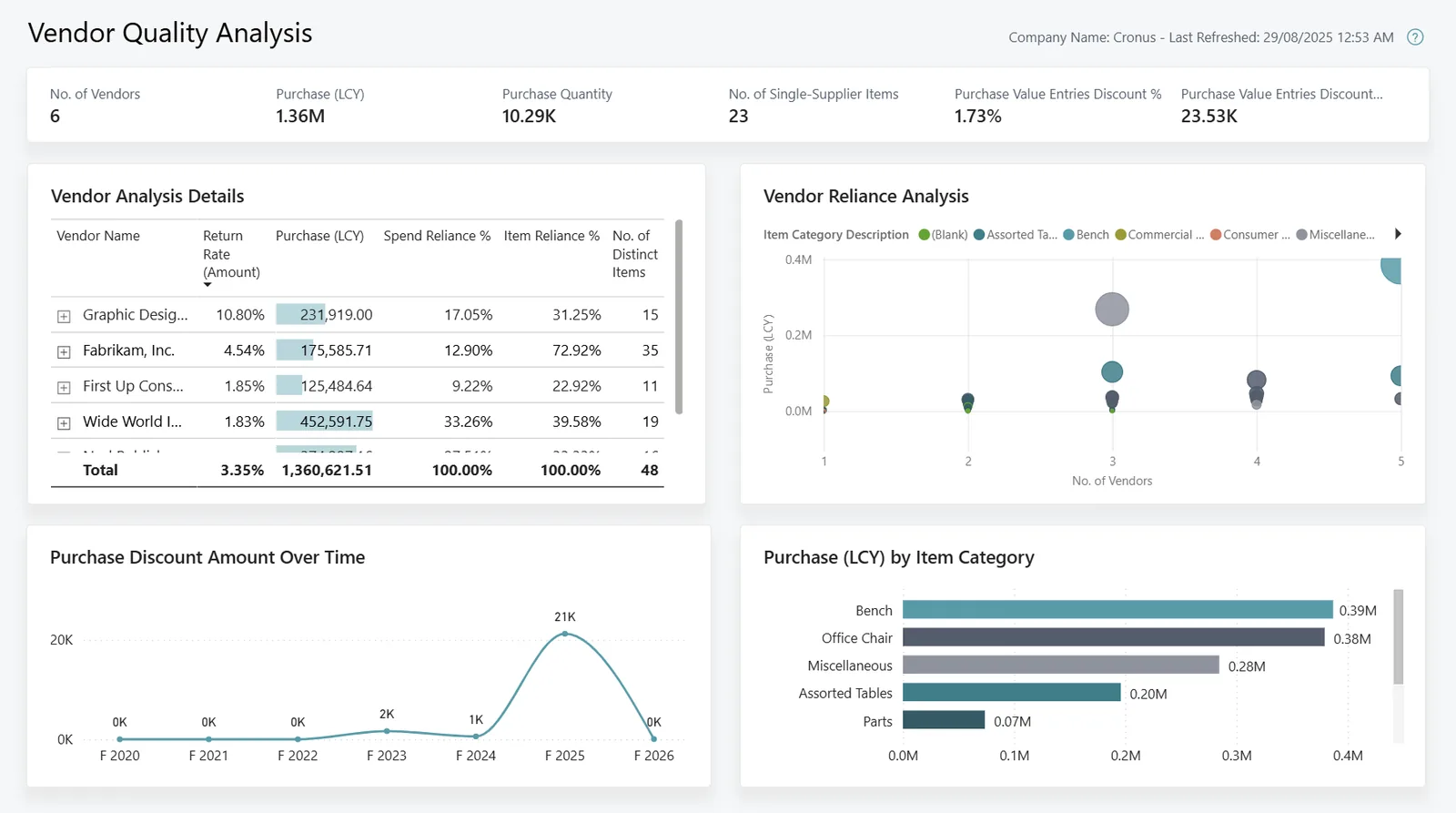
A quality-style view of scrap turns weight in a skip into a list of causes to fix.
All four platforms can record scrap; reason analysis and recovery value tracking vary. Confirm details for your edition and version.
| Zoho | Odoo | ERPNext | Dynamics 365 | |
|---|---|---|---|---|
| Scrap posting | Inventory adjustment with a reason, often logged through a Zoho Creator form | Scrap orders from manufacturing orders or inventory into a scrap location | Scrap items in the BOM and scrap warehouse on the manufacture entry | Scrap quantity in output journals and production order lines |
| Planned scrap | Not a standard BOM field; handled in a custom app | Component quantities and by-products on the BoM | Scrap items with quantity in the BOM and process loss percentage in recent versions | Scrap percentage on BOM lines and routing operations |
| Reason codes | Adjustment reasons | Scrap reasons available; deeper analysis via Quality app | Custom field or Non Conformance records | Scrap codes on output journals |
| Recovery value | Scrap item sold through Zoho Books | By-products with a cost share, sold as products | Scrap item valued at its rate and sold normally | Scrap item or by-product handling depending on setup |
| Rework | Custom process | Rework through new manufacturing or repair orders | Separate Work Order using a rework BOM | Rework production orders |
| Best fit | Light assembly with low scrap | Plants wanting scrap tied to quality checks | Process plants with yield and by-product needs | Plants needing formal scrap variances |
The easier scrap is to record at the machine, the more honest the data.
Scrap creates tax and environmental records, not only cost entries. Confirm specifics with your tax advisor and the relevant authority.
Sales of scrap to recyclers are generally taxable supplies at 5% when you are VAT registered. Issue a proper tax invoice from the ERP for each collection; see VAT in your ERP and confirm treatment with your tax advisor.
Normal process loss is part of product cost; abnormal loss is usually expensed in the period. Clear separation in the ERP supports your accounts and corporate tax return.
Chemical, oily or contaminated waste must go through licensed waste handlers under emirate-level environmental rules. Attach manifests and disposal certificates to the disposal record.
Keep scrap postings, weighbridge slips and scrap sale invoices for at least five years under Cabinet Decision 74 of 2023.
General information, not tax or legal advice. Rules change; confirm current FTA, MOHRE and Ministry of Finance guidance with your advisor.
Measured scrap gets reduced; unmeasured scrap gets accepted.
Reason codes by machine and shift show where to act first, often on setups and changeovers.
Remnants and regrind are visible in stock and used before new material is cut.
Every collection has a weight slip and tax invoice, so income and VAT are complete.
Planned scrap is in the cost, abnormal scrap is visible separately, and WIP is cleared correctly.
Scrap tracking can start on one line and expand. Durations are typical ranges.
Durations are typical ranges; your plan is agreed after discovery.
Weigh scrap by line for a short period and agree reason codes with supervisors.
Create scrap grades, remnant items and locations, and add scrap factors to key BOMs.
Deploy tablets or forms at machines and train operators to report scrap per order.
Set up recycler customers, price lists by grade and disposal records.
Hold a weekly scrap review using the Pareto report and track actions.
We configure the system for the rules UAE businesses report against, and test it before go-live.
General information, not tax or legal advice. Confirm current requirements with the FTA, MOHRE or your advisor. See all UAE compliance guides.
On-site workshops in Dubai, Abu Dhabi and Sharjah, and remote or on-site delivery across the Northern Emirates and free zones.
Official sources and references
Facts on this page were checked against these sources in October 2026. Rules change, so confirm current requirements before acting.
Still have a question? Our consultants are happy to help.
Ask an ExpertWhoever is closest to the event, as long as it is quick. A tablet with reason buttons at the machine works best. A supervisor entering totals at shift end is acceptable if reasons are still captured.
Create regrind as its own item with a lower value, post it from scrap to a regrind location, and allow it as a partial substitute in the BOM. Our page on ERP for plastic manufacturing covers related line-specific needs.
Yes, by recording remnants as items or lots with length, width or weight attributes. Fabricators often use this for sheet and profile offcuts; see ERP for steel manufacturing.
Rework brings a defective item back to specification with extra labor or material. Scrap cannot be recovered as the product and leaves as waste, regrind or saleable scrap. Both should be recorded with reasons.
Not when it is designed well. Recording takes a few seconds with fixed reason codes, scales linked to tablets, and shop floor screens built for operators rather than accountants.
Related Solutions
Related Industries
Related ERP Platforms
Tell us your lines, materials and how scrap is handled today, and we will design a capture and costing flow that fits your plant.
Dubai, United Arab Emirates