L
O
A
D
I
N
G


Zoho, Odoo, ERPNext, Dynamics 365 and custom ERP, delivered by one accountable team.

Packaging is made to order, priced on specs and won on margin. We set up ERP so the estimate, the job ticket, the material issued and the invoice all tell the same story.
An ERP for packaging companies in the UAE must start with a specification-driven quote, because corrugated box, flexible packaging and folding carton converters price each job on dimensions, board grade or film, print colours, quantity and trim waste. The system then links the estimate, job ticket, material issued and invoice, handling reels bought by weight, boxes sold by piece and customer-owned dies.
ERP for packaging companies in the UAE starts with the quote, not the product catalogue. A corrugated box plant in Dubai Industrial City, a flexible packaging converter in Sharjah or a folding carton printer in Ajman rarely sells the same item twice to different customers. Each enquiry arrives with dimensions, board grade or film structure, print colours and quantity, and the price depends on how many units fit on a sheet or reel width and how much falls on the floor as trim.
Food producers, FMCG brands, e-commerce sellers and re-exporters through Jebel Ali all depend on these converters, and they expect fast quotes, consistent repeat orders and on-time delivery. Behind the scenes, the plant buys paper reels by weight, sells boxes by piece, holds cutting dies and printing plates that belong to customers, and produces partial quantities with over-runs and under-runs. A generic stock-and-invoice system cannot hold those rules together.
We configure Odoo, ERPNext, Dynamics 365 Business Central and Zoho for converters, and add a specification-driven estimator where the standard quote screen is not enough. For a wider view of production systems see our manufacturing ERP page; if you mainly print commercial work rather than packaging, see ERP for printing companies.

Most of the margin leaks we see happen between the estimate and the production floor.
Each estimator has a slightly different costing file. Two people can quote the same box at different prices, and nobody knows which assumptions were used when the job is later found to be unprofitable.
Paper is bought in tonnes, issued in reels or sheets and sold in pieces or thousands. Manual conversions lead to stock values that do not match the physical warehouse.
Setup waste, trim and rejected print runs are accepted as normal but rarely recorded per job. Without that data, quotes cannot improve and poor machines or shifts stay hidden.
Customers question invoiced quantities when delivery differs from the order. Agreed tolerance rules are often in an email, not on the order or the invoice.
Cutting dies and plates pile up on racks. When a repeat order arrives, the team cannot quickly find the die, confirm who paid for it or check whether it needs replacing.
We model the job around the specification so repeat orders reuse everything that was already approved.
One shared database: every step updates stock, finance and reports in real time.
The exact list depends on whether you run corrugated, folding carton, flexible or rigid packaging lines.
Calculates material, ink, plates, dies and machine hours from dimensions, quantity and layout, with margins applied by customer or product type.
Stores each approved packaging spec with board grade, flute, film layers, print colours and artwork version so repeat orders are one click.
Schedules jobs across corrugators, printers, die-cutters, laminators and folder-gluers with a clear sequence and shift view.
Reels and sheets tracked by weight, width and GSM, with lot numbers so a quality issue can be traced back to the supplier delivery.
Dies, plates and cylinders recorded as assets or tracked items, linked to the customer and spec, with storage location and usage count.
Compares estimated and actual material, waste, labour and machine time per job so pricing improves with every order.
Incoming material checks, in-process print and dimension checks and final inspection, with reasons recorded for every reject.
Delivery notes carry actual quantities, invoices respect agreed tolerance rules and VAT is applied automatically.
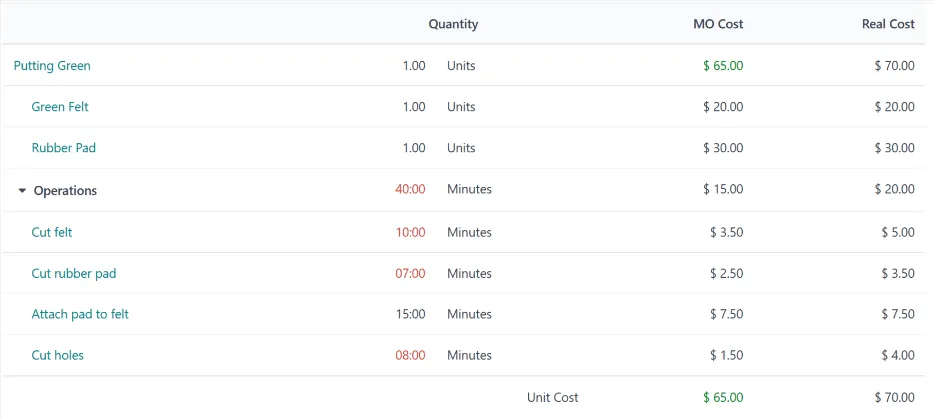
Owners and plant managers usually want to see margin and waste side by side, job by job.
Packaging businesses vary from small sleeve printers to multi-line corrugators. This is how the main platforms tend to line up.
| Company profile | Often a good fit | Why | Watch out for |
|---|---|---|---|
| Trading and light converting (cutting, labelling, kitting) | Zoho Books and Zoho Inventory | Fast setup for buy-sell with simple assemblies and clean VAT invoicing | No native production scheduling or estimating engine |
| Single-plant corrugated or carton maker | Odoo with Manufacturing and a spec-based estimator | Work centres, routings and quality in one system; estimator can be added as a module | Estimating logic is specific to your machines and usually needs development |
| Flexible packaging with lamination and slitting | ERPNext | Batch and unit-of-measure handling with an open framework for custom calculations | Reel splitting and lot genealogy require careful design upfront |
| Group with several plants and export customers | Dynamics 365 Business Central | Multi-company finance, intercompany and strong reporting with Power BI | Shop-floor depth depends on edition and add-ons; confirm current Microsoft licensing |
We implement Zoho, Odoo, ERPNext, Dynamics 365 and custom ERP. We recommend based on your plant, volumes and team.
Packaging plants deal with standard tax rules and a changing environment for plastics. Confirm specific treatments with your tax advisor and the relevant authorities.
Local sales are generally standard-rated at 5%, and exports may qualify for zero-rating when evidence of export is kept. Customer-owned tooling charges should be invoiced with the correct tax treatment, which the ERP applies from the product setup.
The UAE has introduced phased restrictions on certain single-use plastic products at federal and emirate level. Tagging every SKU by material type helps you report affected volumes and adjust the product range as rules change.
Mandatory e-invoicing through Accredited Service Providers starts in 2027 for most businesses, phased by revenue. Packaging firms with many B2B invoices should clean customer TRN data early. Check the latest Ministry of Finance and FTA guidance for dates.
General information, not tax or legal advice. Rules change; confirm current FTA, MOHRE and Ministry of Finance guidance with your advisor.
These outcomes come from better data, not from the software alone.
Every estimator uses the same costing rules, and approved quotes are stored for repeat orders.
Setup and running waste are captured per job and machine, so pricing and maintenance decisions use facts.
Weight-to-piece conversions are handled by the system, so the books match the warehouse.
Tolerance rules and actual delivered quantities appear on the documents customers receive.
Typical ranges only; a custom estimator or multiple plants add time.
Durations are typical ranges; your plan is agreed after discovery.
We review your estimating sheets, machine list and job tickets and agree the costing logic.
Specs, work centres, routings, units of measure and tooling records are configured.
Standard quoting or a custom estimator is built and tested against historical jobs.
Customers, specs, open orders and stock are loaded and tested with real jobs.
Go-live with daily floor support, then a move to regular support.
Further reading on platforms, modules and neighbouring industries.
We configure the system for the rules UAE businesses report against, and test it before go-live.
General information, not tax or legal advice. Confirm current requirements with the FTA, MOHRE or your advisor. See all UAE compliance guides.
On-site workshops in Dubai, Abu Dhabi and Sharjah, and remote or on-site delivery across the Northern Emirates and free zones.
Official sources and references
Facts on this page were checked against these sources in October 2026. Rules change, so confirm current requirements before acting.
Still have a question? Our consultants are happy to help.
Ask an ExpertStandard ERP quote screens do not understand box styles or sheet layouts. We either configure a product configurator where possible or build an estimator that calculates board area, waste and machine time, then passes the result to the quotation.
Reels are received with their weight, width and GSM, often as lots. When a job consumes board, the system converts weight to sheets or pieces using the spec, so stock and job cost both stay accurate.
Yes. Tooling can be tracked as items or assets linked to the customer and specification, with location, usage count and status. This makes repeat orders and tooling replacement easier to manage.
We record the agreed tolerance on the customer or order and invoice the actual delivered quantity within that range. Exceptions outside tolerance can require approval before invoicing.
Sometimes. Many machines expose counts through a controller or a simple data export. Where they do, we can integrate output and waste figures; otherwise operators record them on a tablet at the machine.
Related Solutions
Related Industries
Related ERP Platforms
Share a recent quote and job ticket and we will show you how the same job would be costed and tracked in ERP.
Dubai, United Arab Emirates