L
O
A
D
I
N
G


Zoho, Odoo, ERPNext, Dynamics 365 and custom ERP, delivered by one accountable team.

Zoho works well for assembly, kitting and make-to-order workshops. For complex multi-level production, we will tell you honestly when another platform is the better choice.
Zoho suits UAE manufacturers doing assembly, kitting, batch production from a recipe or make-to-order work. Zoho Inventory's composite items act as a single-level bill of materials, and a Zoho Creator app can add multi-level BOMs, job cards and costing. Plants needing MRP runs, capacity planning or shop-floor data collection usually fit Odoo Manufacturing or ERPNext Manufacturing better.
Zoho for manufacturing companies in the UAE makes sense for a specific type of plant: workshops that assemble finished goods from purchased components, small food and cosmetics producers making batches from a recipe, signage and printing shops, furniture makers working to order, and packaging units with a short list of products. If that describes your factory in Dubai Industrial City, Sharjah's industrial areas or a free zone such as RAKEZ or KEZAD, Zoho can run it at a sensible cost.
The standard tools are Zoho Inventory's composite items, which act as a single-level bill of materials and let you record assemblies that consume components and add finished stock. For anything beyond that, such as multi-level BOMs, routings, work centers, machine time and scrap, we build a production app in Zoho Creator that posts its results back to Inventory and Books.
We are clear about the boundary. Plants with capacity planning, MRP runs across hundreds of components or shop-floor data collection usually do better on Odoo Manufacturing or ERPNext Manufacturing, both of which we also implement. We would rather point you there than stretch Zoho too far.
The products we configure, integrate and support on projects like this one.




Product names and logos are trademarks of their respective owners and are shown only to identify the software we implement.
Small and mid-sized manufacturers tell us about the same few gaps, whatever they produce.
Raw material prices change with each import, and labour and overheads are not allocated. Selling prices are set on old cost sheets.
Production starts before anyone checks component stock. Lines stop while purchasing rushes a local order at a higher price.
Food, cosmetics and chemical producers need to link each finished batch to the raw material lots used. Paper batch records make this slow.
Sales cannot tell a customer when a made-to-order item will be ready, because job progress is not recorded anywhere digital.
Offcuts, rejected units and spillage are written off at stock count. Without recording them per job, the cause is never found.
This make-to-order flow is typical of the plants where Zoho fits. Steps in Zoho Creator post results to Inventory and Books.
One shared database: every step updates stock, finance and reports in real time.
Most manufacturing setups on Zoho combine these apps. The Creator app is where your production logic lives.
Single-level bills of materials and assembly transactions that consume components and add finished stock at combined cost.
Multi-level BOMs, job cards, routing steps, labour and machine time, scrap recording and job costing.
Lot numbers on raw materials and finished goods so each batch can be traced forward and back.
Reorder points and purchase orders in Zoho Inventory, with landed cost on imported raw materials.
Inspection checklists in Creator for incoming material and finished batches, with pass, hold or reject status.
Inventory valuation, cost of goods sold, production overhead journals and the VAT return.
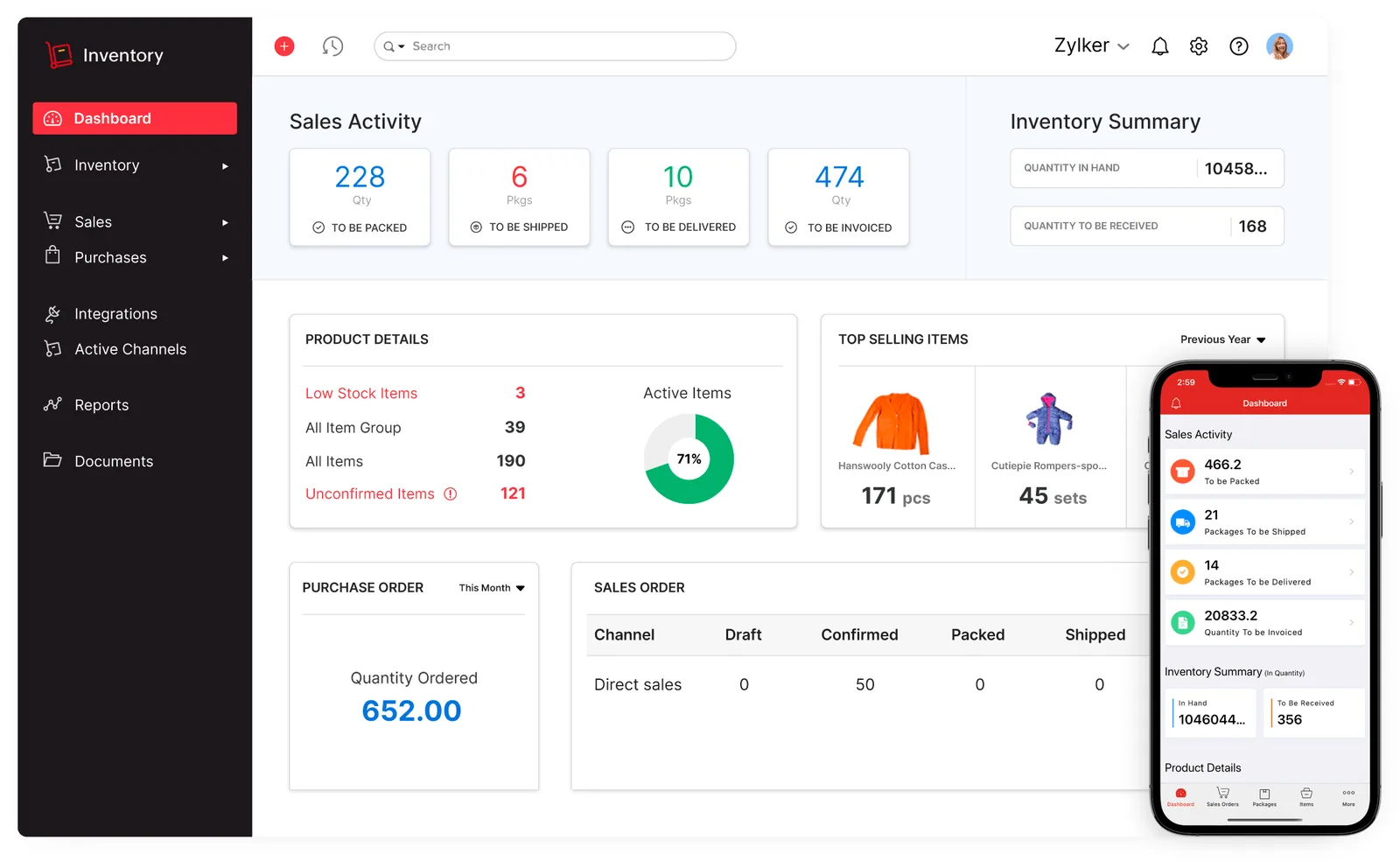
We build a production dashboard from Creator and Inventory data so supervisors and management watch the same numbers.
Manufacturers deal with customs, VAT and sometimes free zone rules. These are setup notes only; confirm your position with your tax advisor.
Imported inputs are usually accounted for under the reverse charge by VAT-registered businesses. We configure Zoho Books tax codes so import VAT and its recovery are reported correctly.
Manufacturing in a free zone may be a qualifying activity for a Qualifying Free Zone Person, subject to substance, de minimis and other conditions. Separating qualifying and non-qualifying income in the books helps your advisor assess it.
Food and cosmetics producers often need batch-level records for municipality or customer audits. Creator batch records with linked raw material lots support that requirement.
Manufacturers selling to distributors and retailers will issue structured e-invoices through an ASP under the PINT AE specification. Check the latest Ministry of Finance and FTA guidance for your date.
General information, not tax or legal advice. Rules change; confirm current FTA, MOHRE and Ministry of Finance guidance with your advisor.
Manufacturing projects include a Creator build and careful BOM work, so allow more time than a trading setup.
Durations are typical ranges; your plan is agreed after discovery.
Review products, BOM depth, production volumes and costing method, and confirm Zoho is the right platform.
Clean raw material and finished goods items, define units of measure and build BOMs.
Warehouses, batch rules, purchase flow, valuation and VAT configuration.
Job cards, routing steps, costing logic, QC records and integration with Inventory.
Run real jobs in parallel, compare costs with the old method, then switch over.
Compare manufacturing options across platforms and see related Zoho apps.
We configure the system for the rules UAE businesses report against, and test it before go-live.
General information, not tax or legal advice. Confirm current requirements with the FTA, MOHRE or your advisor. See all UAE compliance guides.
On-site workshops in Dubai, Abu Dhabi and Sharjah, and remote or on-site delivery across the Northern Emirates and free zones.
Official sources and references
Facts on this page were checked against these sources in October 2026. Rules change, so confirm current requirements before acting.
Still have a question? Our consultants are happy to help.
Ask an ExpertZoho's standard apps do not include full MRP with capacity planning. Zoho Inventory handles single-level assemblies, and we build further production logic in Zoho Creator. For full MRP, Odoo or ERPNext is usually a better fit.
Not natively in Zoho Inventory. We build multi-level BOMs in Zoho Creator, which then posts sub-assembly and finished goods movements to Inventory. It works well when BOM depth and volumes are moderate.
Material cost comes from the components consumed at their inventory value. Labour and overhead can be added per job in Creator using rates you define, and the total is posted to Zoho Books.
For small and mid-sized producers, yes. Batch and expiry tracking in Zoho Inventory, combined with Creator batch records, links finished goods to raw material lots.
Your finance, CRM and HR can stay on Zoho while production moves to a dedicated system, connected by integration. Or you can move the whole operation. We implement both routes, so the choice is yours.
Related Solutions
Related Industries
Related ERP Platforms
Send us a sample BOM and a description of your production steps, and we will give you an honest fit assessment.
Dubai, United Arab Emirates