L
O
A
D
I
N
G


Zoho, Odoo, ERPNext, Dynamics 365 and custom ERP, delivered by one accountable team.

Plan production from real demand, release work orders with material you actually have, and see scrap, downtime and cost variance before the month closes.
A UAE manufacturing manager needs an ERP that runs MRP to net demand against stock and open purchase orders, releases work orders only when material is available, records routing, work center and actual times on the shop floor, and shows scrap, QC holds and cost variance per order and shift. Odoo, ERPNext and Dynamics 365 cover this; Zoho suits light assembly.
ERP for manufacturing managers in the UAE is about one job: getting the right quantity made on time at the expected cost, with the factory you have. Whether the plant is in Jebel Ali, ICAD in Abu Dhabi, Sharjah's industrial areas or a free zone like KEZAD, the manufacturing manager spends Monday reconciling last week's output, Tuesday arguing about material shortages, and the rest of the week reshuffling the schedule around urgent orders and machine breakdowns.
Most UAE manufacturers are make-to-order or mixed: fabricated steel, packaging, food, building materials, furniture, chemicals and plastics. Raw materials often come by sea with long lead times, export orders have fixed vessel cut-offs, and labor is shift-based with a high share of operators who prefer simple screens in more than one language. Planning in Excel works until two big orders collide.
This page looks at ERP from the manufacturing manager's chair. For the full process map, from BOM to costing, see manufacturing ERP processes, and for the module overview see ERP for manufacturing companies.
These problems show up in almost every UAE plant that still plans in spreadsheets.
Work orders go to the floor because sales pushed for them, then stop halfway when a resin, coil or packaging item is short. The line sits idle while the buyer chases an emergency local purchase at a higher price.
The production plan is an Excel sheet rebuilt every morning. A breakdown or a rush export order means calling supervisors one by one, and nobody can see the knock-on effect on other due dates.
Operators fill paper job cards that reach the office the next day or the next week. Yield problems and over-consumption are discovered when stock counts fail, not when they happen.
Engineering changes a recipe or drawing, but the BOM in the system still has the old components. Costing is wrong and the store issues the wrong material.
Inspections are logged in a separate file, so a failed batch is not blocked from dispatch. Traceability back to the raw material lot takes hours during a customer complaint.
Standard costs were set years ago. Without actual material, labor and machine time per work order, the manager cannot tell which products or customers are profitable.
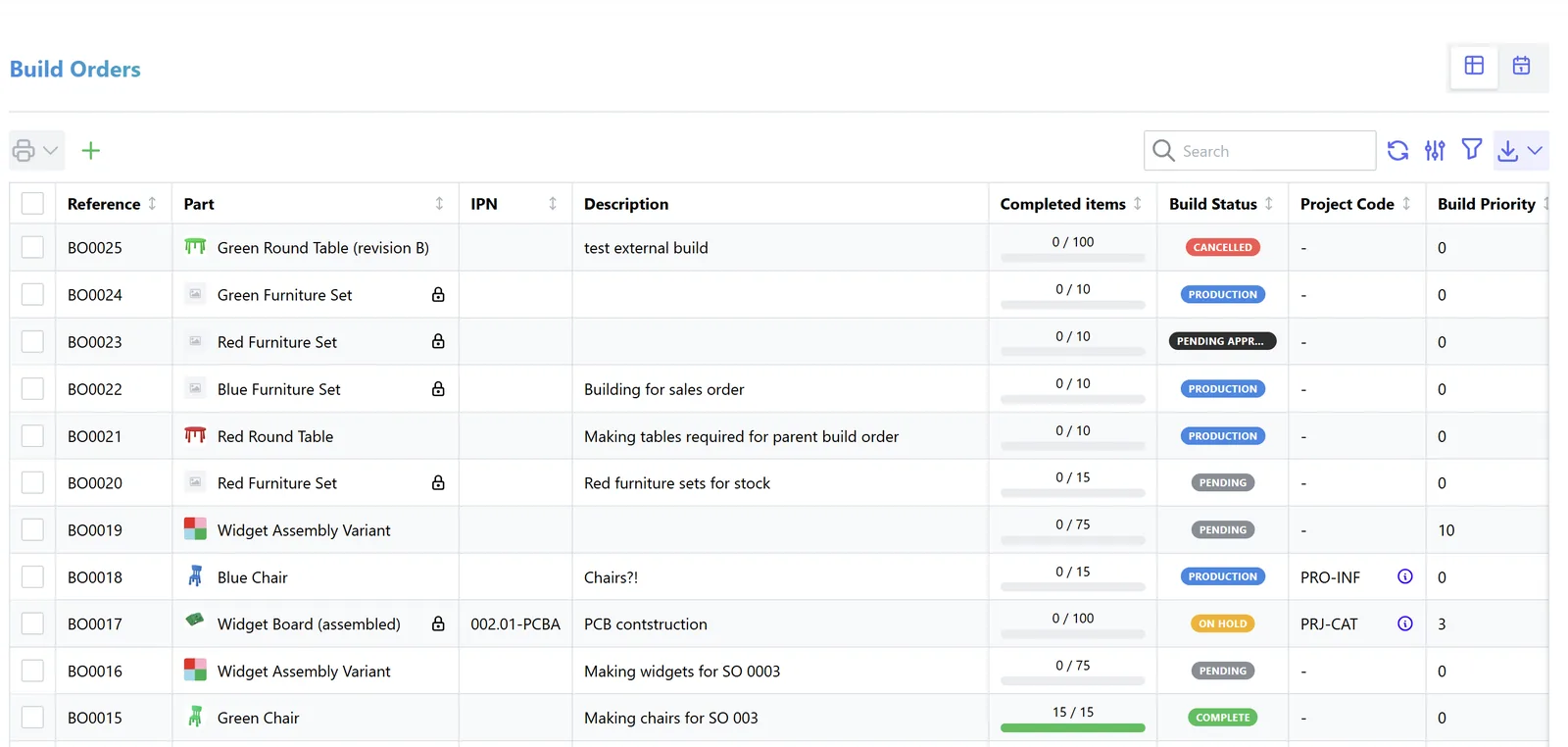
A plant-level view built from work orders, job cards, quality checks and stock moves.
Each one replaces a spreadsheet or a phone call you make today.
Demand from sales orders and forecasts is netted against stock, open POs and open work orders to propose what to make and what to buy, and when.
Work orders follow routings across work centers with capacity, so you can see the load and drag jobs when priorities change.
Operators start and stop operations, record quantities, scrap and downtime reasons on a tablet or kiosk instead of paper job cards.
Versioned BOMs and routings with controlled changes, so the store, costing and production all work from the same recipe.
In-process and final inspections are part of the routing, and a failed check holds the lot before it can be shipped.
Actual material, labor and overhead post per work order, with variance against the standard explained by quantity, price or scrap.
This is the weekly cycle a manufacturing manager runs. The ERP keeps each step linked, so a change upstream shows its effect downstream.
One shared database: every step updates stock, finance and reports in real time.
We implement all four platforms. The right one depends on how complex your routings, recipes and planning really are.
| Zoho | Odoo | ERPNext | Dynamics 365 | |
|---|---|---|---|---|
| Bills of materials | Composite items and assemblies in Zoho Inventory; multi-level BOMs usually via Zoho Creator or an extension | Multi-level BOMs, kits, by-products and variants in Manufacturing | Multi-level BOM with operations, scrap and secondary items | Full BOM and formula management (Business Central or Supply Chain Management) |
| Planning (MRP) | Basic reorder logic; full MRP typically needs a custom or third-party layer | Replenishment rules and MRP; Master Production Schedule in Enterprise | Production Plan with material request generation | Master planning in SCM; planning worksheets in Business Central |
| Shop floor | Custom forms in Zoho Creator | Shop Floor app with tablet view for operators (recent versions) | Job Card per operation with time logs | Production floor execution in SCM |
| Quality | Custom checks in Creator | Quality app with control points (Enterprise) | Quality Inspection templates | Quality management in SCM |
| Best fit | Light assembly and kitting already on Zoho | SMEs and mid-size discrete or batch plants | Cost-conscious plants wanting open source with good BOM depth | Complex, multi-site or process manufacturing |
Confirm features for your edition. Platform detail: Odoo Manufacturing, ERPNext Manufacturing and Zoho for manufacturing companies.
Tax and regulatory work sits with finance, but production data feeds it. Confirm treatment with your tax advisor.
Imports by a VAT-registered manufacturer are generally accounted for under the reverse charge in the VAT return. Landed cost and customs references on the purchase make this traceable from the GRN.
Work in progress and finished goods valuation affects taxable income. A consistent costing method in the ERP, with documented variances, supports the corporate tax return.
Production, stock and costing records are tax records and should be kept for at least 5 years. Keep BOM version history and job card data in the system rather than on paper.
Goods sent to job workers or moved between a designated zone and the mainland can change VAT treatment. See ERP for subcontract manufacturing for how these movements are tracked.
General information, not tax or legal advice. Rules change; confirm current FTA, MOHRE and Ministry of Finance guidance with your advisor.
We configure the system for the rules UAE businesses report against, and test it before go-live.
General information, not tax or legal advice. Confirm current requirements with the FTA, MOHRE or your advisor. See all UAE compliance guides.
On-site workshops in Dubai, Abu Dhabi and Sharjah, and remote or on-site delivery across the Northern Emirates and free zones.
Official sources and references
Facts on this page were checked against these sources in October 2026. Rules change, so confirm current requirements before acting.
Still have a question? Our consultants are happy to help.
Ask an ExpertThey do when the screen is simple: one button to start, one to stop, quantity and scrap reason. We usually pilot one line first and adjust the screen with supervisors before rolling out to all shifts.
Yes. Make-to-order items are triggered by the sales order, while stock items are replenished by reorder rules or forecasts. The MRP run nets both against the same capacity and stock.
Items with weight-based units, cutting losses and offcuts need careful unit-of-measure and scrap setup. Our page on ERP for steel manufacturing covers those specifics.
Once work orders record actual material and time, the ERP compares actual cost with the standard per order. It takes a few months of clean data before the numbers become reliable enough for pricing decisions.
Usually the warehouse owns stock until it is issued to a work order. The handover rules are set in the system; see ERP for warehouse managers and ERP for procurement managers for their side.
For a single plant with clean BOMs, a phased rollout often takes 3-6 months: inventory and purchasing first, then work orders and shop floor, then costing. Multi-site or process manufacturing takes longer.
Related Solutions
Related Industries
Related ERP Platforms
Share your products, routings and planning pain points, and we will walk you through a manufacturing manager's view on the right platform.
Dubai, United Arab Emirates