L
O
A
D
I
N
G


Zoho, Odoo, ERPNext, Dynamics 365 and custom ERP, delivered by one accountable team.

Wholesale margins are thin and order volumes are high. The right ERP makes pricing, bulk units and customer credit predictable instead of negotiable on every call.
An ERP for wholesale companies in the UAE works mainly as a pricing and order engine. It handles customer-group price lists with quantity breaks, carton, pallet and piece units on the same item, system-calculated rebates, credit limits and warehouse picking. A B2B portal lets repeat customers order online and see only their own prices, order history and statements.
An ERP for wholesale companies in the UAE is mainly a pricing and order engine. Wholesalers sell by the carton, pallet or container to grocery stores, contractors, resellers and smaller traders. Every customer expects a slightly different price, a different credit term and a delivery that matches exactly what was ordered.
The pressure points are familiar. Order desks take calls, WhatsApp messages and emails, then retype them into an accounting package. Price lists live in Excel with different versions on different laptops. Volume discounts and year-end rebates are calculated by hand, often after customers have already argued about them. When margins sit in low single digits, one wrong price can wipe out the profit on an order.
We set up wholesale operations on Zoho, Odoo, ERPNext and Dynamics 365 Business Central. Unlike a general trader with many unrelated lines (see ERP for general trading companies), a wholesaler usually has a stable catalog and a large repeat customer base, so the focus shifts to pricing rules, order speed and receivables.

Wholesale problems are rarely dramatic. They are small leaks repeated across thousands of order lines.
Sales reps quote from old sheets or give discounts they are not authorised to give. Finance finds out only when the margin report comes out at month end.
A customer orders ten cartons and the warehouse picks ten pieces, or the invoice bills ten pallets. Each mistake means a credit note, a return trip and an unhappy buyer.
Quarterly or annual volume rebates are worked out manually from sales exports. Disputes are common because neither side can see progress towards the target during the year.
Repeat customers phone in the same order every week. Staff spend hours retyping orders that could be placed through a portal or uploaded from a template.
With hundreds of small B2B accounts, overdue balances creep up and nobody blocks new orders until a customer stops paying altogether.
When a manufacturer raises prices, selling prices lag behind for weeks because updating many price lists is slow and manual.
Each step is a linked document, so a disputed invoice can be traced back to the original order and price rule.
One shared database: every step updates stock, finance and reports in real time.
These are the modules that carry most of the value in a wholesale implementation.
Price lists by customer group, quantity breaks, promotional periods and minimum margin checks applied automatically on each line.
Buy in pallets, store in cartons, sell in cartons or pieces, with conversions handled by the item record.
Approved customers see their own prices and place repeat orders without calling the order desk.
Track volume targets per customer, accrue rebate liability as sales happen and issue credit notes at settlement.
Pick lists sorted by location, barcode scanning and packing checks before goods leave the dock.
Reorder suggestions based on sales velocity and supplier lead times, with purchase price history per supplier.
Credit limits, ageing reports, automatic statements and order blocks for overdue accounts.
Field reps check stock, see customer balances and place orders from a phone while visiting shops.
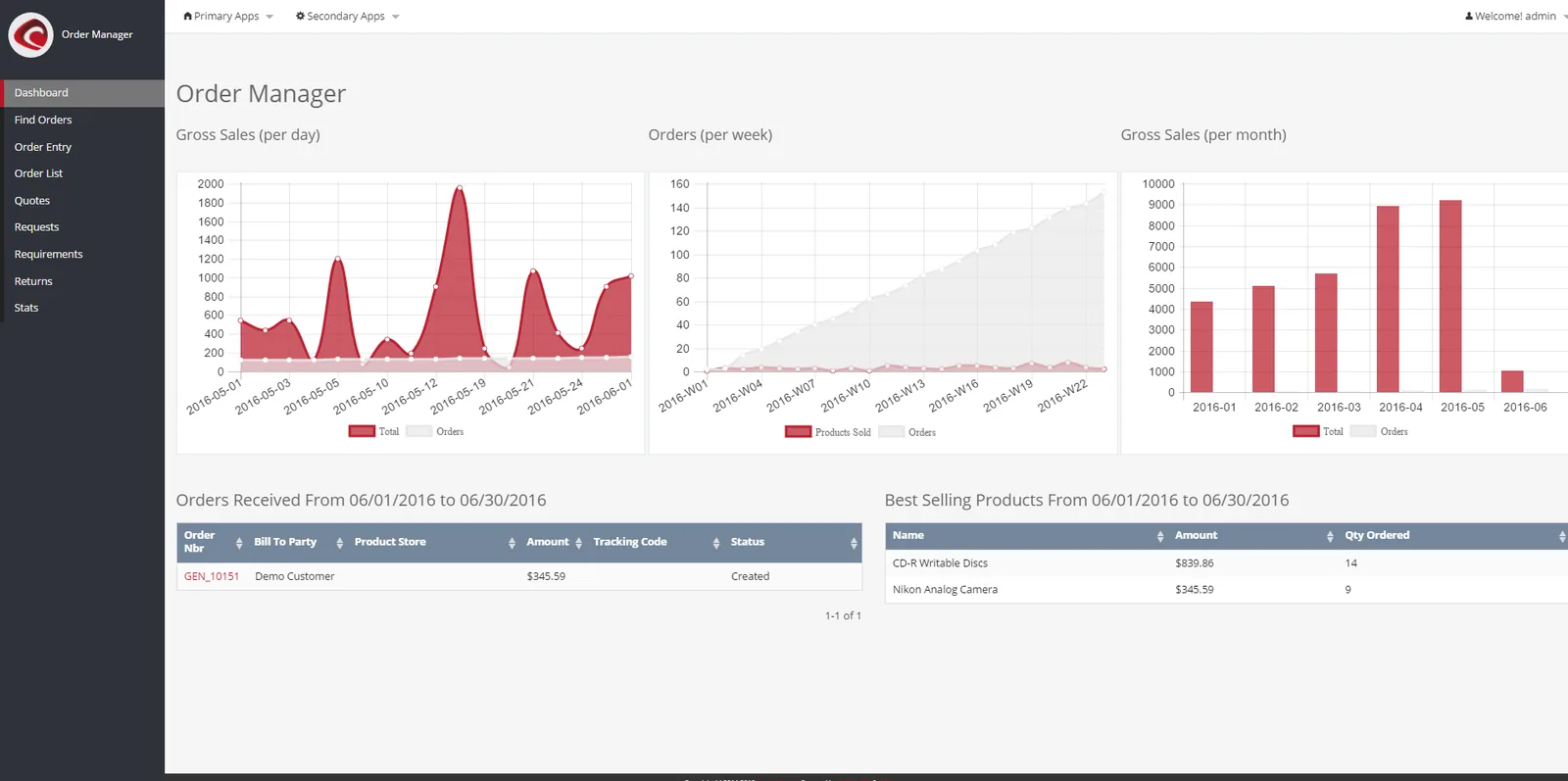
Wholesale managers watch volume and margin together, because growth at the wrong price is not growth.
A rough guide based on wholesaler size and how complex pricing is.
| Wholesale profile | Platform we often recommend | Watch-outs |
|---|---|---|
| Small wholesaler, single warehouse, simple price lists | Zoho Inventory with Zoho Books | Very complex rebate schemes may need custom functions or Zoho Creator. |
| Mid-size wholesaler with portal ordering and many price rules | Odoo | Pricing and portal apps are strong; plan the price list structure carefully to keep it maintainable. |
| Wholesaler wanting open source and flexible pricing rules | ERPNext | Pricing rules are powerful; budget for hosting, backups and a support partner. |
| Larger wholesaler, several entities, heavy finance controls | Dynamics 365 Business Central | Licensing is per user; portal features usually need an add-on or extension. |
| Wholesaler with unique contract pricing models | Platform plus custom module | Keep custom logic small and documented so upgrades stay manageable. |
Our Odoo vs Zoho for trading companies comparison covers the two most common shortlists in detail.
We configure the system to support these requirements. Please confirm tax treatment with your tax advisor.
Volume rebates paid after the sale usually need a tax credit note so output VAT is adjusted. The ERP generates these from the rebate settlement rather than as a manual journal.
Most wholesale customers are VAT registered. Storing and printing their TRN on tax invoices is configured on the customer record.
Returns are usually quarterly. The ERP summarises standard-rated, zero-rated and reverse-charge figures by return box for review before filing.
Wholesalers issue mostly B2B invoices, so the move to PINT AE e-invoicing through an Accredited Service Provider affects nearly every document. Revenue of AED 50 million or more points to the 1 January 2027 phase; below that, 1 July 2027. Check the latest Ministry of Finance and FTA guidance.
General information, not tax or legal advice. Rules change; confirm current FTA, MOHRE and Ministry of Finance guidance with your advisor.
What tends to improve once pricing and orders run through one system.
Rules apply the correct price and block sales below minimum margin unless a manager approves.
Portal and template orders reduce retyping, so the order desk handles more volume with the same team.
Customers and account managers can see progress towards targets during the period, not after it.
Automatic statements and credit blocks keep overdue balances from building up unnoticed.
Many wholesale projects run 10-16 weeks. Portal launches are often phased after the core system is stable.
Durations are typical ranges; your plan is agreed after discovery.
Document every price list, discount and rebate scheme, then simplify before building.
Configure items, units, warehouses, pricing rules, credit limits and tax codes.
Import customers, items and opening stock; connect barcode scanners and bank feeds.
Order desk, warehouse and finance test real orders, then switch over at a period start.
Onboard key customers to self-service ordering and reps to the mobile app.
Platform pages and neighbouring industries worth reading next.
We configure the system for the rules UAE businesses report against, and test it before go-live.
General information, not tax or legal advice. Confirm current requirements with the FTA, MOHRE or your advisor. See all UAE compliance guides.
On-site workshops in Dubai, Abu Dhabi and Sharjah, and remote or on-site delivery across the Northern Emirates and free zones.
Official sources and references
Facts on this page were checked against these sources in October 2026. Rules change, so confirm current requirements before acting.
Still have a question? Our consultants are happy to help.
Ask an ExpertYes. Customers are assigned to price lists or pricing groups, and the system picks the right price on each order line. Quantity breaks and promotional periods can sit on top of the base list.
Rebate agreements are set per customer or group with targets and percentages. The ERP tracks qualifying sales during the period and can accrue the expected cost, then issue a credit note at settlement.
A B2B portal shows each logged-in customer only their own prices, order history and statements. Odoo includes portal features natively; other platforms use add-ons or custom pages.
Each item carries a base unit and conversion factors. Purchases, stock and sales convert automatically, so a pallet received becomes the correct number of cartons and pieces in stock.
It depends on users and features rather than a fixed price. See our ERP cost guide for the drivers, then we can scope your specific case.
Related Solutions
Related Industries
Related ERP Platforms
Send us your current price lists and rebate terms and we will show how they would run inside an ERP.
Dubai, United Arab Emirates