
L
O
A
D
I
N
G


Zoho, Odoo, ERPNext, Dynamics 365 and custom ERP, delivered by one accountable team.

Know weeks in advance whether your machines and people can deliver the orders you have accepted, and decide on extra shifts, overtime or subcontracting while there is still time.
ERP capacity planning compares the load from sales orders, forecasts and work orders against available hours on each work center, after shifts, holidays, maintenance and efficiency. UAE plants use it to see overloads weeks ahead and decide on extra shifts, overtime or subcontracting in time. Odoo, ERPNext and Dynamics 365 support this natively, while Zoho usually needs a Creator app.
An ERP for capacity planning in the UAE answers one question before production starts: do we have enough machine hours and skilled people to make what we have promised, and where will the queue form? It compares the load created by sales orders, forecasts and work orders against the available hours of each work center, after shifts, holidays, planned maintenance and efficiency are taken into account.
Many UAE plants accept orders based on raw material availability alone. Sales confirms a large order for a hotel fit-out or a GCC distributor, the materials arrive, and only then does the factory discover that the CNC router or the powder coating line is booked solid for three weeks. The result is weekend overtime, missed delivery dates and expensive outside processing arranged at short notice.
Capacity planning sits between demand and the detailed schedule. Demand comes from demand planning, the material side is handled by MRP software, and the sequence of jobs on each machine on each shift is the job of production scheduling software.

Most capacity crises are visible weeks in advance if anyone is looking at the right numbers.
Sales commits delivery dates using standard lead times from a price list. Nobody checks the current load on the bottleneck before saying yes.
Operation times in the system were entered years ago or copied from the machine brochure. Planned hours are far below actual hours, so the plan always looks achievable on paper.
Work center calendars assume 24/7 or standard shifts, without public holidays, Eid closures, reduced Ramadan hours or planned shutdowns. Available capacity is overstated in exactly the busiest periods.
A machine may be free but the only qualified welder or setter is on annual leave or on a visa renewal trip. Machine capacity alone gives a false picture.
Outside processing such as galvanizing, heat treatment or printing is arranged only when the job is already late. Short-notice subcontracting costs more and adds transport time.
Groups with plants in Dubai and Sharjah, or a free zone and a mainland unit, plan each site separately. Spare capacity in one plant is not used to relieve the other.
Capacity is checked twice: roughly when demand is accepted, and in detail when work orders are released.
One shared database: every step updates stock, finance and reports in real time.
Capacity planning depends on accurate master data more than on clever algorithms.
Machines, lines or cells with capacity per hour, number of parallel units, efficiency factor and cost rate.
Shift patterns, weekly rest days, UAE public holidays, Ramadan schedules and planned maintenance windows per work center.
Setup and run times per operation for each product, maintained from actual job card data rather than estimates.
The agreed build plan by product family and week, used for rough-cut capacity checks before detailed planning.
Required hours against available hours per work center and period, with overloads highlighted.
Operator availability, leave and skill matrix from HR, so labor constraints are visible alongside machine time.
Outside operations with supplier lead times, used to offload overflow; see ERP for subcontract manufacturing.
Delivery dates checked against capacity, not only stock, before confirmation to the customer.
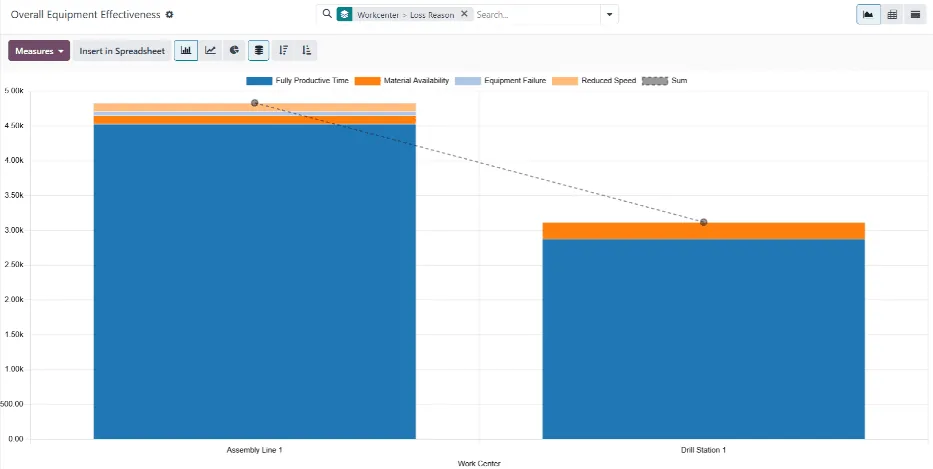
A capacity view should show the next four to twelve weeks, with the bottleneck work centers at the top.
Capacity features differ more between platforms than most other manufacturing functions. Confirm details for your edition.
| Zoho | Odoo | ERPNext | Dynamics 365 | |
|---|---|---|---|---|
| Work center capacity | Not in Zoho Inventory; usually a Zoho Creator planning app or an integrated MRP | Work centers with capacity, efficiency and working hours | Workstations with working hours and production capacity | Work centers and machine centers with capacity, efficiency and calendars |
| Load view | Custom report in Creator or Zoho Analytics | Work center load and Gantt planning in the Manufacturing app | Capacity planning on work orders; job card scheduling per workstation | Work center load and capacity requirement pages in Business Central |
| Finite or infinite | Depends on custom design | Planning respects work center availability; confirm behavior for your version | Capacity planning setting avoids overlapping job cards | Business Central plans mainly infinite with load reports; SCM supports finite capacity scheduling |
| Rough-cut / MPS | Not native | Master Production Schedule in Enterprise edition | Production Plan from sales orders or forecasts | Production forecasts and planning worksheet; master planning in SCM |
| Labor constraints | Custom | Employee assignment on work orders; limited skill-based planning | Employees on job cards; skills by custom fields | Resource and capacity setups; deeper in SCM |
| Typical fit | Light assembly with simple routings | SME discrete and process manufacturers | Plants wanting open-source flexibility | Complex, multi-site or high-volume operations; see Dynamics 365 for manufacturing |
Planning results depend on routing and calendar accuracy on every platform.
Capacity numbers are only as good as the time data and calendars behind them.
Several local rules affect how many productive hours you really have. Confirm details with your HR advisor.
Private sector working hours are reduced by two hours a day during Ramadan. Calendars should reflect this, or capacity will be overstated for the whole month.
UAE Labour Law limits overtime hours and requires overtime pay. Plans that rely on overtime every week are both costly and constrained, so capacity gaps should be solved structurally.
The summer midday work ban affects outdoor yards, such as steel fabrication or precast areas. Outdoor work centers need a separate summer calendar.
UAE public holiday dates, including Eid, depend on moon sighting and are announced close to the date. Planners should update calendars when dates are confirmed.
General information, not tax or legal advice. Rules change; confirm current FTA, MOHRE and Ministry of Finance guidance with your advisor.
The benefit is fewer surprises and better decisions made earlier.
Sales confirms dates that the plant can meet, which protects customer trust and reduces penalties on project orders.
Overloads are seen weeks ahead, so extra shifts are organized calmly and within legal limits.
Planners protect the constrained work center and move non-critical work to alternate machines.
Outside processing is booked with normal lead times and negotiated prices instead of last-minute rates.
Capacity planning usually follows the core manufacturing rollout. A focused project often takes 6-12 weeks.
Durations are typical ranges; your plan is agreed after discovery.
Review historical output and queues to find the two or three work centers that limit the plant.
Update routing times from actual job cards, set efficiency factors and build realistic calendars.
Set up load reports, rough-cut checks and the link from sales orders and forecasts.
Compare system load with the planner's spreadsheet and adjust until both agree.
Review the next eight weeks with sales and production and agree actions for overloads.
We configure the system for the rules UAE businesses report against, and test it before go-live.
General information, not tax or legal advice. Confirm current requirements with the FTA, MOHRE or your advisor. See all UAE compliance guides.
On-site workshops in Dubai, Abu Dhabi and Sharjah, and remote or on-site delivery across the Northern Emirates and free zones.
Official sources and references
Facts on this page were checked against these sources in October 2026. Rules change, so confirm current requirements before acting.
Still have a question? Our consultants are happy to help.
Ask an ExpertCapacity planning checks whether you have enough hours; production planning decides what to make and when, using that information. In practice they run together in the same planning cycle.
Only if your bottleneck is very constrained and job sequence matters a lot. Most UAE SMEs get most of the value from infinite load reports reviewed weekly, then add finite scheduling for the bottleneck later.
Define critical skills as resources or track them on job cards, and include leave and visa-related absences from HR. Where machines are idle because of missing operators, labor is the true constraint.
Yes. Multi-company or multi-site setups can show load across both plants, so overflow can be moved where transfer rules and costs allow. Intercompany pricing and VAT treatment need to be agreed with your advisors.
For people-based planning on projects, see project resource planning. This page focuses on machine and production labor capacity in factories.
Odoo and ERPNext cover work center load well for SMEs, while Dynamics 365 Supply Chain Management suits complex finite scheduling. Our wider enterprise resource planning guide explains how planning fits the full system.
Related Solutions
Related Industries
Related ERP Platforms
Share your routings and current order book and we will show where your bottlenecks fall over the next eight weeks.
Dubai, United Arab Emirates