
L
O
A
D
I
N
G


Zoho, Odoo, ERPNext, Dynamics 365 and custom ERP, delivered by one accountable team.

Material requirements planning turns sales orders and forecasts into dated purchase and production suggestions, so imported materials arrive before the line needs them.
MRP software tells a manufacturer which materials to buy or make, how many and by when. It takes demand from sales orders and forecasts, explodes it through each bill of materials, nets off stock, open purchase orders and work orders, then offsets by lead time. For UAE factories importing materials by sea, this produces dated planned orders and exception messages before shortages stop the line.
MRP software UAE manufacturers rely on answers one question every day: given what we have promised to customers, what we hold in stock and what is already on order, which materials do we need, how many, and by when? Without it, the buyer walks the warehouse, checks a spreadsheet and raises purchase orders when something looks low. That works until a container of film, resin or MDF board takes six weeks from the supplier to Jebel Ali and the line stops in week four.
Material requirements planning (MRP) works in a fixed sequence. It takes gross demand from sales orders and forecasts, explodes it through each bill of materials, subtracts on-hand stock, open purchase orders and work orders already in progress, then offsets the net requirement by lead time. The result is a list of planned purchase orders and planned production orders, each with a date, plus exception messages when existing orders are too late, too early or no longer needed.
MRP is a calculation, not a decision. The planner still reviews the suggestions, merges small orders to fill a container, and decides what to expedite. If you are weighing a standalone MRP tool against a full ERP, our guide on ERP vs MRP explains where each fits.

These issues show up in UAE plants that plan materials with spreadsheets and experience.
The work order is released, the storekeeper goes to pick, and one component is missing. The whole order waits for a local purchase at a premium price.
The buyer knows that Chinese hardware takes longer around Chinese New Year and that a European chemical needs a permit. When that buyer is on leave, nobody else knows.
Without visibility of future demand, buyers order extra of everything. Warehouse space in Dubai and Sharjah is expensive, and slow-moving stock ties up cash.
A purchase order raised last month is not counted, so a second order is raised for the same need. The duplication only shows when two shipments arrive.
The same carton, cap or fastener appears in dozens of products. Planning each product alone hides the combined requirement and the chance to order in economic quantities.
Sales knows Ramadan and back-to-school peaks are coming, but the forecast stays in a sales presentation instead of driving raw material orders.
Most UAE SMEs run MRP daily or weekly. The cycle below keeps the planner in control of what gets released.
One shared database: every step updates stock, finance and reports in real time.
MRP is only as accurate as the data it reads. These modules supply that data and act on the result.
Confirmed orders and demand forecasts by item and period, with a rule for how forecast is consumed by actual orders.
Multi-level structures with quantities and scrap factors, so dependent demand for every component is calculated correctly.
On-hand, reserved and in-transit stock by warehouse, with lot and expiry where materials have shelf life.
Lead time, minimum order quantity, order multiple, safety stock and make or buy flag on each item.
Planned orders converted into RFQs or purchase orders, grouped by supplier, with expected dates fed back into MRP.
Planned production orders become work orders that reserve components and consume capacity.
Shipment tracking and expected arrival dates so in-transit material counts as supply on the right date.
Shortage, exception and coverage reports that show the planner where to act first.
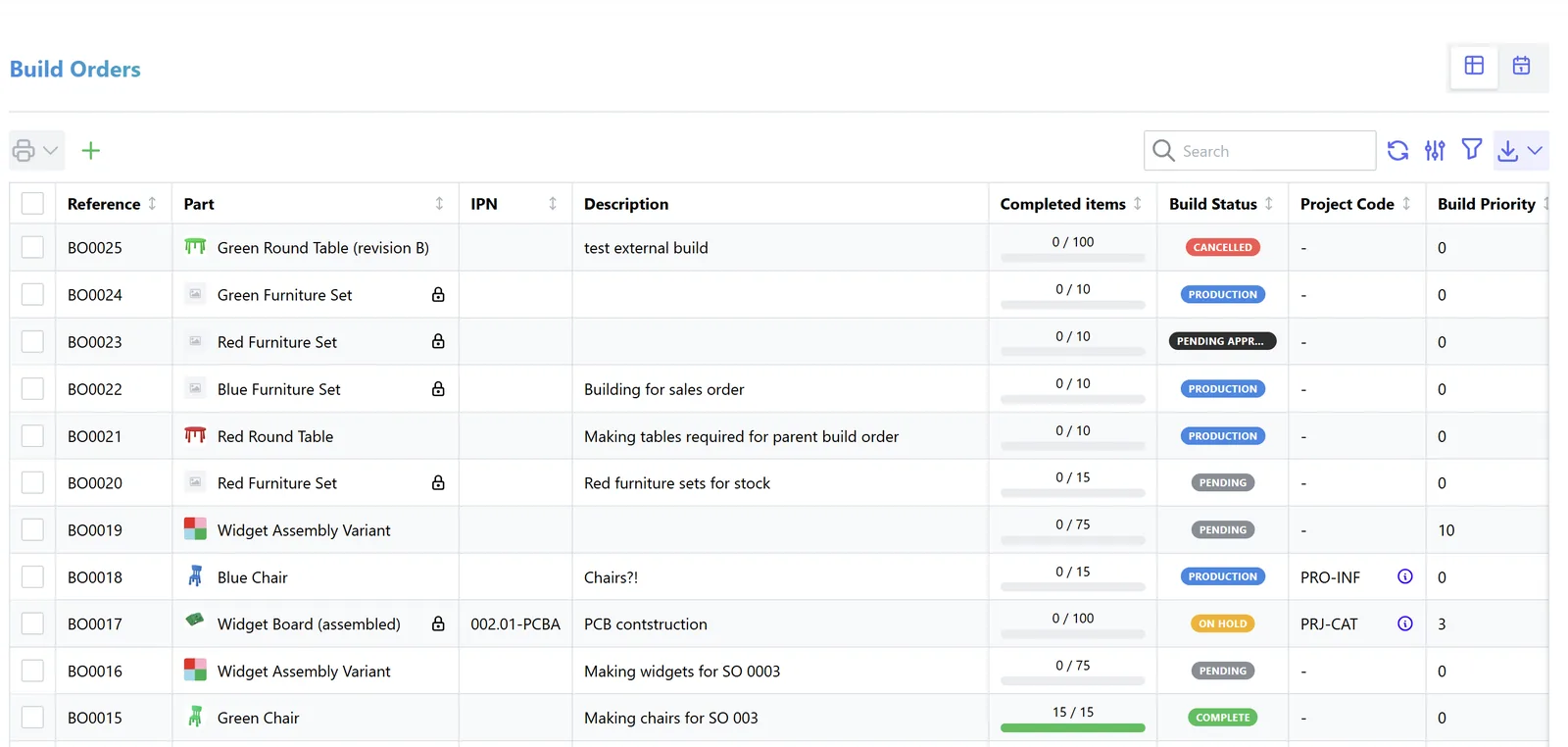
After each run, the planner should see priorities, not a list of hundreds of lines.
Each platform approaches material planning differently. Features vary by edition and release, so confirm against yours.
| Zoho | Odoo | ERPNext | Dynamics 365 | |
|---|---|---|---|---|
| Planning approach | Reorder points and stock alerts in Zoho Inventory; full MRP generally needs a Zoho Creator app or third-party tool | Replenishment report with reordering rules, plus a Master Production Schedule in Enterprise | Production Plan that pulls sales orders or material requests and calculates raw material needs | Planning worksheet with MRP in Business Central; Planning Optimization in Supply Chain Management |
| Multi-level explosion | Not native beyond simple assemblies | Yes, through BoM levels and make-to-order routes | Yes, with sub-assembly items in the Production Plan | Yes, with low-level codes |
| Lead times and safety stock | Reorder level and preferred vendor per item | Vendor lead times, manufacturing lead time and security lead time settings | Lead time days and safety stock on the item | Lead time, safety stock and reorder policies per item or SKU |
| Output | Purchase order suggestions from low-stock reports | Draft purchase and manufacturing orders | Material Requests and Work Orders created from the plan | Planned orders that are firmed into purchase and production orders |
| Exception handling | Manual review | Forecasted stock and late-supply warnings | Manual review of the plan output | Action messages to reschedule, change quantity or cancel |
| Typical fit | Assembly and kitting with modest planning needs | SME and mid-sized plants wanting integrated MRP | Budget-conscious plants with in-house admin skills | Complex or high-volume plants needing detailed planning |
We implement all four platforms and recommend by fit. See Odoo Manufacturing in the UAE for one common option.
Planning improves when the run sees demand and supply from every channel.
MRP itself is operational, but the orders it creates carry tax and customs consequences. This is general information, not tax advice.
Imported materials attract customs duty and import VAT, generally accounted for through the importer's VAT return. Plan landed cost so MRP-driven purchase orders reflect the real cost of supply.
Moving materials between a free zone warehouse and a mainland plant can have customs and VAT implications. Model the locations separately and confirm the treatment with your advisor.
Purchase orders, receipts and stock movements form part of your accounting records, which generally need to be kept for at least five years.
General information, not tax or legal advice. Rules change; confirm current FTA, MOHRE and Ministry of Finance guidance with your advisor.
The benefits come from acting earlier, with the whole picture.
Shortages are visible within the lead time, while there is still time to order by sea instead of paying for air freight or local premiums.
Buying to calculated need rather than gut feel reduces slow-moving material and warehouse space.
Shared components are planned across all products, so orders fill containers and reach better price breaks.
Lead times and rules live in the system, not in one buyer's memory.
Durations are typical ranges for an SME plant and depend on BOM quality and the number of active items.
Durations are typical ranges; your plan is agreed after discovery.
Confirm BOMs, stock accuracy and open orders. MRP on bad data creates bad suggestions.
Set lead times, safety stock, order quantities and make or buy flags for each planned item.
Run MRP alongside the current method and compare suggestions with what buyers actually order.
Switch purchasing to MRP output and adjust parameters where exceptions keep repeating.
We configure the system for the rules UAE businesses report against, and test it before go-live.
General information, not tax or legal advice. Confirm current requirements with the FTA, MOHRE or your advisor. See all UAE compliance guides.
On-site workshops in Dubai, Abu Dhabi and Sharjah, and remote or on-site delivery across the Northern Emirates and free zones.
Official sources and references
Facts on this page were checked against these sources in October 2026. Rules change, so confirm current requirements before acting.
No. MRP plans materials. Production planning decides what to make, in what quantity and in which period, and MRP then works out the materials needed for that plan.
Classic MRP assumes infinite capacity. Capacity is checked separately through capacity planning and detailed scheduling, then the plan is adjusted.
Most SMEs run it daily or at least weekly. Run it more often when orders change quickly, and always after large new orders or big receipts.
Stock on hand, BOMs, open purchase and work orders, and lead times. If stock accuracy is poor, fix it first with cycle counts, otherwise suggestions will be wrong from day one.
Yes. Most platforms let you load a forecast by item and period. Results improve when the forecast comes from a structured demand planning process rather than a single number from sales.
Usually yes. Even make-to-order plants need to know which long-lead materials to stock in advance and which to buy per order. MRP can handle both on the same run.
Related Solutions
Related Industries
Related ERP Platforms
Related Guides
Share a few BOMs and your typical lead times, and we will show how an MRP run would plan your materials on the right platform.
Dubai, United Arab Emirates