
L
O
A
D
I
N
G


Zoho, Odoo, ERPNext, Dynamics 365 and custom ERP, delivered by one accountable team.

Labor is often the largest controllable cost on a UAE site. Workforce management in the ERP ties each worker's documents, deployment and pay to the project that needs them.
Construction workforce management in an ERP ties each worker's visa, Emirates ID, labor card, insurance and skills records to a manpower plan by project and trade. It handles daily site attendance, camp and transport allocation, transfers between projects and supplied agency labor, then runs WPS payroll and posts labor cost to each project, with alerts before documents expire.
Construction workforce management in the UAE means handling hundreds or thousands of workers across trades: masons, steel fixers, carpenters, electricians, plumbers, helpers and drivers, plus engineers, foremen and supervisors. Most are on company visas and live in labor accommodation, some are supplied by manpower agencies, and all need to be on the right site with valid documents every morning.
The HR and site administration team juggles visa and Emirates ID renewals, labor cards, medical insurance, HSE induction records, bus routes from the camps, and the daily question of which crew goes where. Project managers want more steel fixers on one tower and fewer helpers on another; the camp boss needs headcounts for meals; payroll needs to pay everyone correctly through WPS. When this runs in separate spreadsheets, idle labor and expired documents go unnoticed.
This page covers manpower planning, deployment, documents, accommodation, supplied labor and the link to payroll. Capturing daily hours by cost code has its own page, construction timesheet software, and agency or package subcontractors are covered under construction subcontractor management. For the wider system picture, start with our overview of construction ERP.

These issues cost money directly through idle labor and fines, and indirectly through delays.
Deployment is decided on WhatsApp each evening. Head office cannot see headcount by site and trade, so surplus labor on one project is not moved to another.
Visas, Emirates IDs, labor cards, medical insurance and site passes expire on different dates. A worker turned away at a site gate is a lost day.
Manpower agencies invoice by headcount and hours that are hard to verify. Disputes take weeks and payments get delayed.
Accommodation, meals and buses are large costs booked to overheads. Projects do not see their true labor cost per hour.
Scaffolders, riggers and welders need valid competency cards. Without a skills matrix, the wrong person can be sent to a task.
Payroll is run from a separate attendance list, so labor cost by project is estimated rather than measured.
From the manpower request to the payslip, each step leaves a record the next one uses.
One shared database: every step updates stock, finance and reports in real time.
This sits in the HR and payroll side of the ERP, connected to projects.
Trade, grade, visa sponsor, passport, Emirates ID, labor card and insurance details per worker.
Automatic reminders to PRO and HR before each document expires.
Requested versus allocated headcount by project, trade and week.
Competency cards, HSE inductions and training records linked to each worker.
Camp, room and bus route per worker, with cost allocation rules to projects.
Biometric or mobile attendance at site gates feeding payroll and project cost.
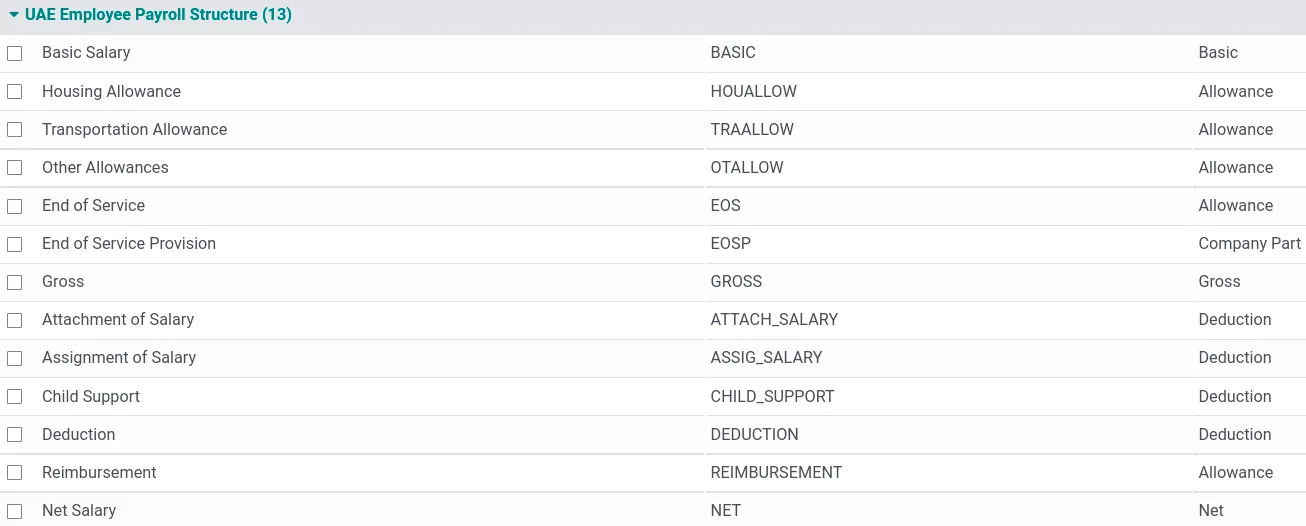
Salary, overtime, allowances and deductions with SIF generation for WPS.
Agency workers with rates, attendance and invoice matching.
A daily view of headcount and compliance replaces the evening round of calls.
All four cover core HR; differences show in UAE payroll, WPS output and construction-specific deployment. Check current localization for your edition.
| Zoho | Odoo | ERPNext | Dynamics 365 | |
|---|---|---|---|---|
| Employee and documents | Zoho People with custom fields and expiry reminders | Employees app with documents; expiry tracking via configuration | Frappe HR employee records with custom document fields | HR in Business Central is basic; often paired with a UAE HR/payroll extension |
| Attendance | Zoho People attendance with biometric integrations | Attendance app with kiosk and device integrations | Employee Checkin and Shift Type, biometric sync via API | Typically via extension or third-party HR system |
| Payroll and WPS | Zoho Payroll is available for the UAE; confirm WPS SIF support for your setup | Payroll with UAE localization (Enterprise); confirm WPS output | Frappe HR payroll; WPS SIF usually via custom report | Partner payroll extensions for the UAE |
| Deployment to projects | Zoho Projects or Creator app | Planning app for shifts by project | Custom deployment DocType linked to projects | Resource planning on jobs |
| Camps and transport | Zoho Creator app | Custom module or Studio | Custom DocTypes | Extension or Power Apps |
| Typical fit | Firms already on Zoho One | Contractors wanting HR and projects in one suite | Large headcount at controlled license cost | Groups on Microsoft with a payroll partner |
Workforce data flows in from devices and out to banks and agencies.
This is a summary of what to configure, not legal advice. Confirm current rules with MOHRE and your advisors.
Salaries for MOHRE-registered workers are paid through approved banks or agents using a Salary Information File. The ERP should generate the SIF and reconcile it to payroll.
Under Federal Decree-Law 33 of 2021, gratuity is 21 days' basic wage per year for the first five years and 30 days per year after, capped at two years' wage. Accrue it monthly per worker.
MOHRE announces a midday outdoor work break each summer. Shift patterns and attendance rules should reflect it so timesheets and overtime stay consistent.
Passport, Emirates ID and medical data are sensitive. Restrict access by role and follow the UAE Personal Data Protection Law (Federal Decree-Law 45 of 2021).
General information, not tax or legal advice. Rules change; confirm current FTA, MOHRE and Ministry of Finance guidance with your advisor.
Gains come from visibility and fewer surprises, rather than from cutting headcount.
Surplus crews are visible and can be moved between projects the same day.
Expiry alerts reach PRO and HR well before a worker is turned away at the gate.
Supplied labor bills are matched to recorded attendance before payment.
Wages, camp and transport are allocated to projects, improving future tenders.
Typical ranges for a contractor with several hundred workers; payroll parallel runs often set the pace.
Durations are typical ranges; your plan is agreed after discovery.
Collect and verify employee, document and camp data for every worker.
Configure trades, shifts, devices and expiry alerts.
Set up pay components, gratuity accrual and SIF output; run parallel payrolls.
Link deployment and attendance to projects and allocate camp costs.
Run live with close support and fix exceptions.
We configure the system for the rules UAE businesses report against, and test it before go-live.
General information, not tax or legal advice. Confirm current requirements with the FTA, MOHRE or your advisor. See all UAE compliance guides.
On-site workshops in Dubai, Abu Dhabi and Sharjah, and remote or on-site delivery across the Northern Emirates and free zones.
Official sources and references
Facts on this page were checked against these sources in October 2026. Rules change, so confirm current requirements before acting.
Still have a question? Our consultants are happy to help.
Ask an ExpertYes. Most contractors use one HR and payroll module with different grades, shifts and pay rules for staff and labor. Site labor usually has daily attendance and overtime, while staff are on monthly attendance.
Record them as supplied labor with the agency, rate and project, capture attendance the same way as your own workers, and match the agency invoice to that attendance. They are not on your WPS payroll.
It should, either natively or through a localization or report. Ask for a sample SIF during the demo and test it with your bank before go-live. See HR and payroll software for the payroll side in more detail.
Usually by headcount-days per project from attendance, using a cost per bed and per seat agreed with finance. The allocation runs monthly and posts to project cost codes.
Per-user licensing matters when many workers need records but few log in. ERPNext for construction is often chosen for large headcounts at controlled cost, while Odoo and Zoho suit firms wanting HR, projects and finance in one suite.
Attendance and timesheets cost each worker's hours to projects, and allocated camp and transport add the overhead. This feeds construction profitability reporting.
Related Solutions
Related Industries
Related ERP Platforms
Talk to us about your headcount, camps and payroll setup and we will show how it would run in one system.
Dubai, United Arab Emirates