
L
O
A
D
I
N
G


Zoho, Odoo, ERPNext, Dynamics 365 and custom ERP, delivered by one accountable team.

Replace spreadsheet payment applications and manual invoices with one ERP billing cycle that knows each contract's advance, retention, VAT and payment terms.
Construction billing software for UAE contractors should run the full cycle from contract setup to final account: advance invoice and guarantee, monthly interim payment applications, the consultant's interim payment certificate, then a tax invoice with automatic retention and advance recovery deductions. It tracks applied, certified, invoiced and received amounts side by side, so certification gaps and overdue receivables are visible per contract.
Construction billing software UAE contractors actually need is not an invoice template. It is a controlled cycle that starts when the contract is signed and ends when the final account is settled. Between those two points sit the advance payment and its guarantee, monthly interim payment applications (IPAs), the consultant's certification, the interim payment certificate (IPC), the tax invoice, retention, advance recovery, contra charges and the collection chase. In many Dubai and Abu Dhabi firms every one of these steps lives in a different spreadsheet owned by a different person.
The result is predictable. The quantity surveyor submits an IPA on the 25th, the consultant certifies a lower figure three weeks later, accounts raises the invoice on the certified amount, and nobody reconciles the gap between applied, certified and paid. Cash is tied up not because the work was not done, but because the paperwork could not keep pace with the site. An ERP that holds the contract terms once and applies them to every bill closes that gap. It sits inside a wider construction project management ERP and feeds contract profitability reporting.
This page covers the contractor's billing cycle end to end: contract setup, application, certification, invoicing and collection, for lump-sum, re-measured and fit-out contracts. The calculation method for percentage-complete and measured-quantity bills is explained in our guide to progress billing software, and retention release has its own page on construction retention management.

These problems come up in almost every billing review we run with UAE main contractors, MEP firms and fit-out companies.
The IPA asks for one figure, the consultant certifies another, and the difference disappears from view. Disputed amounts are never followed up until the final account, months or years later.
Each invoice should recover a share of the advance payment, but the running balance sits in an accountant's personal workbook. Over-recovery or under-recovery is only noticed when the client's QS points it out.
The IPC arrives by email to the project manager and waits days before accounts sees it. Every day of delay pushes the payment due date further out.
A single project may combine a lump-sum main contract, re-measured provisional sums, approved variations and dayworks. Spreadsheets cannot apply the right rule to each line consistently.
Credit controllers chase overdue invoices without knowing which ones are certified, which are under dispute and which are held back as retention, so calls to the client are poorly targeted.
Each step creates or updates a record, so the trail from contract to cash can be audited later.
One shared database: every step updates stock, finance and reports in real time.
Billing pulls data from several modules. The value comes from linking them to one contract record.
Contract sum, type (lump sum, re-measured, cost-plus), advance percentage, retention terms, payment period and bank guarantee details.
Billing lines mirror the priced bill of quantities, so each application references the same item codes the client's QS uses.
Monthly IPA documents with previous, current and cumulative columns, plus status fields for submitted, certified and disputed.
Tax invoices generated from the certified amount with TRN, VAT at the correct rate and deduction lines shown clearly.
Customer ledgers split into billed receivables, retention receivable and unbilled work, with ageing by due date.
Advance payment and performance guarantees tracked with expiry dates and reduction milestones.
Certificates, consultant letters and signed IPAs attached to the invoice they support.
Commercial manager sign-off on IPAs above a threshold and finance review before any invoice is posted.
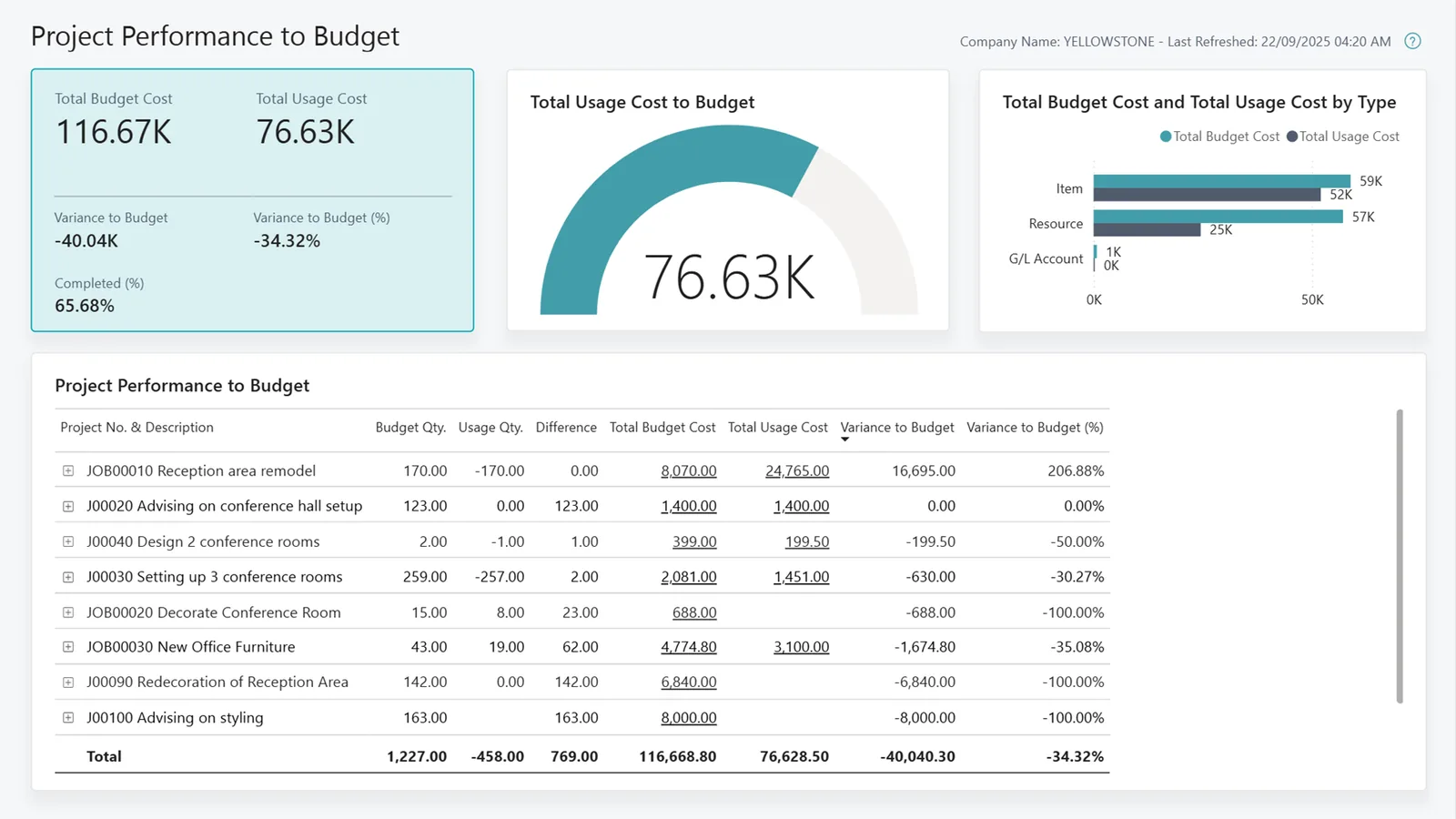
A contractor billing dashboard compares what was applied for, what was certified and what has been collected, contract by contract.
All four platforms we implement can run a contractor billing cycle. They differ in how much is standard and how much is configured. Features vary by edition and version, so confirm details for yours.
| Zoho | Odoo | ERPNext | Dynamics 365 | |
|---|---|---|---|---|
| Contract and billing terms | Zoho Books projects and estimates; contract fields usually added with custom fields or Zoho Creator | Sales order per contract with down payment and milestone invoicing | Project linked to Sales Order with payment schedule and terms template | Projects (Jobs) in Business Central; project contracts in Project Operations or Finance |
| Monthly IPA document | Typically built as a custom module or Creator app | Usually configured or added via a construction app | Custom doctype is common, built on the Frappe Framework | Job planning lines can drive billable progress; IPA layout via report design or partner app |
| Advance payment recovery | Retainer invoices for advances, recovery applied manually or by script | Down payment invoices deducted on later invoices natively | Advance payments allocated against invoices | Prepayment and deduction handling; exact method depends on edition |
| Retention on invoices | Generally via custom fields and separate accounts | Not standard; localisation, third-party app or customisation | Commonly added through customisation | Retention terms in Project management and accounting (Finance); Business Central usually via AppSource apps |
| Receivables and ageing | Strong AR, reminders and customer portal | Follow-up levels and customer portal | Accounts Receivable reports and dunning | Full AR with collections features |
| Best fit | Smaller contractors and fit-out firms wanting fast setup | Mid-size contractors wanting one database for sales, purchase and projects | Cost-conscious contractors happy to customise | Larger groups with complex contracts and multiple entities |
Billing data is only as good as the progress and cost data feeding it.
These points affect how the billing module is configured. They are not tax advice; confirm treatment with your tax advisor.
Construction services are generally standard rated at 5%, with specific rules for some residential and other supplies. For periodic and continuous supplies the date of supply can be triggered by invoice, payment or the contractual due date, so the ERP must record certificate and due dates, not only invoice dates. See our page on VAT accounting software.
Under Ministerial Decisions 243 and 244 of 2025, B2B tax invoices will be exchanged in PINT AE format through Accredited Service Providers. Businesses at AED 50 million revenue and above are mandated from 1 January 2027 and others from 1 July 2027. Interim invoices are in scope like any other tax invoice. Check the latest Ministry of Finance and FTA guidance, and read our page on e-invoicing for construction companies.
Revenue on long-term contracts is usually recognised over time under IFRS 15, which means billing, cost to date and revenue can differ in any month. Keep unbilled work and billings in excess of cost as separate balances so the tax computation is traceable.
Tax records must generally be kept for at least five years, and seven for real estate, under Cabinet Decision 74 of 2023. Linking each invoice to its certificate and IPA keeps the evidence together.
General information, not tax or legal advice. Rules change; confirm current FTA, MOHRE and Ministry of Finance guidance with your advisor.
Benefits depend on how disciplined the monthly cycle becomes, not on the software alone.
Accounts sees the IPC as soon as it is recorded, so the tax invoice is issued the same day rather than the following week.
Under-certified amounts are listed by contract and followed up monthly instead of surfacing only in the final account.
Advance recovery and retention are calculated from contract terms, which removes disputes caused by arithmetic errors.
Certified but unpaid amounts, with due dates, give finance a realistic view of incoming cash for the next eight to twelve weeks.
Durations are typical ranges for a mid-size contractor and depend on the number of live contracts and the platform chosen.
Durations are typical ranges; your plan is agreed after discovery.
Collect sample IPAs, certificates and contracts; agree billing rules for each contract type.
Configure contract fields, IPA layout, deduction logic, VAT and approval steps.
Enter running contracts with cumulative certified values, advance balances and retention held to date.
Prepare one month's IPAs in both the old method and the ERP, then reconcile.
Train QS and accounts teams, then review the first two cycles together.
We configure the system for the rules UAE businesses report against, and test it before go-live.
General information, not tax or legal advice. Confirm current requirements with the FTA, MOHRE or your advisor. See all UAE compliance guides.
On-site workshops in Dubai, Abu Dhabi and Sharjah, and remote or on-site delivery across the Northern Emirates and free zones.
Official sources and references
Facts on this page were checked against these sources in October 2026. Rules change, so confirm current requirements before acting.
Still have a question? Our consultants are happy to help.
Ask an ExpertMost UAE contracts based on FIDIC-style conditions expect the tax invoice to follow the certificate, so the ERP should hold the IPA as a non-accounting document and post the invoice on the certified value. Some private clients accept invoices on application. Configure both options per contract.
Yes, if billing lines are structured per BOQ section with their own method. Lump-sum sections bill by percentage complete, re-measured sections by measured quantity, and variations and dayworks as separate lines.
The contract record stores the advance amount and the recovery rule, such as a fixed percentage of each certificate until fully recovered. Each invoice then shows the deduction and the remaining balance, which also helps when the advance payment guarantee is reduced.
It should. Comparing billed value with committed and actual cost per contract shows under-billing early. Our page on construction project costing software covers the cost side.
Smaller fit-out firms often start with Zoho for construction companies or Odoo, because setup is quicker. Firms with complex multi-entity contracts often look at Dynamics 365. We implement all four platforms and recommend by fit.
The invoice data will need to map to the PINT AE fields and be sent through an ASP. A billing setup that already captures TRNs, contract references and line-level VAT makes that mapping much easier.
Related Solutions
Related Industries
Related ERP Platforms
Bring a sample IPA and certificate, and we will walk through how your contracts would be billed in Zoho, Odoo, ERPNext or Dynamics 365.
Dubai, United Arab Emirates