
L
O
A
D
I
N
G


Zoho, Odoo, ERPNext, Dynamics 365 and custom ERP, delivered by one accountable team.

Most contractors know their revenue to the dirham. Far fewer know, mid-project, what the job will actually earn. That is the question construction profitability software answers.
A UAE contractor can see expected project profit by comparing tender margin, budget margin and forecast profit at completion each month. Construction profitability software combines cost and commitments with contract value, approved and pending variations, claims, certified progress, retention and penalties. A monthly cost-to-complete review records the reason for every movement, so margin fade is visible long before the final account.
A contractor in Dubai or Abu Dhabi wins a job on a tender margin, then spends 12 to 24 months finding out what the real margin was. Steel prices move, a consultant delays approval of a variation, a subcontractor goes slow and a second one is brought in, and liquidated damages appear in the final account. Construction profitability software tracks the margin of each project from the tender estimate through every revision to the final account, so management sees margin fade while it can still be managed.
Profitability is not the same as cost tracking. Project costing tells you what has been spent. Profitability brings in the revenue side too: contract value, approved and pending variations, claims, certified progress, retention and penalties. It then compares the forecast profit at completion with the tender margin and the last forecast, and explains the movement.
For UAE contractors this usually means three layers: margin per project, margin per package or cost code inside a project, and margin across the portfolio by client, project type and emirate. The last layer is often the most valuable, because it shows which kinds of work to bid for at the next tender.

These are the causes we see most often when we review project results with UAE contractors.
Without a regular cost-to-complete forecast, the margin is assumed to be the tender margin until the job closes. Losses show up a year late, often in a single painful write-down.
Site teams carry out instructed work before the variation order is signed, and the expected value is assumed in the margin. When the consultant values it lower, or rejects it, the profit disappears.
Head office, yard, equipment and staff costs sit in general overheads, so every project looks profitable on direct cost while the company as a whole barely breaks even.
Labourers move between sites without timesheets, so their wages land on whichever project the payroll clerk chooses. Some jobs look better than they are, others look worse.
Deductions from subcontractors for rework or delays are agreed on site but never recorded, while the client's liquidated damages are. Margin leaks in both directions.
Estimators price the next villa project with the same rates as the last, because nobody fed the actual outcome back. Underpriced work repeats.
Margin control is a monthly cycle, not a year-end exercise. These are the steps, each producing a record in the ERP.
One shared database: every step updates stock, finance and reports in real time.
Profitability depends on both sides of the ledger being complete, so it draws on more modules than costing does.
The priced BOQ and tender margin, stored as the first baseline for every later comparison.
Original budget, revisions and a monthly forecast-to-complete per cost code, with the reason for each change.
Variations and claims by status: instructed, submitted, approved, rejected, with values that feed revenue only once approved.
IPCs, certified values and revenue recognized over time, kept separate from the amount invoiced.
Subcontract values, certified work, back-charges and retention, so subcontract cost is complete when margins are calculated.
Timesheets and equipment logs charged to projects at standard or actual rates, including idle time.
Rules that spread yard, head office and supervision costs to projects, so net margin is shown as well as gross.
Reports by project, client, project type and emirate, with margin trend from tender to completion.
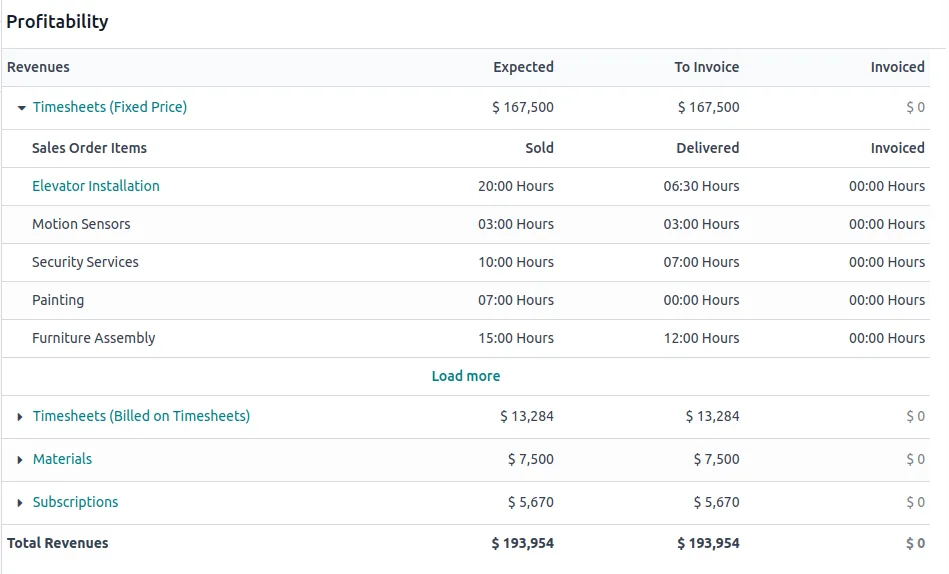
These views support the monthly commercial review between the project manager, QS and finance.
Each platform can report project margin. The depth of forecasting and variation tracking is where they differ. Confirm features for your edition.
| Zoho | Odoo | ERPNext | Dynamics 365 | |
|---|---|---|---|---|
| Project profit and loss | Project-level reporting in Zoho Books with Zoho Projects; deeper views in Zoho Analytics | Analytic accounts give revenue and cost per project; project profitability reports in recent versions | Project profitability report and cost center P&L | Job ledgers and job P&L in Business Central; project accounting in Finance and Operations |
| Forecast to complete | Usually built in Zoho Analytics or a Creator app | Analytic budgets plus custom forecast fields | Budget and custom forecast doctype, often added in construction setups | Job planning lines and estimate-to-complete in project accounting |
| Variation and claims tracking | Custom module | Custom module or sale order amendments | Custom doctype linked to project and BOQ | Change orders via configuration or construction add-ons |
| Revenue recognition over time | Manual journals or custom logic | Configurable with accounting; complex cases customized | Supported with configuration and journals | Job WIP methods (for example percentage of completion) in Business Central |
| Overhead allocation | Manual journals or Analytics | Analytic distribution rules | Cost center allocation and journals | Allocation rules in Finance and Operations; journals in Business Central |
| Portfolio analysis | Zoho Analytics | Pivot views and spreadsheets; Power BI via connector | Report builder; external BI if needed | Power BI with native integration |
Construction-specific features often come from partner add-ons or custom modules; we scope them during discovery.
Margins are only accurate when every cost and revenue source reaches the project.
Profit figures feed tax filings and audited accounts. These are the areas to get right; confirm treatment with your auditor and tax advisor.
Project profits form part of taxable income, taxed at 9% above AED 375,000. Revenue recognition and the treatment of provisions for expected losses should be consistent and documented. See ERP for corporate tax compliance.
Each progress invoice and the final account carry 5% VAT. Retention released at the end of the defects period needs the right VAT treatment, so confirm it with your tax advisor.
Tax records generally need to be kept for at least five years (seven for real estate). Forecasts, variation files and cost reports support figures in the return if questioned.
Salaries are paid through WPS; gratuity accrues under Federal Decree-Law 33 of 2021. Charging both to projects avoids overstating site margins.
General information, not tax or legal advice. Rules change; confirm current FTA, MOHRE and Ministry of Finance guidance with your advisor.
We avoid promising numbers. These are the practical gains once the monthly cycle is running.
Forecast profit is reviewed monthly, so loss-making jobs are recognized early rather than at the final account.
Instructed but unapproved work is visible by value, so the commercial team chases it before the evidence goes stale.
Actual margins by project type and client feed the estimating team, so the next tender is priced on real results.
Net margin after overheads shows which projects really carry the company and which only cover direct cost.
Typical ranges for a contractor that already records costs per project; starting from scratch takes longer.
Durations are typical ranges; your plan is agreed after discovery.
Agree cost codes, revenue recognition approach, overhead rules and the format of the monthly review.
Load tender estimates, budgets, contracts and variation registers for live projects.
Build forecast-to-complete, variation tracking, allocations and profitability reports.
Run two or three monthly reviews in parallel with the old pack, then retire it.
We configure the system for the rules UAE businesses report against, and test it before go-live.
General information, not tax or legal advice. Confirm current requirements with the FTA, MOHRE or your advisor. See all UAE compliance guides.
On-site workshops in Dubai, Abu Dhabi and Sharjah, and remote or on-site delivery across the Northern Emirates and free zones.
Official sources and references
Facts on this page were checked against these sources in October 2026. Rules change, so confirm current requirements before acting.
Still have a question? Our consultants are happy to help.
Ask an ExpertCosting captures what each project spends. Profitability combines that with contract value, variations, certified revenue and forecasts to show the expected margin at completion and how it has moved since tender.
Monthly for active projects is common practice in the UAE. The QS and project manager update the remaining cost per cost code, and the system records the change and the reason.
Many contractors show them separately: approved variations in revenue, submitted ones as a possible upside with a probability. That keeps the margin honest while still showing what is at stake; see variation order software.
Retention is part of earned revenue but cash comes later, so it affects cash flow more than profit. The profit view should still flag retention at risk from defects; retention management covers that in detail.
Yes, if projects are tagged by client, type and emirate. Portfolio reports then show average margin by category, which is often the most useful input for the next round of bidding.
It depends on your size and existing systems. Dynamics 365 has mature job accounting, ERPNext and Odoo are flexible with construction customizations, and Zoho works well with Analytics on top. Compare Odoo for construction and ERPNext for construction for detail.
Related Solutions
Related Industries
Related ERP Platforms
We review two or three of your projects and show how margin would be tracked from tender to final account in your ERP.
Dubai, United Arab Emirates