
L
O
A
D
I
N
G


Zoho, Odoo, ERPNext, Dynamics 365 and custom ERP, delivered by one accountable team.

Get the cumulative maths right on every progress claim, and see at a glance whether each project is over-billed or under-billed against cost.
Progress billing software calculates each claim as contract value completed to date, less previously billed, minus deductions, based on percent complete or measured quantities priced at contract rates. It stops lines exceeding 100 percent without approved variations and compares billed progress with cost incurred. UAE contractors, fit-out firms and fabricators use it to avoid cumulative spreadsheet errors and flag under-billing.
Progress billing software UAE companies use has one job above all: calculate what is due this period from what has been completed to date, without errors creeping into the cumulative figures. Instead of billing a fixed amount on a date, the company bills a share of the contract value that reflects real progress. That progress is measured either as a percentage complete per item or section, or as quantities physically measured on site and priced at contract rates.
The arithmetic is simple on paper and fragile in a spreadsheet. Every claim has the same structure: contract value, cumulative completed to date, less previously billed, equals this period's value, followed by deductions. One overwritten formula, one row inserted in the wrong place or one quantity carried forward incorrectly, and the cumulative position is wrong for every later claim. Contractors, fit-out firms, steel fabricators, MEP subcontractors and engineering consultancies in the UAE all run into the same problem.
This page focuses on the method: how progress is measured, how cumulative billing works and how it ties to work in progress. The wider contractor cycle, from IPA to collection, is covered under construction billing software. If your projects bill on fixed dates or deliverables instead, compare milestone billing and fixed fee project billing.

These are the errors that show up when we audit progress billing files for UAE project-based businesses.
Each month's workbook is copied from the last, and previous-to-date values are pasted by hand. After a few periods the cumulative total no longer matches the sum of invoices issued.
Site teams estimate progress by eye, with no link to installed quantities, labour hours or cost incurred. Clients' consultants then cut the figures, and the contractor has no evidence to push back.
Some projects are front-loaded and others under-billed for months. Without comparing billed percentage with cost percentage, finance cannot see which projects are funding the others.
Approved variations add new items or alter rates, but the claim template still uses the original BOQ. The wrong rate is applied until someone notices.
When a claim is revised after a consultant's comments, the earlier version is overwritten. Months later nobody can show what was submitted and what was changed.
The ERP keeps the cumulative position per line and only asks the team for this period's progress.
One shared database: every step updates stock, finance and reports in real time.
These are the building blocks we configure for percent-complete and measured billing.
Contract value broken into lines or sections that progress is reported against, aligned with the priced BOQ.
Percent complete or quantity to date per line, captured by the site engineer or QS with date, remarks and attachments.
Previous, current and to-date values worked out by the system, with checks that no line exceeds 100% without an approved variation.
Cost incurred divided by estimated total cost, used as a cross-check against physical progress.
Billings in excess of cost and cost in excess of billings posted to separate balance sheet accounts each period.
Each revision saved with who changed what, so submitted and certified versions can be compared.
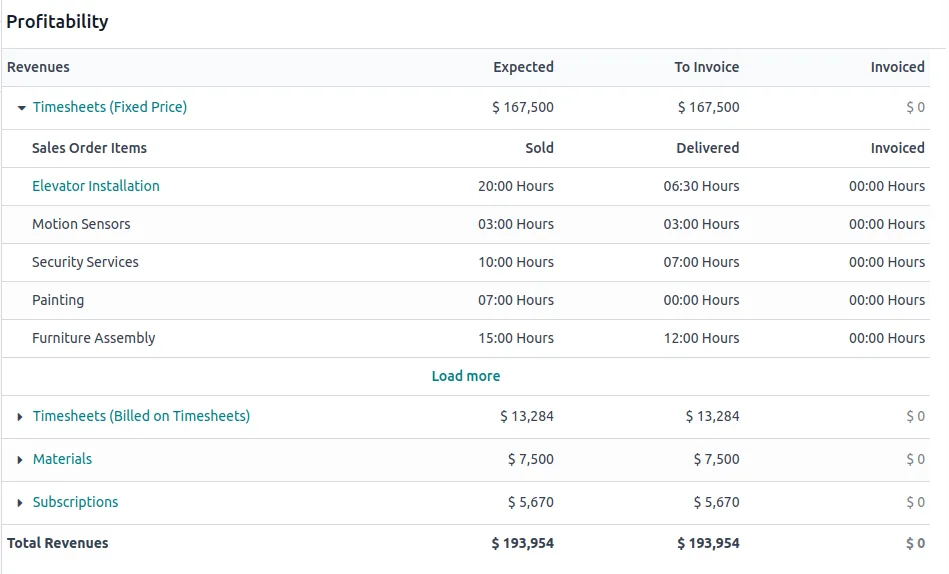
This dashboard puts physical progress, cost progress and billed progress next to each other for every running project.
Progress billing is native in some platforms and configured in others. Capabilities vary by edition, so confirm details for your version.
| Zoho | Odoo | ERPNext | Dynamics 365 | |
|---|---|---|---|---|
| Percent-complete invoicing | Partial invoicing from estimates or projects; per-line percentages usually need customisation | Milestone-based service invoicing with delivered percentage updated per line | Invoice partial amounts from a Sales Order; per-line percent claims often customised | Business Central projects support billing from planning lines; Project Operations and Finance support progress and milestone billing |
| Measured quantity billing | Quantity updates on invoice lines; quantity-to-date tracking via Zoho Creator | Delivered quantity on order lines drives what is invoiced | Billed quantity tracked against Sales Order quantity | Usage and quantity posted to project lines before invoicing |
| Cumulative claim layout | Custom template | Custom report or construction app | Custom print format | Report layouts or partner app |
| Cost-to-cost percent complete | Reporting through Zoho Analytics | Analytic accounting comparison, often custom | Project costing reports compare cost with estimate | WIP methods including cost-based percentage of completion in Business Central |
| WIP / over-under billing entries | Manual journals or scripted | Manual or custom journal | Manual or custom journal | WIP calculation and posting available natively |
| Best fit | Service and fit-out firms with simpler contracts | Contractors wanting order-driven progress billing | Teams comfortable extending a flexible framework | Firms that need formal WIP accounting |
Progress figures are stronger when they come from records rather than estimates.
How the billing module should be configured for UAE rules. This is not tax advice; confirm with your tax advisor.
Progress claims are usually periodic supplies, where the date of supply can be the earliest of invoice, payment or the date payment is due under the contract. Record each of these dates on the claim so VAT is reported in the correct return period.
Under IFRS 15, revenue on many construction and engineering contracts is recognised over time. The ERP should separate what has been billed from what has been earned, which supports both the audit and the corporate tax computation. See ERP for work in progress.
From the mandatory phases starting 1 January 2027 (AED 50 million revenue and above) and 1 July 2027 (others), B2B progress invoices will need PINT AE data sent through an ASP. Check the latest Ministry of Finance and FTA guidance.
Keep measurement sheets and progress photos attached to each claim. They support the invoice during an FTA review and during disputes with the client's consultant.
General information, not tax or legal advice. Rules change; confirm current FTA, MOHRE and Ministry of Finance guidance with your advisor.
The gains come from removing manual arithmetic and making progress evidence visible.
Previous-to-date values come from posted claims, so the running total always equals invoices issued.
Percent complete is backed by quantities, cost and photos, which gives the commercial team evidence when figures are challenged.
Projects where cost runs ahead of billing are flagged monthly, before the cash gap grows.
WIP adjustments are calculated from system data instead of a separate reconciliation workbook.
Typical ranges; a business with a few large contracts moves faster than one with many small jobs.
Durations are typical ranges; your plan is agreed after discovery.
Agree which contracts bill by percent complete, measured quantity or a mix, and how cost-to-cost checks will be used.
Set up schedules of values, claim layouts, approval steps and WIP accounts.
Load cumulative billed values and cost to date for each running project.
Run claims in the ERP with a side-by-side check against the old file.
We configure the system for the rules UAE businesses report against, and test it before go-live.
General information, not tax or legal advice. Confirm current requirements with the FTA, MOHRE or your advisor. See all UAE compliance guides.
On-site workshops in Dubai, Abu Dhabi and Sharjah, and remote or on-site delivery across the Northern Emirates and free zones.
Official sources and references
Facts on this page were checked against these sources in October 2026. Rules change, so confirm current requirements before acting.
Still have a question? Our consultants are happy to help.
Ask an ExpertProgress billing charges for the share of work completed in the period, whatever the stage. Milestone billing charges a fixed amount when a defined event is reached, such as slab completion or handover. Many UAE contracts mix both; read our page on milestone billing software for the event-based method.
No. Engineering consultancies, fabrication shops, interior fit-out firms and IT project companies also bill by percent complete. The same engine applies; only the progress source changes.
Each line carries its contract value, and the system warns or blocks when the cumulative claim would exceed it. The fix is an approved variation that increases the line value, rather than an override.
Over-billing means billed value is ahead of earned value based on cost or physical progress. It is a liability on the balance sheet and can hide a loss-making project, so it should be reviewed every month.
Yes. Dayworks and reimbursable items can sit on separate lines billed on actuals, as described in time and material billing, while the main scope bills on progress.
For service firms that bill a mix of retainers, hours and fixed fees, see project billing software. Progress billing is one of the methods that setup can include.
Related Solutions
Related Industries
Related ERP Platforms
Send us a recent progress claim and we will show how the same figures would be calculated, approved and posted in the ERP.
Dubai, United Arab Emirates