
L
O
A
D
I
N
G


Zoho, Odoo, ERPNext, Dynamics 365 and custom ERP, delivered by one accountable team.

Contractors win work through pre-qualification lists, consultant relationships and well-priced tenders. A construction CRM tracks all three and hands awarded jobs cleanly to the project team.
A CRM for UAE construction companies tracks the tender journey rather than a simple lead funnel: pre-qualification, invitation, site visit, clarifications, BOQ pricing, submission, negotiation and award. It links developers, consultants and main contractors to each opportunity, records bid/no-bid scoring and lost-bid reasons, keeps pre-qualification documents current, and hands awarded jobs to the project team with all commercial terms.
A main contractor, MEP subcontractor or fit-out company in the UAE rarely gets a cold lead that turns into a contract next week. Work comes from being on a developer's approved vendor list, from consultants who recommend you for tender invitations, from main contractors who invite subcontract bids, and from government and semi-government portals. Each opportunity passes through pre-qualification, tender invitation, site visit, clarification queries, BOQ pricing, submission, post-tender negotiation and, if you are lucky, a letter of award. A CRM for construction companies in the UAE is built around that journey rather than a simple lead funnel.
Most contractors run business development out of a tender register in Excel, an estimator's inbox and the managing director's phone. The register shows submission dates but not who influences the decision, why the last three bids to the same developer were lost, or how much estimating time went into tenders that were never realistic. When an award comes through, the estimate, the clarifications and the commercial assumptions are emailed to the project team in pieces.
This page focuses on the commercial side before contract award. Pricing detail sits with construction estimation software, and the tender document process itself with construction tender management. The CRM ties them together around the client, the consultant and the decision.

These are the issues that cost contractors estimating hours and margin long before a project starts.
Estimators price every invitation that arrives, including ones the company has little chance of winning. Strong opportunities get rushed because the team is busy on weak ones.
Vendor registrations with developers and government entities need renewed trade licenses, insurance and financials. Nobody tracks expiry, and the company drops off a list without knowing.
The business development manager knows which consultant's project manager trusts the company. When that person moves on, the network goes with them.
Losses are not recorded with a reason, competitor or price gap. The company keeps bidding the same way to the same clients and losing for the same reasons.
The project team receives the contract but not the clarifications, exclusions and commercial assumptions made during tendering, which surfaces later as variation disputes.
Management cannot see likely awards against current project load and manpower, so the company either overcommits or underbids its capacity.
Every step leaves a record against the client and the opportunity, so the history is there for the next bid.
One shared database: every step updates stock, finance and reports in real time.
These are configured on top of a standard CRM; most platforms handle them with custom fields, stages and related records.
Developer, consultant, project manager and main contractor recorded as separate accounts linked to each opportunity, with each person's role.
Vendor registration status per client with document expiry dates for trade license, insurance and audited financials, and reminders before they lapse.
Stages from invitation to award, with submission deadline, bid bond requirement, estimated value and probability.
A short scorecard on client relationship, payment history, scope fit, competition and capacity, recorded with the decision and approver.
Tender queries and answers, addenda and site visit notes stored on the opportunity so nothing is lost at award.
Loss reason, winning competitor where known and price difference, reported by client and by work type.
Tender documents, submitted proposals and the letter of award attached to the record, with version history.
Awarded opportunity creates the project in the ERP with contract value, client, retention terms and key assumptions carried over.
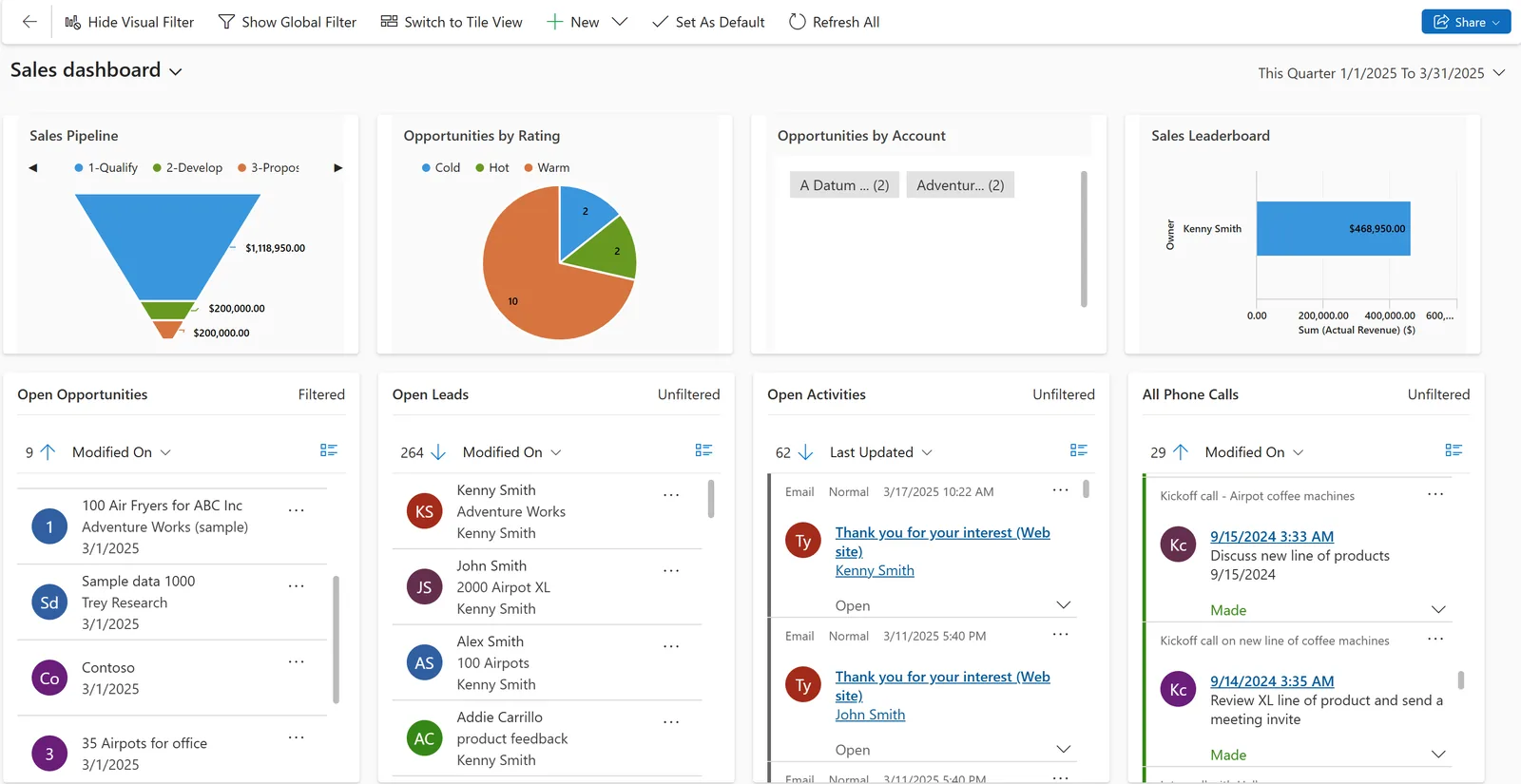
Built for the weekly tender meeting between the MD, BD lead and chief estimator.
None of the four ships a dedicated contractor CRM out of the box; all can be configured for it. The difference is how well CRM connects to project and cost control. Confirm features for your edition.
| Zoho | Odoo | ERPNext | Dynamics 365 | |
|---|---|---|---|---|
| Tender pipeline | Custom pipeline and Blueprint stages in Zoho CRM | CRM pipeline with custom stages and fields | Opportunity with custom stages and fields | Dynamics 365 Sales opportunities with business process flows |
| Stakeholder mapping | Related lists and multi-lookup fields | Contacts and partners with tags and roles | Linked contacts and custom child tables | Connection roles between accounts and contacts |
| Pre-qualification tracking | Custom module with expiry reminders | Custom model or Studio app with activities | Custom DocType with notifications | Custom table in Dataverse with Power Automate reminders |
| Handover to projects | Into Zoho Projects or a partner construction solution | Into Odoo Project with sales order and analytic accounts | Into ERPNext Projects with cost centers | Into Project Operations or Business Central jobs |
| Best fit | Subcontractors and fit-out firms wanting quick setup | Contractors wanting CRM, projects and accounting in one system | Contractors wanting open source with project costing | Larger contractors standardized on Microsoft |
These links stop tender data from being retyped when a job is won.
These affect how you record tender and client information. Confirm specifics with your advisors.
Many clients ask for a current trade license and contractor classification with the relevant municipality. Track your own document expiry dates in the pre-qualification register so submissions are not rejected.
Construction services are generally standard rated at 5%, while some new residential buildings can involve zero-rated first supplies by the developer. Record whether submitted prices include or exclude VAT, and confirm treatment with your tax advisor.
Capture the retention percentage, advance payment and payment terms in the opportunity so they flow into the contract and project billing setup.
Consultant and client contact details are personal data under Federal Decree-Law No. 45 of 2021. Restrict exports and keep access role-based.
General information, not tax or legal advice. Rules change; confirm current FTA, MOHRE and Ministry of Finance guidance with your advisor.
Typical outcomes once tenders run through one system. We do not promise percentages.
A recorded bid/no-bid step filters out tenders the company is unlikely to win.
Expiry reminders keep pre-qualifications current with key developers and authorities.
Consultant and developer contacts, meetings and history are shared, not personal.
Clarifications, exclusions and commercial terms reach the project team on day one.
Indicative ranges; firms with several divisions or heavy integration to project costing take longer.
Durations are typical ranges; your plan is agreed after discovery.
Review the tender register, bid/no-bid habits, stakeholder types and handover gaps with BD and estimating.
Tender stages, stakeholder roles, pre-qualification register, scorecard and dashboards.
Import the last two to three years of tenders with outcomes, plus clients and consultants.
Connect award to project creation in the ERP; see ERP for construction companies for the project side.
Use the dashboard in the weekly tender meeting until it replaces the Excel register.
We configure the system for the rules UAE businesses report against, and test it before go-live.
General information, not tax or legal advice. Confirm current requirements with the FTA, MOHRE or your advisor. See all UAE compliance guides.
On-site workshops in Dubai, Abu Dhabi and Sharjah, and remote or on-site delivery across the Northern Emirates and free zones.
Official sources and references
Facts on this page were checked against these sources in October 2026. Rules change, so confirm current requirements before acting.
Still have a question? Our consultants are happy to help.
Ask an ExpertYes. Subcontractors bid many packages to a small number of main contractors, so tracking each one's invitation volume, hit rate and payment behavior is valuable. It shows which relationships deserve more effort and which are costing estimating time for little return.
Tender management handles documents, addenda and submission. The CRM manages the relationships and decisions around the tender: who the stakeholders are, whether to bid, and why you won or lost. Many contractors use both, linked on the same opportunity.
Yes, when CRM and ERP are connected or are the same system. The awarded opportunity creates a project with client, contract value and retention terms. Our CRM integration team sets this up where the systems are separate.
If you want CRM, project costing and accounting in one place, Odoo for construction or ERPNext for construction are strong options. If you already run Zoho, extending Zoho CRM is often faster. We implement all of them and recommend by fit.
Usually yes. We map the Excel columns to opportunities, clients and outcomes and import several years of history, which gives useful hit-rate reports from day one.
Make the CRM the only place where meetings and contacts are logged, and review activity in weekly meetings. Contacts then belong to the account, and new BD staff see the full relationship history.
Related Solutions
Related Industries
Related ERP Platforms
We will review how your company tracks tenders today and show a CRM setup built for contractors.
Dubai, United Arab Emirates