
L
O
A
D
I
N
G


Zoho, Odoo, ERPNext, Dynamics 365 and custom ERP, delivered by one accountable team.

Most UAE small businesses do not lose deals to competitors. They lose them to slow follow-up, a salesperson who left with the contacts, and quotes nobody chased.
A CRM helps UAE SMEs move leads out of personal WhatsApp chats into one shared pipeline, so enquiries get replies, quotes get chased and customer history stays when a salesperson leaves. The core workflow is capture, qualify, quote, follow up, win or record a loss reason, then hand to accounting. Zoho CRM or Bigin, Odoo, ERPNext and Dynamics 365 all fit different SME profiles.
A typical SME in Dubai, Sharjah or Abu Dhabi has three to fifteen people who sell, and the owner is usually the best salesperson of all. Leads arrive through WhatsApp, Instagram DMs, website forms, Google Business calls, trade shows at the World Trade Centre and referrals. Each salesperson keeps them on a personal phone. Quotes are typed in Word, sent as PDF, and followed up when someone remembers. A CRM for SMEs in the UAE is simply the place where all of that is captured once, owned by the company, and turned into a visible list of next actions.
The trap for small companies is buying a CRM built for a 200-seat sales floor. Ten custom modules, five approval layers and a forecasting engine look impressive in a demo and are abandoned by month three. What works at SME size is a short pipeline with four to six stages, mandatory next-activity dates, a shared contact list, and quotes generated from the same record. Everything else can wait. Our broader CRM solutions overview covers larger and more complex sales teams.
This page is about getting that small-business setup right: which problems to solve first, what the workflow looks like, which platform suits which kind of SME, and how to connect CRM to your accounting without buying a full ERP on day one. If you are still deciding whether you need CRM or ERP first, read our explainer on ERP vs CRM for UAE companies.

These are the patterns we see again and again when we first sit with an SME owner and their sales team.
Enquiries live in WhatsApp chats on each salesperson's mobile. When someone resigns or is on leave, the company loses both the contacts and the conversation history.
Quotes go out and nobody chases them for two weeks. There is no reminder, no list of stale deals, and the owner only hears about a lost order when the customer has already bought elsewhere.
Asking what is likely to close this month means calling each salesperson. Numbers in the Friday Excel sheet are optimistic, out of date and in different formats.
Customer names, TRNs and prices are retyped from the quote into the accounting system. Errors reach tax invoices and VAT records, and credit notes follow.
The company pays for Google Ads, Instagram promotion and portal listings but cannot say which source produced paying customers, so the budget is set by gut feel.
Nobody in the company is a system administrator. A CRM that needs constant configuration or a developer for every change will drift out of use.
Keep it this short. Each step is one screen, and the system nudges the salesperson to the next one.
One shared database: every step updates stock, finance and reports in real time.
Start with the first four. Add the rest when the team is using the basics every day.
One shared record per customer with TRN, emirate, trade license details where useful, and every call, email and message logged against it.
Website forms, landing pages and imported trade-show lists create leads automatically, tagged with their source.
A visual board with four to six stages, deal value and expected close date, so the owner sees the month at a glance.
Calls, meetings and follow-up tasks with due dates; overdue items appear on each user's home screen every morning.
Branded PDF quotes with products, discounts and 5% VAT shown, sent by email or WhatsApp from the deal record.
Conversations attached to the contact instead of sitting on one phone, using the WhatsApp Business Platform through an approved provider.
Won deals become customers and sales orders in the accounting system without retyping, so tax invoices carry correct details.
Pipeline by stage, leads by source, activities by salesperson and win rate; enough for a weekly sales meeting.
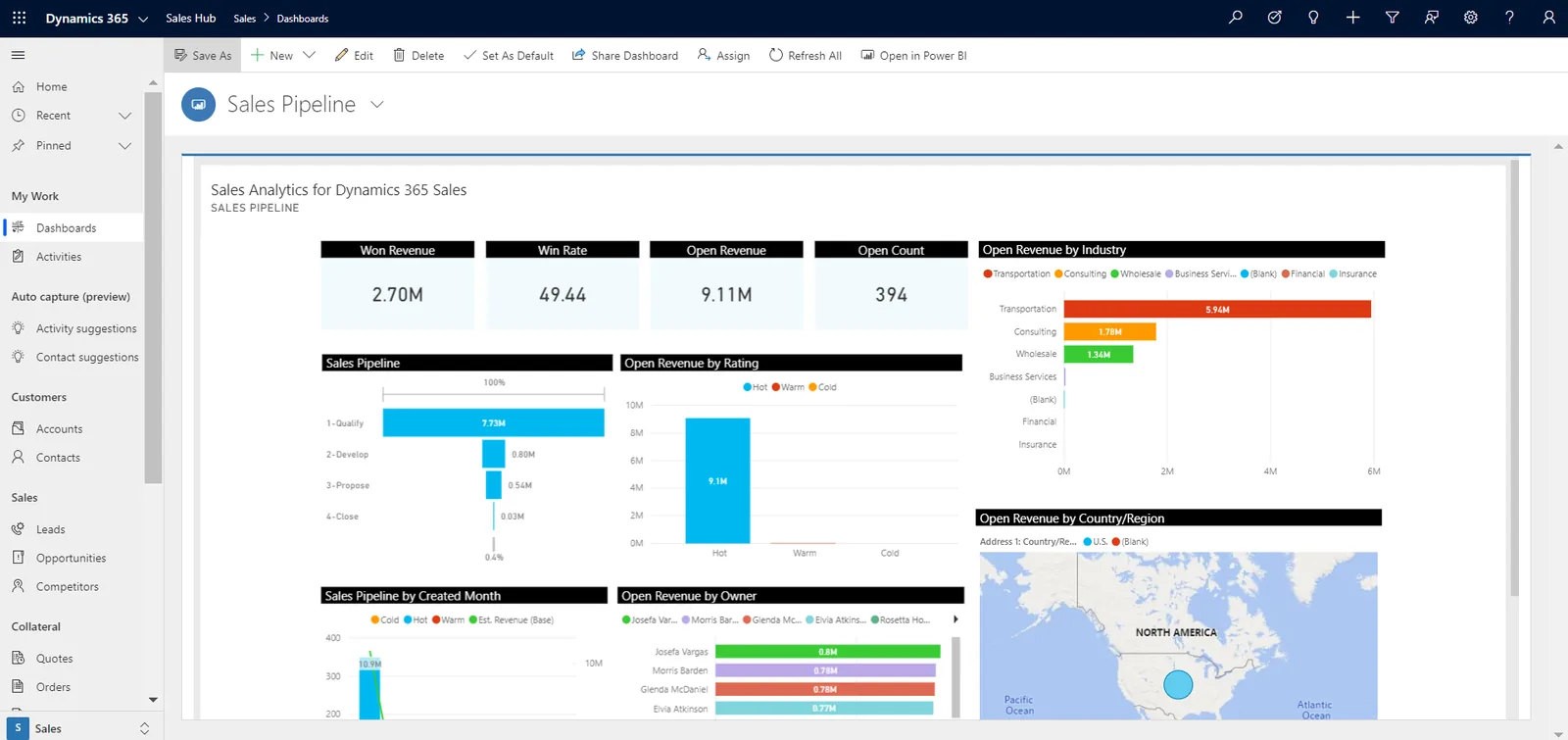
An SME does not need forty reports. These five answer the questions owners ask every Sunday or Monday morning.
We implement all four, so the honest answer is that fit depends on what else you run and who will look after the system. Features and plan names change; confirm against the current edition.
| Zoho | Odoo | ERPNext | Dynamics 365 | |
|---|---|---|---|---|
| Typical SME fit | Teams wanting a ready cloud CRM quickly; Bigin suits very small pipeline-only teams, Zoho CRM suits growing ones | SMEs who also want sales, inventory and accounting in one database | Cost-conscious SMEs comfortable with open source and a partner for hosting | SMEs already standardized on Microsoft 365 and planning to grow |
| Pipeline and activities | Mature pipeline, tasks and reminders; Blueprint for guided stages | Kanban pipeline with scheduled activities on every record | Lead, opportunity and to-do records; the separate Frappe CRM app offers a newer interface | Dynamics 365 Sales opportunity management and activities |
| Quotation to invoice | Native link to Zoho Books for quotes, invoices and VAT | Quotation becomes sales order and invoice inside Odoo | Quotation to sales order to sales invoice in one system | Typically paired with Business Central for invoicing |
| Via Zoho marketplace extensions or provider integrations | WhatsApp integration in recent Enterprise versions; confirm for your edition | Through community apps or a provider API | Via partner connectors or Microsoft customer engagement tools; confirm licensing | |
| Admin effort | Low for standard setup | Low to moderate; Studio for no-code changes | Moderate; benefits from technical support | Moderate to high; usually partner-managed |
| Arabic interface | Available | Available | Available | Available |
We do not quote license prices here. Per-user pricing and edition limits change often, so we size them during a short consultation.
Each connection removes one place where data is typed twice.
CRM is not a tax system, but it holds personal data and feeds invoices. Confirm specifics with your legal and tax advisors.
Federal Decree-Law No. 45 of 2021 on Personal Data Protection sets rules for collecting and using personal data. Record consent, limit access by role and be able to export or delete a contact's data on request. Free zones such as DIFC and ADGM have their own data protection regimes.
UAE telemarketing rules restrict unsolicited calls and messages; respect the national Do Not Call Register and only send WhatsApp templates to contacts who opted in.
Store the customer's TRN and address correctly in CRM so the tax invoice raised in accounting carries the prescribed fields. Quotes should show the 5% VAT clearly.
Under the UAE e-invoicing program, businesses below AED 50 million revenue are expected to go live from 1 July 2027 through an Accredited Service Provider. Clean customer master data in CRM makes that easier; check the latest Ministry of Finance and FTA guidance.
General information, not tax or legal advice. Rules change; confirm current FTA, MOHRE and Ministry of Finance guidance with your advisor.
No percentages promised. These are the changes owners usually notice first.
Assignment rules and reminders mean enquiries no longer wait in someone's unread chats.
Contacts and conversation history stay in the system when a salesperson leaves.
Weekly meetings use one live report instead of collected Excel sheets.
Customer details flow from CRM to accounting once, so fewer tax invoices need correction.
Typical ranges for a three to fifteen-user sales team on a standard setup. Scope, data quality and integrations change them.
Durations are typical ranges; your plan is agreed after discovery.
Map how enquiries arrive today, agree pipeline stages, loss reasons and who owns which customers.
Configure fields, stages, web forms, quote template with VAT and user roles.
Clean and import contacts from Excel, phone exports and the accounting customer list, removing duplicates.
Connect email, WhatsApp provider and accounting. See our CRM integration service for heavier connections.
Short role-based sessions, then weekly check-ins on overdue activities until the habit sticks.
We configure the system for the rules UAE businesses report against, and test it before go-live.
General information, not tax or legal advice. Confirm current requirements with the FTA, MOHRE or your advisor. See all UAE compliance guides.
On-site workshops in Dubai, Abu Dhabi and Sharjah, and remote or on-site delivery across the Northern Emirates and free zones.
Official sources and references
Facts on this page were checked against these sources in October 2026. Rules change, so confirm current requirements before acting.
Still have a question? Our consultants are happy to help.
Ask an ExpertUsually yes, if leads come from several channels or deals take more than one conversation to close. The value is less about reports and more about never losing a follow-up and keeping customer history in the company. A small team can be live within a few weeks on a standard setup.
If your pain is mainly leads, follow-up and quotes, start with CRM and connect it to accounting. If stock, purchasing and invoicing are also messy, a combined system may be better. Our guide to ERP software for SMEs explains when to make that jump.
Open-source ERPNext CRM has no license fee but needs hosting and support. Zoho CRM and Odoo CRM have per-user subscriptions with entry-level plans. The total cost depends more on setup, integrations and support than on the license line, so compare like for like.
Yes, through the WhatsApp Business Platform via an approved provider. Customers must opt in, and business-initiated messages use pre-approved templates. Conversations are then logged against the contact instead of staying on one phone.
Yes. We clean duplicates, standardize phone formats and map fields before import. Larger moves with history, attachments and open deals are covered by our CRM migration service.
For most SMEs we nominate one internal owner, often the sales coordinator, and train them to manage users, fields and simple reports. We handle anything beyond that under a support plan, so you do not need an in-house developer.
Related Solutions
Related Industries
Related ERP Platforms
Tell us how enquiries reach you today and we will suggest the simplest CRM setup that fits your team and budget.
Dubai, United Arab Emirates










