L
O
A
D
I
N
G


Zoho, Odoo, ERPNext, Dynamics 365 and custom ERP, delivered by one accountable team.

Civil work is measured in cubic meters, machine hours and certified quantities. We set up ERP so your site measurements, plant logs and IPCs all feed the same cost picture.
Civil contractors in the UAE need an ERP that uses BOQ items as the backbone of budgets, costing and billing, posts daily plant hours and diesel issues to both the job and the machine, and turns measured quantities into interim payment certificates (IPCs) with retention and advance recovery. This replaces separate Excel site logs, QS workbooks and accounts packages across Dubai, Abu Dhabi and the northern emirates.
ERP for civil contractors in the UAE has to handle work that a building contractor rarely sees in the same volume: excavation and backfilling by the cubic meter, asphalt laid by the ton, pipe laid by the linear meter, and a fleet of excavators, rollers, tippers and water bowsers that eats diesel every day. Margins depend on how productively that plant and those crews move earth, not only on what you buy.
Most civil firms we meet in Dubai, Abu Dhabi and the northern emirates run their numbers in three places. The site team keeps daily progress and plant logs in Excel. The quantity surveyor builds interim payment applications in another workbook. Accounts posts invoices and payroll in a separate package. By the time anyone compares cost against certified value, the month has closed and the overrun is already sunk.
We configure ERP around the bill of quantities, so every cost line, every plant hour and every certified quantity rolls up against a BOQ item. Our wider ERP for construction companies page covers building contractors; this page focuses on earthworks, roads, utilities, drainage and site preparation.

These are the operational gaps we see most often when a UAE civil contractor asks us to review how it tracks cost.
Owned machines, hired machines and operators are often charged to a general overhead account. Nobody can then say whether a road package made money once the excavator and roller hours are added.
Fuel is issued from bowsers and site tanks with handwritten slips. Without issues linked to a machine and hour meter, consumption per hour cannot be checked and leakage goes unnoticed.
Quantities done on site do not always reach the IPC, especially variations and extra excavation. Unbilled work sits in the ground and the cash gap grows each month.
Retention held by the client, retention held from subcontractors, performance bonds and advance payment guarantees all have release dates. When these live in a personal file, money and bank charges are lost.
Piling, dewatering and asphalt subcontractors bill on their own measurement. Without an agreed measurement sheet in the system, overpayment is easy and back-charges are forgotten.
From tender to final account, each stage becomes a linked record so the cost and revenue on a BOQ line can be traced back to its source.
One shared database: every step updates stock, finance and reports in real time.
We avoid switching on everything. These are the modules that carry weight for earthworks, roads and utilities work.
Budgets loaded per BOQ item and cost code, with actuals from purchases, timesheets, plant and stores posted against them.
Owned and hired machines with hour meters, internal hire rates, maintenance history and allocation to jobs by day.
Diesel issues per machine from site tanks or bowsers, with consumption per hour reports and stock reconciliation.
Measured quantities and percentage complete turned into interim payment applications, with retention and advance recovery calculated.
Subcontract orders with rates, measurement sheets, certified payments, retention held and back-charges.
Material requests from site, purchase orders for aggregates, pipes and rebar, and goods received at each site store.
Crew timesheets by job and cost code, overtime, accommodation costs and WPS payroll for site labour.
Register of performance bonds and advance payment guarantees with expiry alerts and bank charge tracking.
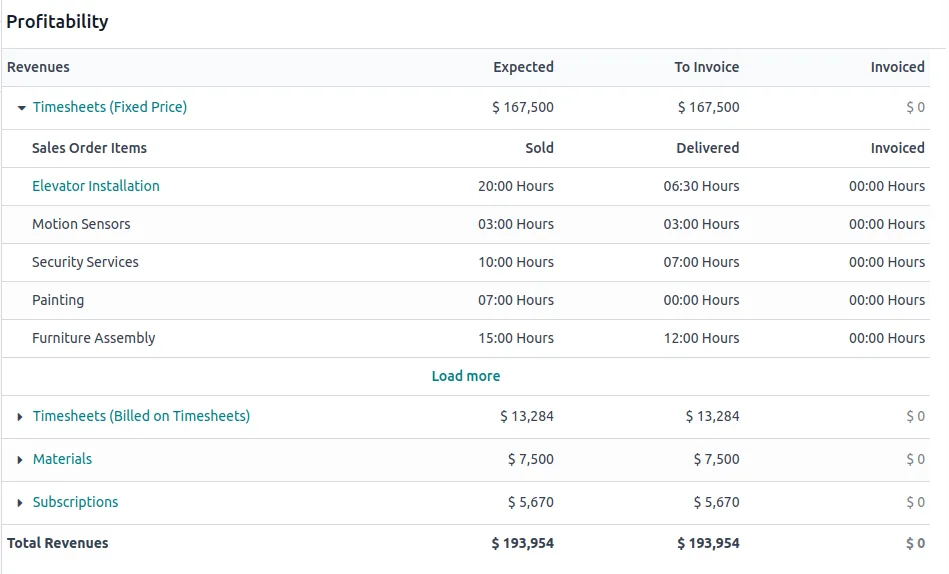
Project managers and the commercial team look at the same screen during the monthly cost review, instead of reconciling three workbooks.
We implement Zoho, Odoo, ERPNext, Microsoft Dynamics 365 and custom ERP. The right one depends on your size, plant fleet and how complex your contracts are.
| Contractor profile | Usual fit | Why |
|---|---|---|
| Small site works or utilities subcontractor, a few machines | Zoho One or ERPNext | Light project costing, simple progress invoices and payroll without heavy setup |
| Mid-size earthworks or roads contractor with its own fleet | Odoo or ERPNext | Project accounting, maintenance and stock in one database, with custom plant and fuel logs |
| Contractor with several companies, JVs and large plant division | Microsoft Dynamics 365 | Multi-entity finance, intercompany plant hire and stronger controls for larger groups |
| Contractor with a unique measurement or plant model | Custom ERP or a custom layer | Built around your own measurement sheets and hire logic where packaged apps fall short |
Fit is a starting point. We confirm it against your actual contracts, fleet size and reporting needs during discovery.
We configure the system to support these obligations. Tax treatment of specific contracts should be confirmed with your tax advisor.
VAT at 5% on each interim payment application, with the tax point handled on certified or invoiced values and retention treated consistently. Returns are filed through EmaraTax.
Corporate tax applies at 9% on taxable income above AED 375,000. Revenue on long contracts needs a consistent recognition method, so ERP should hold work-in-progress and cost-to-complete figures that your auditor can follow.
Large site workforces are paid through the MOHRE Wage Protection System. Payroll should produce the Salary Information File and track end-of-service gratuity under the UAE Labour Law.
Under the PINT AE model, invoices will be exchanged through an Accredited Service Provider, with the first mandatory phase from 1 January 2027 for larger businesses. Progress invoices need clean structured data; check the latest Ministry of Finance and FTA guidance.
General information, not tax or legal advice. Rules change; confirm current FTA, MOHRE and Ministry of Finance guidance with your advisor.
We do not promise numbers, but these are the improvements civil contractors usually aim for and can measure themselves.
Plant, labour and material cost post daily, so overruns on a section show while the crew is still on it.
Measured work is compared with certified work every cycle, so variations and extras are claimed rather than forgotten.
Utilization and idle time per machine help decide whether to keep, hire out or dispose of equipment.
Release dates and expiries are tracked in one register, cutting bank charges on bonds that should have been returned.
Durations are typical ranges for a mid-size contractor and depend on the number of live projects and the quality of existing data.
Durations are typical ranges; your plan is agreed after discovery.
Review contracts, BOQ formats, plant registers, fuel processes and how IPCs are prepared today.
Agree cost codes, BOQ structure, internal plant rates, approval limits and the IPC template.
Configure projects, plant, stores, subcontracts and payroll, and build any custom measurement screens.
Load open projects with cost-to-date, retention balances and plant, then run one live project in parallel.
Bring remaining projects across, train site engineers and storekeepers, and support the first IPC cycles.
Compare platforms and read about related contracting segments.
We configure the system for the rules UAE businesses report against, and test it before go-live.
General information, not tax or legal advice. Confirm current requirements with the FTA, MOHRE or your advisor. See all UAE compliance guides.
On-site workshops in Dubai, Abu Dhabi and Sharjah, and remote or on-site delivery across the Northern Emirates and free zones.
Official sources and references
Facts on this page were checked against these sources in October 2026. Rules change, so confirm current requirements before acting.
Still have a question? Our consultants are happy to help.
Ask an ExpertYes. We set an internal hourly or daily rate per machine class and post plant usage from daily logs to the project. The plant division then shows its own recovery against depreciation, repairs and fuel, which tells you whether the internal rate is right.
Measured quantities or percentages are entered against BOQ items, and the system calculates gross value, previous certified amounts, retention and advance recovery. The approved certificate becomes a VAT invoice. Formats can follow FIDIC-style layouts your consultants expect.
Most platforms we implement support mobile forms or a web app that works on a phone. Foremen record hours, hour meter readings and fuel issues on site, and the entries post once approved.
Hired plant is set up as purchase agreements with rates per hour, day or month. Timesheets from site are matched to the supplier's invoice so you only pay for hours actually logged.
No. We implement Zoho, Odoo, ERPNext, Microsoft Dynamics 365 and custom ERP. We can migrate your data from other systems, including SAP Business One, Tally or Excel, and we compare options honestly during discovery.
For a mid-size civil contractor, a first rollout often takes three to five months. Smaller firms with fewer live projects can move faster, and we usually pilot on one project before moving the rest.
Related Solutions
Related Industries
Related ERP Platforms
Send us one BOQ and one recent IPC, and we will show how they would run through ERP.
Dubai, United Arab Emirates