L
O
A
D
I
N
G


Zoho, Odoo, ERPNext, Dynamics 365 and custom ERP, delivered by one accountable team.

Infrastructure contracts run for years, involve partners and change constantly. We set up ERP to keep the board, the client and the auditors looking at one version of each program.
UAE infrastructure contractors use ERP to control a portfolio of multi-year programmes through a programme, contract and work package hierarchy with budgets, forecasts, joint venture accounting, earned value and group consolidation. Larger multi-entity groups often fit Microsoft Dynamics 365, while regional contractors do well with Odoo or Business Central. Scheduling tools such as Primavera usually remain the planning system.
ERP for infrastructure companies in the UAE is less about a single site and more about a portfolio: road interchanges, bridges, utility networks, treatment plants, rail and port works, often delivered for government or semi-government clients over several years. A single contract can involve a joint venture partner, a design consultant, dozens of subcontractors, performance bonds worth a large share of the contract and a stream of variation orders.
The pressure points are governance and forecasting. Leadership wants to know the estimate at completion of every program, how much risk sits in unapproved variations, and what cash each joint venture will need next quarter. Clients and lenders ask for progress reports in their own formats. Auditors need a revenue recognition method they can test. Spreadsheets break down quickly at that scale because each project team keeps its own version.
We structure ERP so that each program, contract, JV and work package has its own ledger dimension, and consolidation happens automatically. For site-level earthworks and roads costing, our ERP for civil contractors page goes deeper; here we focus on the program and group layer.

These issues tend to appear once a contractor moves from building projects into larger public works and long programs.
The project team, commercial team and finance each hold a different estimate at completion. Board packs end up reconciling opinions instead of reviewing one forecast.
JV books are often kept in a separate small package or spreadsheet. Partner cash calls, profit shares and intercompany charges then have to be matched by hand every quarter.
Instructed but unapproved variations can represent a large share of value at risk. Without a register linked to cost, nobody can tell how much work is being done at risk.
Government and semi-government clients expect monthly progress reports, S-curves and cash flow forecasts in set formats. Teams lose days each month copying figures into templates.
Recognizing revenue over time needs reliable cost-to-date and cost-to-complete figures. If those numbers are weak, the audit becomes long and painful.
Performance, advance payment and retention bonds consume bank facilities. Expired or released bonds that are not returned keep costing commission.
We map the program life cycle so that each stage leaves a record that feeds forecasting and reporting.
One shared database: every step updates stock, finance and reports in real time.
These modules carry the weight in a multi-year, multi-entity environment.
Separate legal entities for contracting, plant, JVs and holding, with intercompany postings and consolidation.
Hierarchy of program, contract and work package, each with baseline, revised budget, commitments and actuals.
Planned value, earned value and actual cost captured per period to produce CPI, SPI and estimate at completion.
Variation orders and claims from instruction to approval, linked to the cost they generate.
Long-lead items, framework agreements and subcontract packages with approval workflows by value.
Guarantee register, facility usage by bank, cash flow forecasting per program and partner cash calls.
Contract documents, correspondence references and approvals stored against the program record.
Portfolio dashboards and board packs drawn from the ledger instead of manual extracts.
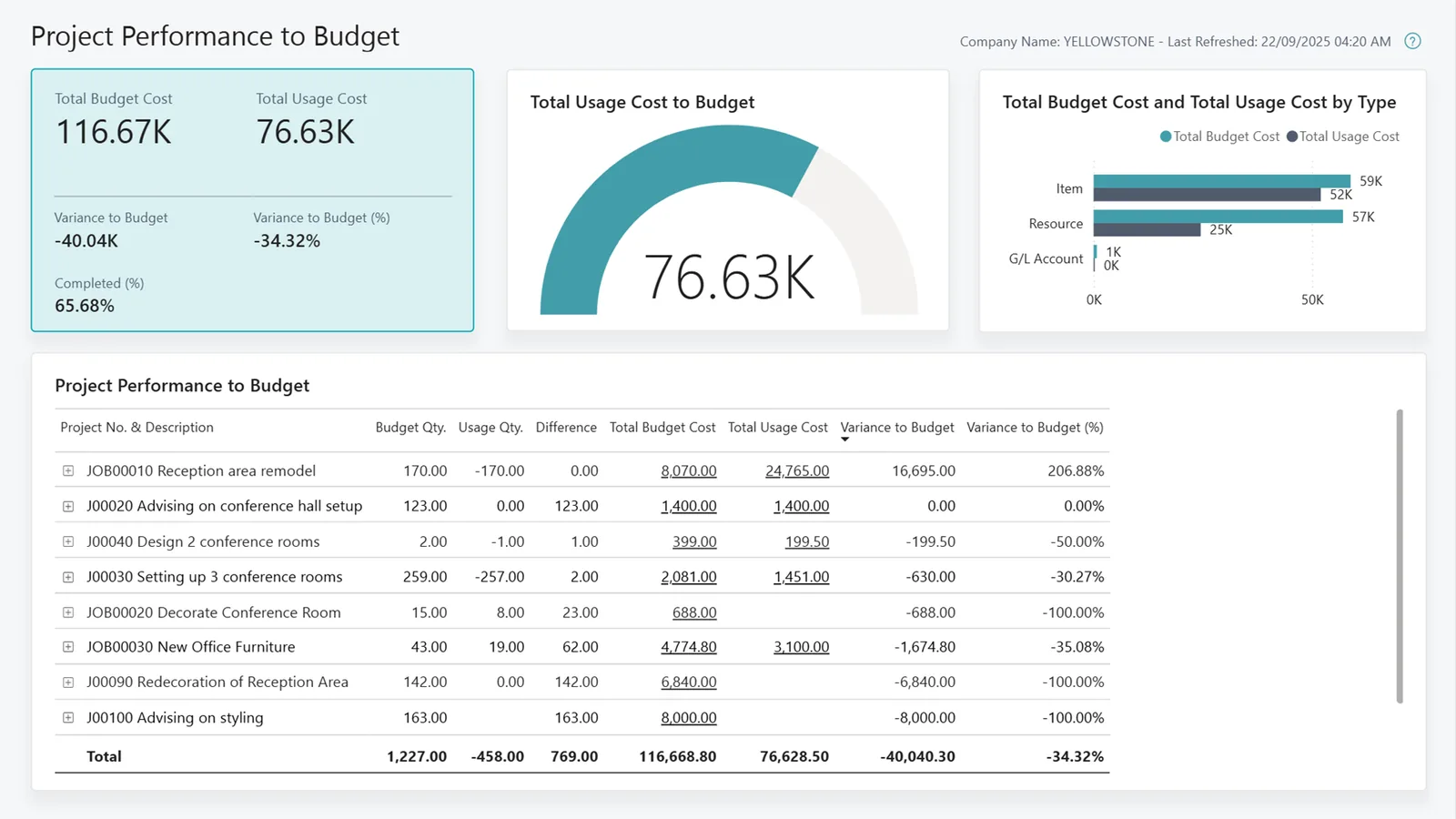
Directors see every program on one page, then drill into any contract or JV to see the figures behind the forecast.
Infrastructure work tends to push toward stronger multi-entity finance. This is how we usually match profiles to platforms.
| Company profile | Usual fit | Reasoning |
|---|---|---|
| Large group with several entities, JVs and international partners | Microsoft Dynamics 365 | Mature multi-entity consolidation, project operations and integration with Microsoft reporting tools |
| Regional infrastructure contractor with one or two entities | Odoo or Dynamics 365 Business Central | Project accounting and multi-company in one system, with less overhead than a large enterprise suite |
| Specialist infrastructure subcontractor | ERPNext or Odoo | Projects, assets and stock with room to add custom earned value fields |
| Group needing a program control layer over existing finance | Custom ERP or Zoho Creator | A portfolio and forecasting application integrated with the ledger you already run |
We do not implement SAP or Oracle. If you run one of them today, we can integrate with it or migrate from it, and we will tell you plainly when staying put makes more sense.
These are areas where ERP configuration matters. Confirm the treatment of your specific contracts with your tax advisor.
Corporate tax at 9% above AED 375,000 applies per taxable person or tax group. ERP should support entity-level and group-level reporting and keep JV records clear enough to support the treatment your advisor recommends.
Progress invoices carry 5% VAT under the continuous supply rules, and government clients may have specific invoicing requirements. The system should keep tax invoices, credit notes and return mapping consistent across entities.
Businesses with revenue of AED 50 million or more must appoint an Accredited Service Provider by 30 October 2026, with mandatory e-invoicing from 1 January 2027. Government entities follow from 1 October 2027. Check the latest Ministry of Finance and FTA guidance as dates have changed before.
Long programs need records retained and traceable over many years. Every budget revision, forecast change and approval should be logged with user and date.
General information, not tax or legal advice. Rules change; confirm current FTA, MOHRE and Ministry of Finance guidance with your advisor.
The value is mostly in governance and earlier warnings rather than in saved data entry.
Project, commercial and finance teams update the same estimate at completion, so board discussions start from agreed figures.
Falling performance indices and growing pending variations show up in the monthly review, not at the final account.
Progress, S-curve and cash flow reports are generated from live data instead of rebuilt each month.
Revenue recognition inputs, JV balances and approvals are all traceable to source records.
Larger groups usually go live in waves. Durations below are typical ranges, not commitments.
Durations are typical ranges; your plan is agreed after discovery.
Map entities, JVs, reporting obligations and existing systems, and agree the program hierarchy.
Design chart of accounts, dimensions, forecasting method, approval matrix and consolidation rules.
Configure entities, intercompany, procurement and bonds, and integrate with banks and existing tools.
Add program budgets, earned value, variations and portfolio dashboards for a pilot set of contracts.
Move remaining programs and JVs across, then refine reports with each monthly review.
Explore related contracting segments and platforms suited to larger groups.
We configure the system for the rules UAE businesses report against, and test it before go-live.
General information, not tax or legal advice. Confirm current requirements with the FTA, MOHRE or your advisor. See all UAE compliance guides.
On-site workshops in Dubai, Abu Dhabi and Sharjah, and remote or on-site delivery across the Northern Emirates and free zones.
Official sources and references
Facts on this page were checked against these sources in October 2026. Rules change, so confirm current requirements before acting.
Still have a question? Our consultants are happy to help.
Ask an ExpertYes. The JV is usually set up as its own company in the ERP, with partner shares, cash calls and distributions recorded there. Intercompany entries to each partner's books can be generated automatically, which keeps the quarterly reconciliation short.
Usually not. Scheduling tools such as Primavera remain the planning system. We bring planned and earned progress into ERP so cost and schedule performance can be calculated against real financials.
ERP holds cost to date, approved budget and cost to complete for each contract, which are the main inputs to an input-based method. Your finance team and auditors decide the policy; the system provides consistent, traceable figures.
Larger groups with several entities tend to fit Microsoft Dynamics 365. Regional contractors often do well with Odoo or Business Central. We recommend after discovery, and we disclose that we implement Zoho, Odoo, ERPNext, Dynamics 365 and custom ERP.
Yes. Some groups keep their ledger and add a program control layer built on a platform such as Zoho Creator or a custom application, integrated through APIs. This can be a sensible first step before a full replacement.
Related Solutions
Related Industries
Related ERP Platforms
Related Guides
Book a working session with our Dubai team to map your programs, entities and reporting needs.
Dubai, United Arab Emirates